
Drip vs Klaviyo for Shopify: Which Email Platform Is Right for Your Store?

You're comparing two email platforms built for ecommerce. Both are good. But they're built for different stores at different stages.
We're a Shopify agency. We don't sell either platform. We don't earn affiliate commissions from Drip or Klaviyo. When clients ask us which one to pick, we recommend whichever tool fits their actual business.
This guide covers real pricing at multiple tiers, the SMS situation that most comparisons get wrong, a Shopify-specific breakdown, and a clear decision framework so you can stop reading comparison posts and start sending emails.
Table of Contents
- Quick Verdict: Drip vs Klaviyo at a Glance
- What's Changed in Drip and Klaviyo Since You Last Looked
- Drip vs Klaviyo Pricing: What You'll Actually Pay
- Shopify Integration: Where Klaviyo Pulls Ahead
- Drip vs Klaviyo Automation & Flows
- Drip vs Klaviyo Segmentation
- Klaviyo SMS vs Drip: The Dealbreaker
- Drip vs Klaviyo Deliverability
- Drip vs Klaviyo Email Builder & Ease of Use
- Drip vs Klaviyo Customer Support
- Drip vs Klaviyo Onsite Forms
- The Decision Framework
- FAQ
Quick Verdict: Drip vs Klaviyo at a Glance
If you're short on time, here's the summary. Scroll down for the full breakdown.
| Category | Drip | Klaviyo |
|---|---|---|
| Best For | SMBs wanting simpler ecommerce email | Scaling stores needing advanced data + AI |
| Pricing (10K contacts) | ~$154/mo | ~$150/mo (email only) |
| Free Plan | ❌ (14-day trial) | ✅ (250 profiles) |
| Shopify Integration | ⭐⭐⭐⭐ | ⭐⭐⭐⭐⭐ |
| Ease of Use | ⭐⭐⭐⭐⭐ | ⭐⭐⭐ |
| Automation Power | ⭐⭐⭐⭐ | ⭐⭐⭐⭐⭐ |
| SMS Marketing | ❌ Discontinued for new users | ✅ Native SMS + WhatsApp |
| AI Features | ❌ Basic | ✅ Predictive analytics, AI agents |
| Deliverability | ⭐⭐⭐ (88.2% per EmailToolTester) | ⭐⭐⭐⭐ |
| Customer Support | ⭐⭐⭐⭐⭐ (fast, 90-day onboarding) | ⭐⭐⭐ (email + chat, weekdays) |
| Our Verdict | Simpler, cheaper at scale, great support | More powerful, better Shopify integration, AI edge |
Choose Drip if: You want simpler ecommerce email, don't need SMS, prefer hands-on support, and want all features at every price tier.
Choose Klaviyo if: You're on Shopify, want predictive analytics and AI features, need SMS, and you'll actually use the advanced segmentation.
Choose Shopify Email if: You're under $30K/month revenue with a small list and just need the basics.
What's Changed in Drip and Klaviyo Since You Last Looked
If you compared these two platforms a year or two ago, a lot has changed. Four out of five comparison posts ranking on Google right now have at least one major factual error. Here's what's actually going on.
Drip Killed SMS for New Users
This is the single biggest change, and most comparison posts still get it wrong.
Drip discontinued SMS marketing for all new customers. Their SMS features page at drip.com/features/sms now returns a 404 error. We checked.
⚠️ Important: If you sign up for Drip today, you cannot use SMS. Existing users who already had SMS configured can continue using it as a legacy feature. But new signups? No SMS. Period.
If you need email and SMS in one platform, this alone narrows your decision. You either choose Klaviyo (or another platform with native SMS), or you pair Drip with a dedicated SMS tool like Postscript or Attentive.
Klaviyo's Active Profiles Billing Change
Klaviyo shifted to active profile-based pricing, and the implications are bigger than most people realize.
You now pay for ALL active profiles in your account. Not just the contacts you email. Unengaged subscribers, suppressed contacts, profiles you imported six months ago and never emailed once: they all count toward your bill.
💰 Real-World Example: Say you have 10,000 profiles in Klaviyo but you only actively email 5,000 of them. You're paying for 10,000. On Drip, your cost is based on active people in your account and email volume, but Drip includes unlimited email sends at every tier.
The fix? Regular list cleaning. We've seen stores reduce their Klaviyo bill by 20-40% just by archiving unengaged profiles quarterly.
Klaviyo's AI Push
Klaviyo has been investing heavily in AI, and the gap between the two platforms here is significant.
Klaviyo now offers:
- Marketing Agent for AI-powered campaign drafting
- AI subject line generator built into the email editor
- Predictive analytics including predicted customer lifetime value, churn risk scoring, and predicted next order date
- AI product recommendations in emails and flows
Drip has no comparable AI features. If predictive analytics and AI-driven personalization matter to your strategy, this is a Klaviyo-only capability right now.

Drip vs Klaviyo Pricing: What You'll Actually Pay
Most comparison posts show pricing at one or two subscriber tiers. That's not helpful when you're trying to plan for growth. Here's what both platforms cost at multiple levels.
Side-by-Side Pricing at Scale
| Contacts | Drip | Klaviyo (Email Only) | Klaviyo (Email + SMS) |
|---|---|---|---|
| 500 | ~$39/mo | Free (up to 500) | ~$35/mo |
| 1,000 | ~$39/mo | ~$30/mo | ~$45/mo |
| 2,500 | ~$39/mo | ~$60/mo | ~$75/mo |
| 5,000 | ~$89/mo | ~$100/mo | ~$120/mo |
| 10,000 | ~$154/mo | ~$150/mo | ~$175/mo |
| 25,000 | ~$349/mo | ~$400/mo | ~$450/mo |
| 50,000 | ~$699/mo | ~$720/mo | ~$800/mo |
Pricing based on published rates from Drip and Klaviyo. Verify current pricing on their websites before making a decision.
What the Pricing Doesn't Tell You
The sticker prices above don't tell the full story. Here's what to watch for.
Drip:
- No free plan, but a 14-day free trial (no credit card required)
- All features included at every pricing tier. No feature paywalls.
- Unlimited email sends at every tier
- Pricing is based on active people in your account plus email volume
Klaviyo:
- Free plan covers up to 250 profiles and 500 emails per month
- Feature tiers exist. Some capabilities are locked behind higher plans.
- SMS costs extra on top of email pricing
- You pay for ALL active profiles, not just contacts you email
💰 The Bottom Line: Drip tends to be cheaper below 5,000 contacts and above 25,000 contacts. In the 5,000-25,000 range, the two platforms converge in cost. But Klaviyo's "active profiles" billing means your actual bill may be higher than the published price if you're not cleaning your list regularly.
A Shopify store with 10,000 contacts pays roughly the same on both platforms ($150-154/mo for email). But if that same store has 15,000 profiles in Klaviyo with 5,000 inactive contacts, they're paying for all 15,000.
Our Take: Pricing is nearly identical in the sweet spot (5K-25K contacts). Drip wins on transparency since all features are included at every tier and sends are unlimited. Klaviyo's hidden costs come from active profile billing and feature paywalls. Factor in SMS costs if you need it, because Drip can't offer it at all.
Shopify Integration: Where Klaviyo Pulls Ahead
As a Shopify agency, this is the section we care about most. And it's where the biggest gap between these two platforms shows up.
Klaviyo's Shopify Integration
Shopify invested in Klaviyo before its IPO. That strategic partnership shows in the integration depth.
- Tracks 40+ Shopify event types (product views, add-to-cart, checkout steps, order updates, refunds)
- Shopify Flow integration lets you trigger Klaviyo flows from any Shopify Flow connector
- Shopify Markets support for multi-currency and multi-language stores
- Shopify POS integration for unified online and offline customer profiles
- Native product catalog sync for dynamic email recommendations
- Back-in-stock automations with real-time inventory tracking
- Pre-built Shopify-optimized flow templates
Drip's Shopify Integration
Drip's Shopify app is solid and well-reviewed. It covers the fundamentals.
- Syncs customers, orders, and products
- Supports core ecommerce automations (abandoned cart, post-purchase, welcome series)
- Revenue attribution and order tracking
- Good for straightforward ecommerce email flows
- Less depth on browse behavior tracking compared to Klaviyo
- No Shopify Flow integration at Klaviyo's level
- No native Shopify Markets support
Which Matters for YOUR Store?
Not every store needs the deepest possible integration. Here's how we think about it:
- Standard Shopify store (Basic or Shopify plan, domestic sales, under 25K contacts): Either platform works fine. Drip covers the essentials.
- Growing Shopify store (Shopify plan, starting international sales, 25K+ contacts): Klaviyo's deeper integration starts to matter.
- Shopify Plus store (complex checkout, international selling, headless setup): Klaviyo is the clear choice.
Our Take: Klaviyo wins Shopify integration. Full stop. But for standard Shopify stores doing domestic sales with straightforward email flows, Drip's integration covers what you need. The gap matters most for stores running sophisticated browse abandonment flows, selling internationally, or on Shopify Plus.
If you're weighing whether you even need a third-party email tool, read our Shopify Email vs Klaviyo comparison first.

Drip vs Klaviyo Automation & Flows: How They Actually Compare
Both platforms have visual workflow builders. Both can handle the core ecommerce automations. The differences are in the details.
Flow Builder Comparison
| Feature | Drip | Klaviyo |
|---|---|---|
| Visual workflow builder | ✅ Yes | ✅ Yes |
| Pre-built templates | ✅ 20+ | ✅ 50+ |
| Conditional splits | ✅ Yes | ✅ Unlimited nesting |
| A/B testing in flows | ⚠️ Campaign-level only | ✅ Within flows |
| SMS in flows | ❌ Not available | ✅ Native |
| Time delays | ✅ Yes | ✅ Yes |
| Behavioral triggers | ✅ Strong | ✅ More event types |
| Predictive triggers | ❌ No | ✅ Predicted next order, churn |
| Webhooks | ✅ Yes | ✅ Yes |
Where Drip Holds Its Own
Don't count Drip out on automation. It does the core stuff well.
- Point-and-click email builder is genuinely easier to use than Klaviyo's
- Visual automation builder is clean and intuitive
- Fewer options means faster setup and less decision fatigue
- Drip's onsite engagement tools (pop-ups, slide-ins, spin-to-win) integrate directly with automations
- All automation features available at every pricing tier
Where Klaviyo Pulls Ahead
If you're building complex, data-driven flows, Klaviyo gives you more to work with.
- A/B testing within flows (test subject lines, content, timing, even entire flow paths)
- Predictive triggers based on churn risk and predicted next order date
- AI-powered product recommendations inside flows
- SMS and email in the same automation flow
- Deeper conditional logic with unlimited nesting
💡 Pro Tip: Think about it this way. An abandoned cart flow in Drip sends an email, waits, sends another email. Simple and effective. The same flow in Klaviyo can add predictive timing based on when that specific customer is most likely to buy, include an SMS fallback for non-openers, and dynamically adjust product recommendations based on browsing history.
Our Take: Klaviyo's automation engine is more powerful. But Drip's is easier to use and covers the core ecommerce flows well. If you're running 5-10 standard automations (welcome series, abandoned cart, post-purchase, winback), Drip handles it. If you're building 20+ flows with A/B tests, conditional branches, and predictive triggers, Klaviyo gives you the room to grow.
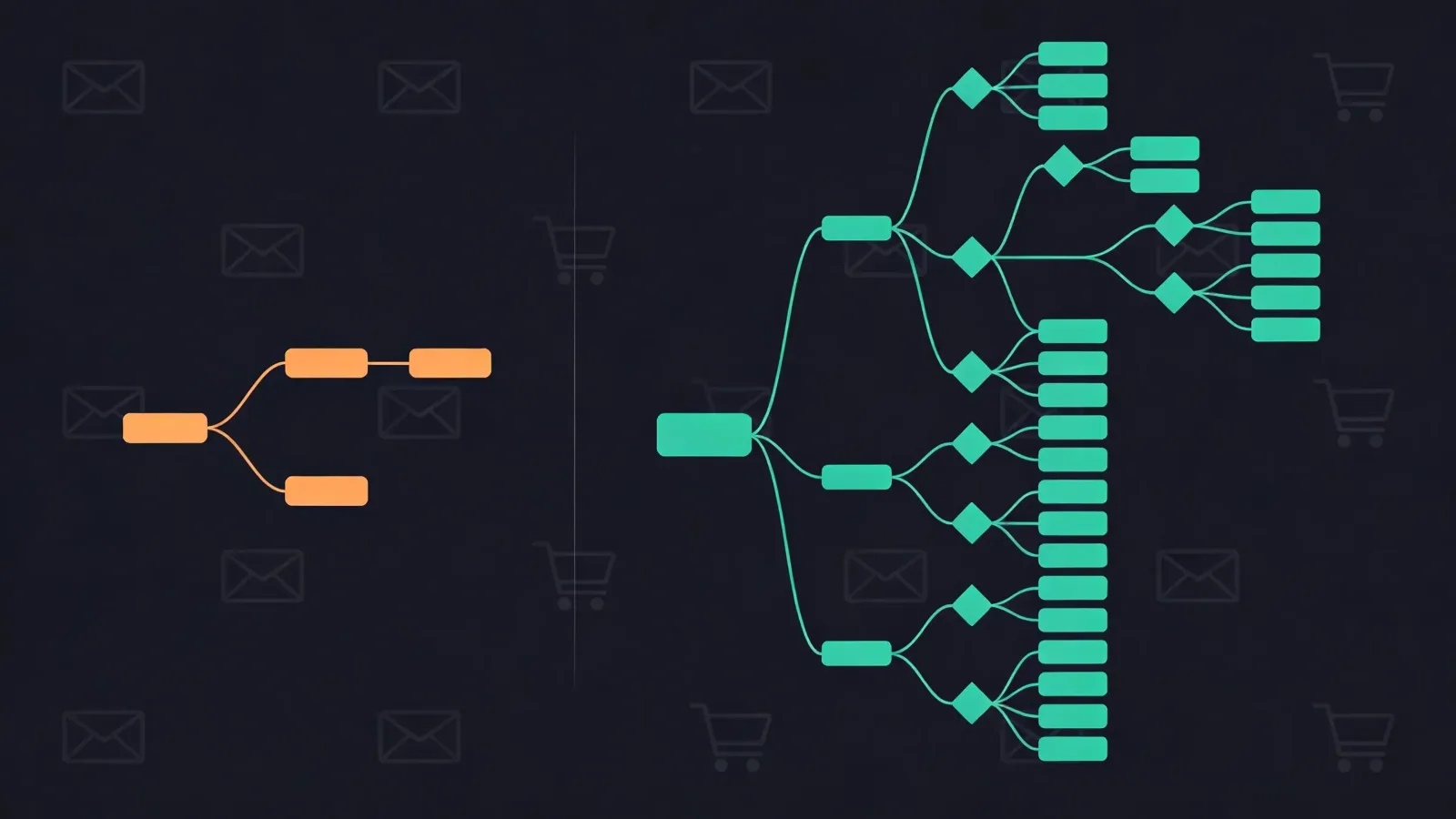
Drip vs Klaviyo Segmentation: Simple vs Sophisticated
Segmentation is where Klaviyo flexes its data muscles. But "more powerful" doesn't always mean "more useful."
Drip uses tag-based segmentation. It's flexible, visual, and easy to understand. You tag contacts based on behavior (opened email, purchased product, visited page) and build segments from those tags. For straightforward segments like "purchased in the last 30 days" or "opened an email recently," it works well.
Klaviyo uses list-based segmentation plus predictive analytics. On top of standard behavioral segments, you get predicted customer lifetime value, churn risk scoring, RFM (recency, frequency, monetary) analysis, and predicted gender. Segments update in real time.
When does the advanced stuff matter? In our experience, stores under 25,000 contacts and sending fewer than 8 campaigns per month rarely touch Klaviyo's advanced segmentation. You need enough data and enough campaigns for the predictions to be meaningful.
Our Take: Most stores under 25K contacts won't use Klaviyo's advanced segmentation. If your most complex segment is "bought in the last 90 days and opened an email recently," Drip handles that fine. If you need predicted lifetime value and churn scoring to power a retention strategy, that's Klaviyo-only territory.
Klaviyo SMS vs Drip: The Dealbreaker
We gave this its own section because it's the single biggest functional difference between these two platforms. And most comparison posts still get it wrong.
Drip has no SMS for new users. Full stop. They discontinued it. Their SMS features page returns a 404 error. If you're signing up today, SMS is not an option.
Klaviyo has native SMS in approximately 17 countries, plus WhatsApp support and upcoming RCS messaging. SMS is fully integrated into Klaviyo's automation flows, so you can build sequences that combine email and text messages in the same workflow.
| Feature | Drip | Klaviyo |
|---|---|---|
| SMS available | ❌ Discontinued for new users | ✅ Native |
| Two-way SMS | ❌ | ✅ (US, CA, UK, AUS) |
| ❌ | ✅ | |
| SMS in automations | ❌ | ✅ Fully integrated |
| MMS (picture messages) | ❌ | ✅ |
| Compliance tools | ❌ | ✅ Smart opt-in, quiet hours |
If you choose Drip and still want SMS, you'll need to pair it with a dedicated SMS platform like Postscript or Attentive. That adds cost and complexity. Running two separate tools means your email and SMS data live in different places, which makes unified customer journeys harder to build.
Our Take: If SMS is part of your marketing strategy, stop reading and choose Klaviyo. This isn't a feature gap. It's a missing feature. If you're fine with email-only marketing, or you're willing to pair Drip with a separate SMS tool, keep reading. Both approaches work. One is just simpler than the other.
For more on how SMS compares across platforms, check our Klaviyo vs Omnisend breakdown.
Drip vs Klaviyo Deliverability: What the Data Actually Says
Deliverability is the topic everyone asks about but nobody has great data on. Here's what we know.
EmailToolTester, an independent testing service, scored Drip at 88.2% deliverability in their most recent round of testing. That's decent but not best-in-class. Drip's scores have fluctuated historically, ranging from 62% to 89.8%.
Klaviyo wasn't included in EmailToolTester's tests, so we don't have a direct independent comparison. Community reports and our own client experience suggest Klaviyo's deliverability is generally strong, but we can't put a verified number on it.
Drip's self-reported "99% delivery rate" likely measures server acceptance (did the receiving server accept the email?) rather than inbox placement (did it land in the primary inbox?). Those are very different metrics. A 99% delivery rate with 75% inbox placement still means 1 in 4 emails goes to spam or promotions.
Both platforms support SPF, DKIM, and DMARC authentication. Both use shared IP pools by default, with dedicated IPs available at enterprise tiers.
Our Take: Drip's 88.2% independent score is decent but not best-in-class. Klaviyo lacks comparable independent testing data, so a direct comparison is difficult. Here's the honest truth: deliverability depends more on YOUR list hygiene, sending practices, and authentication setup than on which platform you pick. Focus on authentication, list cleaning, and engagement metrics. Those matter more than the platform name.
Drip vs Klaviyo Email Builder & Ease of Use
This is where Drip quietly shines. Not because it's more powerful, but because it's faster to learn.
Drip uses a point-and-click editor rather than traditional drag-and-drop. It's simpler by design. Fewer options means less decision fatigue. Non-designers can build decent-looking emails without a tutorial. The trade-off is less flexibility for complex layouts.
Klaviyo has a full drag-and-drop editor with more power under the hood. Dynamic product blocks, deep personalization tokens, conditional content blocks that show different content to different segments. The template library is larger (100+ templates, with community submissions pushing that higher). But the learning curve is real.
| Factor | Drip | Klaviyo |
|---|---|---|
| Time to first email | ⭐⭐⭐⭐⭐ Fast | ⭐⭐⭐ Learning curve |
| Email builder | ⭐⭐⭐⭐ Simple, clean | ⭐⭐⭐⭐ Powerful, dense |
| Onboarding | ⭐⭐⭐⭐⭐ 90-day 1:1 support | ⭐⭐⭐ Self-service + Academy |
| Documentation | ⭐⭐⭐⭐ Good help center | ⭐⭐⭐⭐⭐ Klaviyo Academy |
| Template library | ⭐⭐⭐ Solid ecommerce templates | ⭐⭐⭐⭐⭐ 100+ templates |
Our Take: Drip is easier to learn and faster to launch. If you're a solo founder or small team without an email specialist, that matters more than you think. Klaviyo is more powerful once you learn it, but the learning curve is real. Budget 15-20 hours to get comfortable with Klaviyo vs 5-10 hours for Drip.
Drip vs Klaviyo Customer Support: The Underrated Factor
Support quality doesn't show up in feature comparison tables, but it matters a lot when you're stuck at 11pm trying to fix a broken automation before a sale launch.
| Feature | Drip | Klaviyo |
|---|---|---|
| Email support | ✅ All paid plans | ✅ All plans (60 days on free) |
| Live chat | ✅ ($99+/mo plans) | ✅ Paid plans (weekdays) |
| Phone support | ❌ | Enterprise only |
| Response time | ⭐⭐⭐⭐⭐ (3.5x faster per claims) | ⭐⭐⭐ |
| Hours | 9am-5pm CT, Mon-Fri | 24/5 weekdays |
| Free migration help | ✅ Free migration service | ❌ |
| 1:1 onboarding | ✅ 90 days for new customers | Enterprise only |
| Learning resources | Drip Community | Klaviyo Academy + Community |
Drip's 90-day 1:1 onboarding is a genuine differentiator. When you sign up, you get dedicated support to help you set up your account, build your first flows, and get results. Drip also claims 3.5x faster response times than the industry average, and community feedback generally backs that up.
Klaviyo Academy is excellent for self-paced learning. If you're the type who prefers to watch tutorials and figure things out yourself, Klaviyo's educational resources are best-in-class. But if you want someone to walk you through setup, Drip's onboarding is hard to beat.
Drip also offers a free migration service for people switching from other platforms. That's a real cost savings if you're moving from Mailchimp, Klaviyo, or anywhere else.
Our Take: Drip wins on support. Faster response times, free 1:1 onboarding for 90 days, and free migration help. If you're switching platforms and value hand-holding, Drip makes the transition easier. Klaviyo Academy is better for self-learners who want to go deep on email marketing strategy.
Drip vs Klaviyo Onsite Forms: Drip's Hidden Strength
This is a Drip advantage that most comparisons skip entirely.
Drip's onsite engagement tools go beyond standard pop-up forms. You get:
- Pop-ups and slide-ins with multiple design options
- Sidebar forms for persistent lead capture
- Gamification forms like spin-to-win (these genuinely convert well for ecommerce)
- Multiple trigger types: exit intent, scroll depth, time on page, cart value thresholds
- Built-in A/B testing for forms
Klaviyo has sign-up forms and pop-ups too, but with less variety and no gamification options. For stores focused on list growth who want creative lead generation tools without adding another app to their stack, Drip has a real edge here.
Our Take: Drip's onsite forms are underrated. If list growth is a priority and you want creative lead gen tools without adding another Shopify app, Drip has an edge here. It's a small thing, but for stores in growth mode it adds up.
The Decision Framework: Which One Is Right for YOUR Store?
We've covered a lot of features. Let's make the choice simpler. Find the scenario that sounds most like you.
"I run a small Shopify store under $50K/month and want simple, affordable email marketing."
→ Go with Drip. Lower learning curve, great support, all features at every tier. You won't miss Klaviyo's advanced features at this stage. But check if you need SMS first. If you do, Drip is off the table.
"I run a growing Shopify store ($50K-200K/month) and need email + SMS in one platform."
→ Go with Klaviyo. The SMS discontinuation alone makes this decision. Klaviyo's deeper Shopify integration and AI features justify the cost at this revenue level.
"I'm on Shopify Plus with complex international selling and need the deepest possible integration."
→ Go with Klaviyo. No contest. Shopify Flow integration, Shopify Markets support, POS sync, 40+ event types. Drip can't match this.
"I care most about ease of use and customer support."
→ Go with Drip. Simpler interface, faster onboarding, 90-day 1:1 support, free migration service. You'll be up and running faster.
"I need predictive analytics and AI-powered personalization."
→ Go with Klaviyo. Drip has no predicted CLV, churn scoring, or AI campaign tools. This is Klaviyo-only territory right now.
"I'm switching from Mailchimp and want something ecommerce-focused."
→ Either works. If budget is the priority, Drip. If you want the most powerful option, Klaviyo. Both are miles ahead of Mailchimp for ecommerce. Read our Klaviyo vs Mailchimp comparison for more detail on that switch.
If you're still not sure, check our full Klaviyo Alternatives guide for a wider view of the options. We also break down Klaviyo vs Omnisend if Omnisend is on your radar.

FAQ
Does Drip have SMS marketing?
No. Drip discontinued SMS for all new customers. Their SMS features page (drip.com/features/sms) now returns a 404 error. Existing users who already had SMS set up can continue using it, but new signups cannot access SMS. If you need SMS, pair Drip with a dedicated tool like Postscript, or choose a platform with native SMS like Klaviyo.
How much does Drip cost?
Drip starts at roughly $39/month for up to 2,500 contacts. At 10,000 contacts, expect around $154/month. At 25,000, roughly $349/month. There's no free plan, just a 14-day trial with no credit card required. All features are included at every tier, and email sends are unlimited.
Is Drip or Klaviyo better for Shopify?
Klaviyo has the deeper Shopify integration with 40+ event types, Shopify Flow support, Shopify Markets compatibility, and POS sync. Drip's Shopify integration is solid for standard use cases like abandoned cart emails and post-purchase flows. For most small to mid-size Shopify stores, both work. For Shopify Plus or complex international stores, Klaviyo is the clear winner. See our Shopify Email vs Klaviyo comparison for more.
Is Klaviyo worth the higher price?
It depends on whether you'll use the advanced features. Klaviyo's predictive analytics, AI tools, and deep Shopify integration justify the cost for stores doing $100K+ per month with a dedicated email person. For simpler setups, Drip delivers the core ecommerce email capabilities at a comparable or lower price.
Can I migrate from Drip to Klaviyo?
Yes. Export your contacts and email templates from Drip (CSV format). Automations must be rebuilt from scratch in Klaviyo since workflows don't transfer between platforms. Budget 2-4 weeks for a full migration. Warm up your sending domain on the new platform and run both platforms in parallel for 1-2 weeks during the transition.
Can I migrate from Klaviyo to Drip?
Yes. Drip offers a free migration service that helps with the transition, which is a nice touch. Export contacts from Klaviyo, rebuild your flows in Drip, and warm up gradually. Drip's 90-day onboarding support helps with the rebuild. Keep in mind you'll lose access to Klaviyo's predictive analytics and AI features.
Who are Klaviyo's main competitors?
The main Klaviyo competitors for ecommerce are Omnisend, Drip, ActiveCampaign, Brevo, and Mailchimp. We've compared the most popular options. See our Klaviyo Alternatives guide or our Omnisend vs Mailchimp comparison.
Is drip marketing effective?
Yes. Automated drip campaigns (welcome series, abandoned cart sequences, post-purchase flows) consistently outperform one-off broadcast campaigns. They're one of the highest-ROI email tactics for ecommerce. Both Drip and Klaviyo support drip campaigns. Worth noting: "Drip" the platform and "drip marketing" the strategy are different things. You can run drip campaigns on any email platform.
Does Klaviyo charge for inactive contacts?
Since the February 2025 pricing change, Klaviyo charges for all active profiles in your account. This includes contacts you haven't emailed. Regularly cleaning your list and archiving unengaged contacts is the best way to keep costs under control. We recommend doing a list cleanup at least once per quarter.
Drip vs Klaviyo: Final Verdict
Both platforms are built for ecommerce. Drip is simpler, has outstanding support, and costs less at scale. Klaviyo is more powerful, has deeper Shopify integration, and includes SMS and AI features that Drip simply can't match right now.
Your choice comes down to where you are today and where you're headed. Small store, small team, email-only? Drip. Growing store, need SMS, want predictive analytics? Klaviyo.
Neither is a bad choice. Both are better than Mailchimp for ecommerce. The worst option is spending three more weeks reading comparison posts instead of actually sending emails.
This comparison is maintained by Aesymmetric, a Shopify agency with no affiliate relationships with Drip, Klaviyo, or any email platform mentioned. Explore more: Top Klaviyo Alternatives for Shopify · Klaviyo vs Omnisend · Shopify Email vs Klaviyo · Omnisend vs Mailchimp · Klaviyo vs Mailchimp
Last updated: February 17, 2026. Pricing and features verified against official sources. We update this comparison quarterly to keep it accurate.
We love working with ambitious Shopify brands.
We can help optimize your store's conversion rate and increase sales.
We can create custom apps that integrate third-party services or add new features to your store.
We can create any theme customization you need to improve the look and feel of your brand.
Get in Touch
Written by
Alex is the founder of AESYMMETRIC, a Shopify agency specializing in conversion rate optimization, custom app development, and theme customizations. With eight years of experience in the Shopify ecosystem and e-commerce industry, he helps brands maximize sales and reduce costs through data-driven strategies and innovative technical solutions.