
10 Best Klaviyo Alternatives in 2026: Real Pricing, Honest Trade-Offs, and a Migration Guide

Your Klaviyo bill went up. Maybe 20%. Maybe 40%. You're not imagining it.
After the February 2025 pricing overhaul, thousands of ecommerce stores saw their monthly costs jump overnight. At 10,000 active profiles, Klaviyo runs roughly $150/month. At 25,000 profiles, you're looking at $400/month. At 50,000, it's over $700/month, or $8,400 a year.
That's a lot of money. Whether it's too much money depends on your store, your revenue, and what you actually use.
This guide gives you real pricing at scale (not starter-tier bait), honest trade-offs for each tool (including what you'll lose by switching), and a step-by-step migration checklist. We also tell you when you should stay with Klaviyo. Because sometimes, you should.
How we evaluated these alternatives: We reviewed 15+ email marketing platforms against seven criteria: pricing at scale, ecommerce integration depth, automation capability, SMS features, deliverability, migration ease, and analytics quality. We have no affiliate relationships with any tool on this list. Our only interest is helping you make the right choice.
The Short Version: Best Klaviyo Alternatives at a Glance
If you want an answer in 30 seconds, here it is.
| Tool | Best For | Price at 10K Contacts | Free Plan? | Our Take |
|---|---|---|---|---|
| Omnisend | Shopify stores wanting Klaviyo-like features at lower cost | ~$132/mo | 250 contacts, 500 emails | The safe bet. Closest thing to Klaviyo for ecommerce. |
| Brevo | Stores with big lists that don't email daily | ~$29/mo (by emails sent) | 300 emails/day, unlimited contacts | Unbeatable value if you email 2-4x per month. |
| ActiveCampaign | Brands that need the strongest automation builder available | ~$139/mo | 14-day trial only | The automation builder rivals Klaviyo's. CRM included. |
| Mailchimp | Small stores wanting a familiar, simple platform | ~$130/mo | 500 contacts, 1,000 sends | You know the name. But it's not cheaper than Klaviyo at scale. |
| MailerLite | Stores under 10K contacts watching every dollar | ~$73/mo | 1,000 contacts | Best value for small lists. Clean, simple, surprisingly capable. |
| Drip | DTC ecommerce brands that need behavioral tracking | ~$154/mo | 14-day trial only | Underrated. Built for ecommerce. No SMS though. |
| Moosend | Growing stores wanting automation on a budget | ~$88/mo | 30-day trial only | Good mid-range pick. Less known, but functional. |
| Sender | New stores wanting maximum features for $0 | ~$47/mo | 2,500 contacts, 15K emails | Most generous free plan in email marketing. |
| HubSpot | Businesses needing CRM + email in one platform | ~$210/mo | Free CRM tools | Overkill for pure ecommerce. Perfect for CRM-heavy businesses. |
| Constant Contact | Small businesses wanting phone support and simplicity | ~$120/mo | 30-day trial only | Simple and reliable. But not a serious ecommerce tool. |
Note: All pricing is approximate and based on published rates as of February 2026. Actual costs vary by plan tier and feature set.
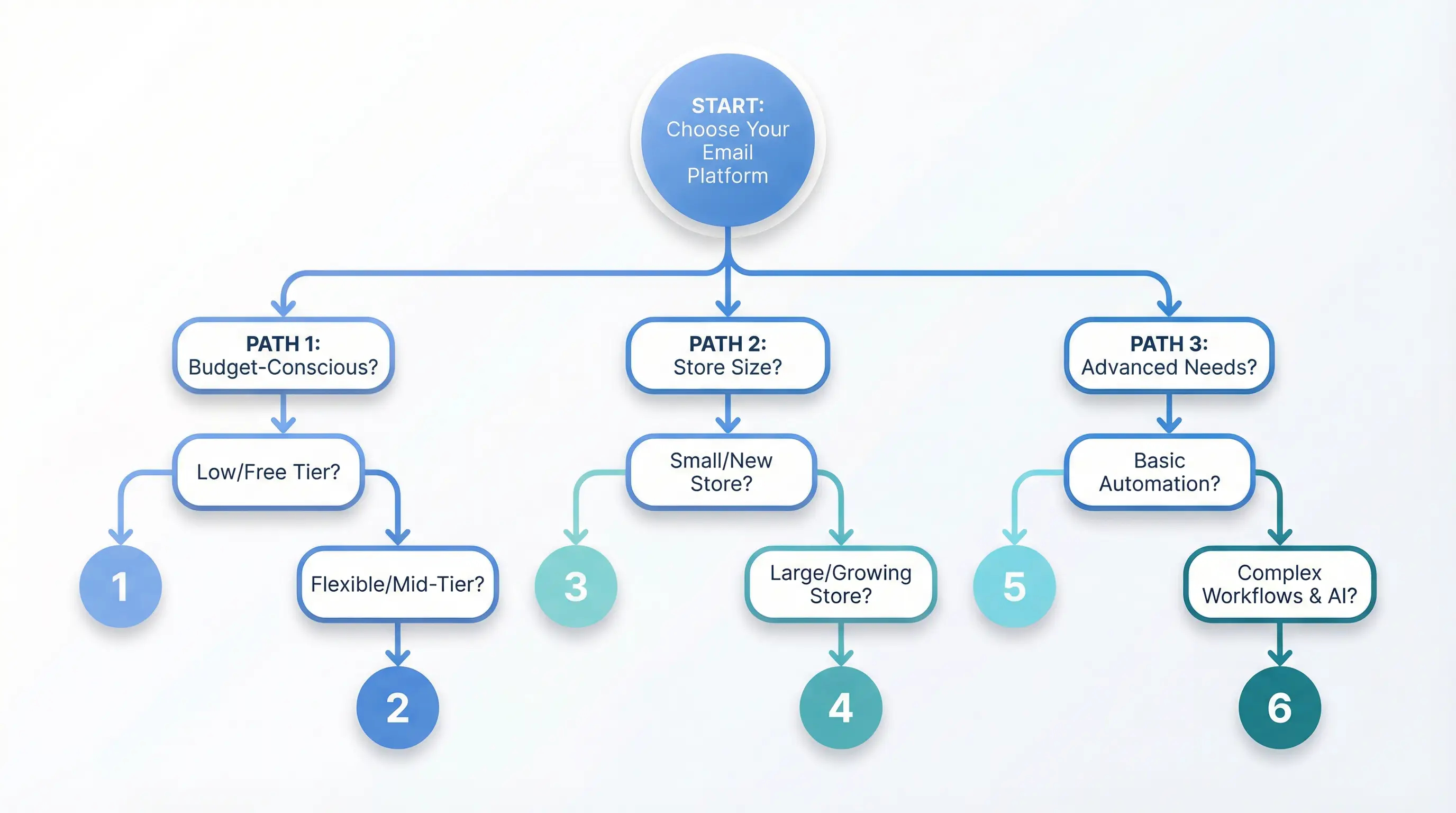
Which Alternative Fits Your Store?
You don't need to read reviews for all 10 tools. Find your situation below.
"I run a Shopify store with under 5K contacts and need to save money."
Start with Sender (free up to 2,500 contacts) or MailerLite (free up to 1,000 contacts with better automation). Move to a bigger platform when you outgrow them.
"I run a Shopify store with 5K-50K contacts and want Klaviyo-like features for less."
Omnisend is your best bet. It's the closest feature-for-feature match to Klaviyo at roughly half the price. Jump to the Omnisend review → Or read our detailed Klaviyo vs Omnisend head-to-head comparison.
"I need advanced automation that rivals Klaviyo's flow builder."
ActiveCampaign has the most powerful automation builder outside of Klaviyo. It's not ecommerce-native, but the workflow capabilities are unmatched. Jump to ActiveCampaign →
"I'm not in ecommerce (or I'm a hybrid business) and need CRM + email."
HubSpot or ActiveCampaign. Both offer CRM functionality that Klaviyo doesn't. Jump to HubSpot →
"I run a DTC brand doing $1M+ and need SMS + email + deep Shopify integration."
Omnisend for an affordable all-in-one. If you want high-touch support and unlimited emails, look into Sendlane (not in our top 10, but worth evaluating at this level).
"I just want the absolute cheapest option that works."
Brevo. They charge by emails sent, not contacts. If you have a big list but don't email daily, the savings are dramatic. Jump to Brevo →
Why People Are Leaving Klaviyo in 2026
Let's be specific about what's driving people to search for alternatives. It's not that Klaviyo is a bad product. It's that the cost-to-value equation changed.
The February 2025 Pricing Change
In February 2025, Klaviyo shifted from list-based pricing to active profile-based pricing. If you had a large list with many dormant subscribers, your bill didn't change much. But if most of your list was active, some stores saw increases of 15-25%.
Here's what that looks like in practice:
| Active Profiles | Klaviyo Email-Only (Monthly) | Klaviyo Email + SMS (Monthly) | Annual Cost (Email Only) |
|---|---|---|---|
| 1,000 | ~$30/mo | ~$45/mo | ~$360/yr |
| 5,000 | ~$100/mo | ~$120/mo | ~$1,200/yr |
| 10,000 | ~$150/mo | ~$175/mo | ~$1,800/yr |
| 25,000 | ~$400/mo | ~$450/mo | ~$4,800/yr |
| 50,000 | ~$720/mo | ~$800/mo | ~$8,640/yr |
| 100,000 | ~$1,380/mo | ~$1,510/mo | ~$16,560/yr |
At 25,000 contacts, you're spending $4,800 a year on email alone. At 50,000, it's $8,640. For many growing Shopify stores, that's a significant line item.
💰 Real-World Pricing Impact
A Shopify store with 15,000 contacts paying $250/month in January 2025 saw their bill jump to $350+ by March after the active-profile pricing change. At 25,000 contacts, stores reported increases from roughly $325/month to $400+/month. That's an extra $900-1,200 per year, with no new features to show for it.
Beyond Pricing
Cost is the biggest driver, but it's not the only one. Common frustrations we hear from clients and see echoed across Reddit threads:
- SMS limitations. Klaviyo's SMS works in roughly 17 countries. If you sell internationally, that's restrictive. Messages are capped at 160 characters (70 if you use emojis).
- Support gaps. Free plan users get email support for 60 days, then nothing. Even paid users report slow response times and no phone support.
- Per-contact pricing penalizes growth. You pay for every active profile whether you email them once a month or once a day. Stores with large lists and moderate sending frequency feel this the hardest.
These are legitimate reasons to explore alternatives. But they're not the whole picture.
When You Should Stay with Klaviyo
This is the part no other "Klaviyo alternatives" article will tell you, because most of them are written by Klaviyo's competitors.
Here's the truth: Klaviyo is genuinely excellent at what it does. For certain stores, no alternative comes close. You should probably stay with Klaviyo if:
Your email revenue justifies the cost. If Klaviyo-attributed revenue exceeds 5x your platform cost, the ROI math still works. A store paying $400/month but generating $8,000+/month from email flows and campaigns is getting a strong return. Switching to save $200/month isn't worth the risk if your flows are dialed in.
You rely on predictive analytics. Klaviyo's predictive CLV scoring, churn risk analysis, and RFM segmentation are the strongest in ecommerce email. No alternative matches this depth. If you use these features to drive your retention strategy, switching means losing real capability.
You depend on deep Shopify event tracking. Klaviyo tracks 40+ Shopify event types: product views, add-to-cart, started checkout, placed order, fulfilled order, and more. It syncs your full product catalog for dynamic recommendations. Most alternatives track a fraction of these events.
You're at high scale with complex flows. If you have 50+ active automations with conditional splits, A/B branches, and behavioral triggers, the cost of rebuilding those flows on a new platform is significant. Budget 4-8 weeks and factor in the revenue you might lose during the transition.
You haven't optimized your active profile count yet. Before switching platforms, clean your list first. You might be paying for profiles that shouldn't be there.
If none of these apply, keep reading.
How to Reduce Your Klaviyo Bill Without Switching
Before you go through the pain of migrating, try these five steps first.
💡 Pro Tip: These five steps can reduce your Klaviyo bill by 20-40% without losing a single subscriber. Try them before committing to a migration.
1. Archive unengaged contacts. Contacts who haven't opened an email in 90-120 days still count as active profiles. Suppress or archive them. You can always reactivate them later.
2. Merge duplicate profiles. Multiple signups, checkout entries, and imported lists create duplicates. Klaviyo's merge tool can reduce your profile count by 5-15%. That translates directly to a lower bill.
3. Review your plan tier. Klaviyo's pricing works in tiers. If you recently cleaned your list and dropped below a tier threshold, make sure your plan adjusted. It doesn't always happen automatically.
4. Use suppression lists strategically. Instead of including your full list in every campaign, build targeted segments. Sending to 8,000 engaged contacts is better than blasting 25,000 and paying for the full list.
5. Negotiate directly. This one surprises people. Klaviyo's retention team offers discounts if you call to cancel or downgrade. We've seen clients get 10-20% off by asking. The worst they can say is no.
If you've done all five and the bill is still too high, it's time to look at alternatives.
What to Look for in a Klaviyo Alternative
Not all email platforms are built the same. Before diving into individual tools, here's the framework we use when helping clients evaluate alternatives.
1. Pricing model and total cost at YOUR scale. Don't look at the starting price. Look at what the tool costs at your current contact count, and at 2x your current count (where you'll be in a year). Some tools charge per contact. Others charge per email sent. The difference changes the math dramatically.
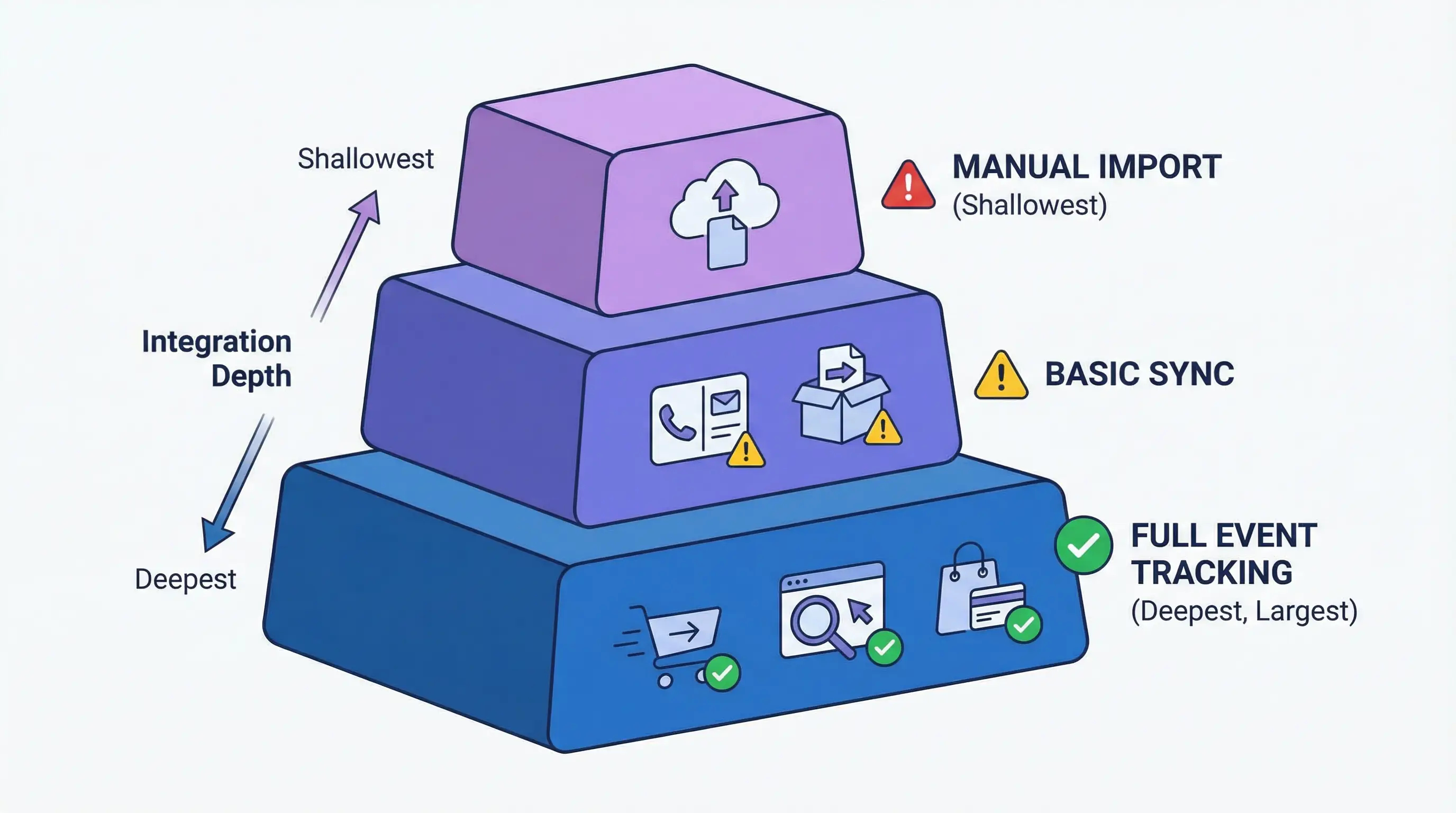
2. Ecommerce integration depth. "Integrates with Shopify" is a checkbox on every platform's website. But integration depth varies wildly. Does it track product views? Cart events? Checkout events? Does it sync your product catalog for dynamic email content? These details determine whether you can replicate your Klaviyo flows.
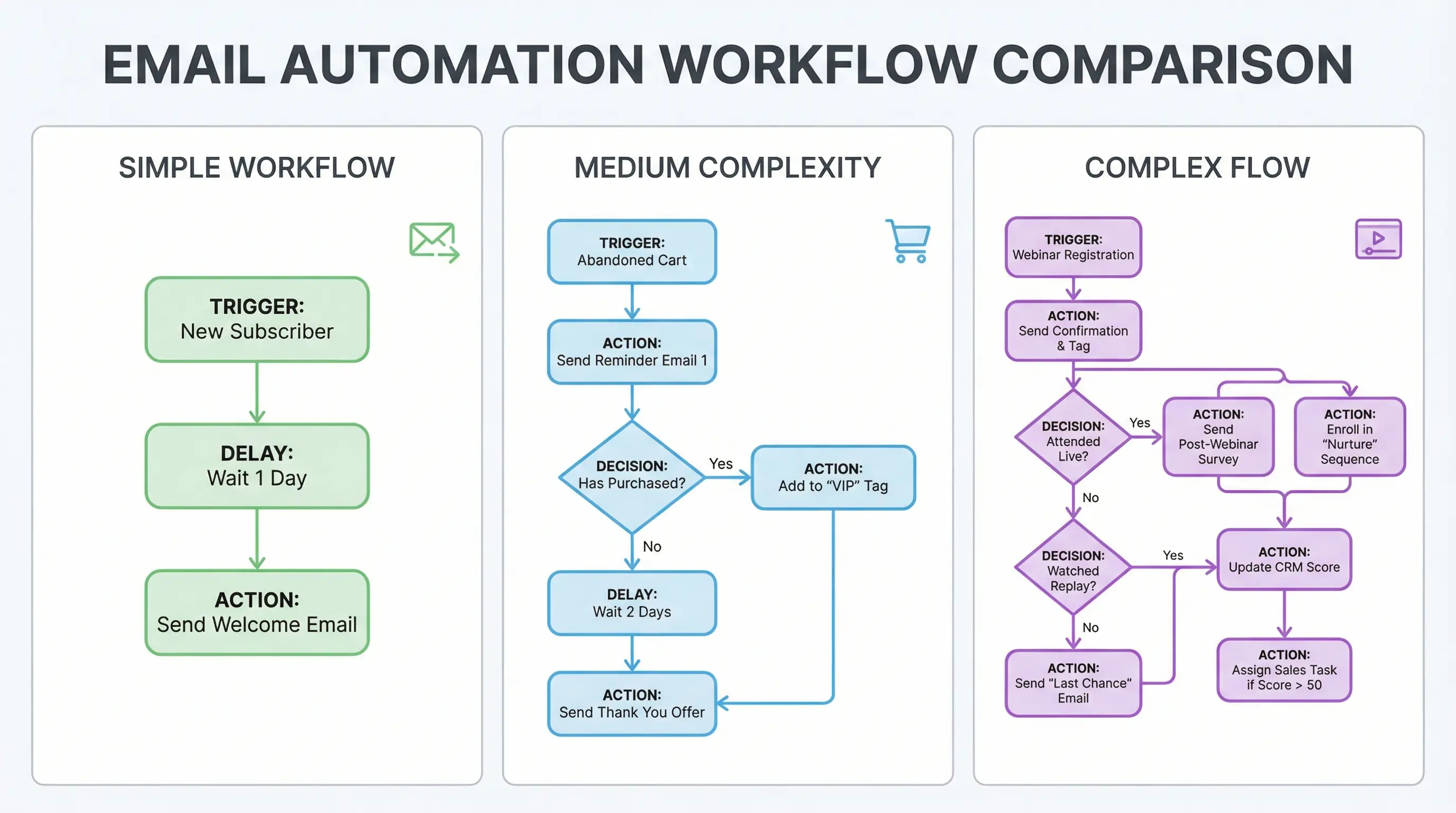
3. Automation builder capability. Can you build conditional splits? A/B branches? Time delays? Multi-step sequences triggered by specific behaviors? Klaviyo's flow builder is powerful. Make sure the alternative can handle whatever complexity you need.
4. SMS and multichannel features. If SMS is part of your marketing strategy, verify the alternative supports it, in the countries you sell to, at a price you can afford. Some tools bundle SMS. Others charge separately. Several don't offer it at all.
5. Deliverability track record. A tool that's 50% cheaper but lands 10% more emails in spam is a terrible trade. Check third-party deliverability tests from EmailToolTester and look for consistent results.
6. Migration ease. How hard is it to move your contacts, segments, and templates? What needs to be rebuilt? We cover this in detail in our migration section below.
7. Analytics and attribution. Revenue per email, revenue per flow, conversion tracking, A/B test results. Klaviyo's analytics are strong. Make sure you won't lose visibility into what's working.
The 10 Best Klaviyo Alternatives in 2026
1. Omnisend
Omnisend is the closest thing to Klaviyo for Shopify stores, at roughly half the price.
Best for: Shopify stores with 5K-50K contacts that want comparable ecommerce email features without the Klaviyo price tag.
Pricing at scale:
| Contacts | Omnisend (Standard) | Klaviyo (Email Only) | Monthly Savings |
|---|---|---|---|
| 1,000 | ~$16/mo | ~$30/mo | $14 |
| 5,000 | ~$81/mo | ~$100/mo | $19 |
| 10,000 | ~$132/mo | ~$150/mo | $18 |
| 25,000 | ~$270/mo | ~$400/mo | $130 |
| 50,000 | ~$468/mo | ~$720/mo | $252 |
The savings grow as your list grows. At 50,000 contacts, you're saving over $3,000 a year.
What it does well:
Omnisend was built for ecommerce. The Shopify integration tracks product views, cart events, checkout events, and order data. You get pre-built ecommerce automation workflows (abandoned cart, welcome series, post-purchase, browse abandonment) that work out of the box.
The automation builder supports conditional splits, A/B branching, and time delays. It's not as granular as Klaviyo's, but it handles most ecommerce flows without issues. We've implemented Omnisend for DTC brands doing $2M+ annually and found the builder covers 90% of what Klaviyo can do.
SMS is included in the Pro plan and works in the US, UK, Canada, and Australia. Credits are bundled with your plan rather than charged separately.
Product recommendation blocks work inside emails, pulling from your synced Shopify catalog. The drag-and-drop builder is clean and intuitive.
What you'll miss from Klaviyo:
- Predictive CLV scoring and churn risk analysis. Omnisend doesn't have comparable predictive analytics.
- RFM segmentation depth. Klaviyo's recency/frequency/monetary scoring is more granular.
- The full Shopify event taxonomy. Omnisend tracks fewer event types than Klaviyo's 40+.
- Benchmarking reports that compare your performance to similar stores.
Our verdict: If you're a Shopify store paying too much for Klaviyo and you want a straightforward switch, Omnisend is the safest choice. You'll lose some analytical depth. You'll keep the core ecommerce capabilities. And you'll save real money, especially above 10K contacts. Check Omnisend's current pricing for the latest rates. We've compared Omnisend and Mailchimp in detail if you're weighing those two. For a deep dive on how Omnisend stacks up against Klaviyo specifically, read our Klaviyo vs Omnisend comparison.
2. Brevo
Brevo is the budget play. It charges by emails sent, not contacts. That changes the math for a lot of stores.
Best for: Stores with large contact lists (10K+) that send 2-4 email campaigns per month. Also strong for businesses that need transactional emails (order confirmations, shipping updates) bundled in.
Pricing model: Per email, unlimited contacts on all plans.
| Plan | Emails/Month | Monthly Cost | Annual Cost |
|---|---|---|---|
| Free | 300/day (~9,000/mo) | $0 | $0 |
| Starter | 20,000 | ~$9/mo | ~$108/yr |
| Business | 20,000 | ~$18/mo | ~$216/yr |
| Starter | 60,000 | ~$39/mo | ~$468/yr |
| Business | 60,000 | ~$69/mo | ~$828/yr |
Compare that to Klaviyo: if you have 25,000 contacts and send 4 campaigns per month (100,000 emails), Klaviyo charges ~$400/month. Brevo's Business plan at 100K emails costs roughly $69/month. That's a $331/month difference, or $3,972 per year in savings.
What it does well:
The per-email pricing model is Brevo's killer feature. If you have a big list but don't blast it daily, you save a fortune compared to per-contact platforms.
Brevo is genuinely multichannel: email, SMS (in 200+ countries, far more than Klaviyo), WhatsApp campaigns, and live chat are all built in. Transactional emails are included too, which means you can consolidate your order confirmation and shipping notification emails into the same platform.
The API is solid. Developers like working with it. If you need programmatic email alongside marketing campaigns, Brevo handles both.
What you'll miss from Klaviyo:
- Deep ecommerce event tracking. Brevo's Shopify integration syncs orders and contacts but doesn't match Klaviyo's behavioral depth (product views, browse events, checkout stages).
- The visual automation builder is simpler. It works for linear sequences and basic splits, but complex multi-branch flows with behavioral triggers feel limited compared to Klaviyo.
- No native product recommendation engine. You can add product blocks manually, but there's no automatic "recommended for you" based on browsing behavior.
- Predictive analytics are minimal.
Our verdict: If cost is your primary concern and you don't need Klaviyo-level automation, Brevo is the smartest move for your budget. The unlimited contacts model is genuinely different and genuinely cheaper for most stores. But know this: you're trading automation depth for savings. If your abandoned cart flow has 8 conditional branches, Brevo will frustrate you. If it's a straightforward 3-email sequence, Brevo handles it fine. See Brevo's pricing page for the latest rates.
3. ActiveCampaign
ActiveCampaign is the automation nerd's choice. If you live in your flow builder, this is your tool.
Best for: Brands (ecommerce or not) that need the most powerful automation builder on the market, plus a built-in CRM.
Pricing at scale:
| Contacts | ActiveCampaign (Lite) | Klaviyo (Email Only) |
|---|---|---|
| 1,000 | ~$15/mo | ~$30/mo |
| 5,000 | ~$79/mo | ~$100/mo |
| 10,000 | ~$139/mo | ~$150/mo |
| 25,000 | ~$259/mo | ~$400/mo |
What it does well:
The automation builder is the best outside of Klaviyo, and many users would argue it's better. Conditional splits, A/B paths, wait conditions, goal tracking, webhook triggers, contact scoring, and branching logic that can go 20+ steps deep. If you've ever felt constrained by another platform's flow builder, ActiveCampaign will feel liberating.
The built-in CRM is a genuine differentiator. You get deal pipelines, lead scoring, and sales automation alongside your marketing email. For businesses that need both marketing and sales tools, this eliminates the need for a separate CRM.
With 900+ integrations and a solid Shopify app, ActiveCampaign connects to most ecommerce stacks. The Shopify integration tracks orders, revenue, and basic product data.
What you'll miss from Klaviyo:
- ActiveCampaign isn't ecommerce-native. Product catalog sync and dynamic recommendation blocks aren't as deep as Klaviyo's. You won't get automatic "recommended for you" product blocks based on browsing behavior.
- Shopify event tracking is less granular. It captures orders and basic events, but doesn't track the same depth of product views and checkout stages that Klaviyo does.
- No native SMS. ActiveCampaign offers SMS through integrations, but it's not a built-in feature the way Klaviyo handles it.
Our verdict: ActiveCampaign is the best choice if automation complexity is your top priority. If you're more of an "automation-first" business than an "ecommerce-first" business, it arguably beats Klaviyo. For pure Shopify stores that need deep product data in their emails, Omnisend is a better fit. For businesses that also need CRM, ActiveCampaign is unmatched in this price range. Check ActiveCampaign's pricing for current rates.
4. Mailchimp
Mailchimp is the name everyone knows. That's both its strength and its problem.
Best for: Small stores that want a recognizable platform with solid templates and simple campaign tools. Not a great Klaviyo alternative for anyone needing advanced automation.
Pricing at scale:
| Contacts | Mailchimp (Standard) | Klaviyo (Email Only) |
|---|---|---|
| 500 | ~$13/mo | ~$20/mo |
| 5,000 | ~$75/mo | ~$100/mo |
| 10,000 | ~$130/mo | ~$150/mo |
| 25,000 | ~$310/mo | ~$400/mo |
Notice the gap isn't dramatic. At 25K contacts, you save $90/month. That's real money ($1,080/year), but it's not the 50-70% savings you get with Brevo or MailerLite.
What it does well:
Mailchimp's email builder is polished. The template library is extensive. AI-powered content tools help generate subject lines and body copy. For straightforward campaigns (newsletters, promotions, product launches), the experience is smooth and beginner-friendly.
The analytics dashboard is respectable, with click maps, comparative reports, and campaign benchmarks. Mailchimp also offers a website builder, social posting tools, and basic CRM features, making it a true all-in-one for very small businesses.
The Shopify integration was restored in 2024 after a rocky breakup. It works now, but the history creates trust issues for some store owners. We've written a detailed Klaviyo vs Mailchimp comparison if you want the full breakdown.
What you'll miss from Klaviyo:
- Automation is significantly limited on lower-tier plans. Conditional splits, A/B paths, and behavioral triggers are restricted or unavailable unless you're on the Premium plan ($350+/month at 10K contacts). At that price, you might as well stay with Klaviyo.
- Ecommerce event tracking isn't as deep. Basic order data syncs, but Klaviyo's granular product view and checkout stage tracking doesn't have a Mailchimp equivalent.
- The Shopify integration, while functional, has a complicated past that makes some merchants nervous.
Our verdict: Mailchimp is familiar and functional. But it's hard to justify as a Klaviyo "alternative" for serious ecommerce operations. It's not meaningfully cheaper at scale, and its automation is weaker. If you're simplifying your tech stack and only need basic campaigns, Mailchimp works. If you're switching from Klaviyo because of automation needs or pricing, look elsewhere.
5. MailerLite
MailerLite is the best value under 10K contacts. Simple, clean, and surprisingly capable for the price.
Best for: Shopify stores under 10K contacts that want a capable email platform at minimal cost. Also great for content creators and bloggers with ecommerce on the side.
Pricing at scale:
| Contacts | MailerLite (Growing Business) | Klaviyo (Email Only) | Monthly Savings |
|---|---|---|---|
| 1,000 | ~$9/mo | ~$30/mo | $21 |
| 5,000 | ~$39/mo | ~$100/mo | $61 |
| 10,000 | ~$73/mo | ~$150/mo | $77 |
| 25,000 | ~$139/mo | ~$400/mo | $261 |
At 25,000 contacts, MailerLite saves you $3,132 per year compared to Klaviyo. That's substantial.
What it does well:
The interface is the cleanest of any platform on this list. If you value simplicity and speed over feature density, MailerLite is refreshing. The drag-and-drop builder is intuitive. The automation builder supports multi-step sequences with conditions and delays, which is more than many budget tools offer.
The free plan (1,000 contacts, 12,000 emails/month) is generous enough for new stores to get started without any commitment. Paid plans include landing pages, a website builder, and a built-in newsletter signup/unsubscribe management system.
Deliverability has been solid in third-party tests. EmailToolTester has consistently ranked MailerLite among the top performers.
What you'll miss from Klaviyo:
- No SMS. MailerLite is email-only. If SMS is part of your marketing, this is a dealbreaker.
- Shopify integration is surface-level. It syncs contacts and purchase data but doesn't offer the deep behavioral event tracking (product views, browse events, checkout stages) that Klaviyo provides.
- No predictive analytics, no RFM segmentation, no product recommendation engine.
- Automation is capable for simple flows but can't match Klaviyo's complexity for advanced multi-branch sequences.
Our verdict: MailerLite is the best starting point for budget-conscious stores under 10K contacts. The free plan is excellent. The interface is a pleasure to use. But you will likely outgrow it if your ecommerce email strategy gets sophisticated. Plan to migrate again in 12-18 months if your store takes off. That's fine. Start cheap, scale later. See MailerLite's pricing for current plans.
6. Drip
Drip is built for DTC ecommerce. Smaller than Klaviyo, but laser-focused on the same use case.
Best for: DTC brands that want strong ecommerce automation, behavioral tracking, and revenue attribution without Klaviyo's price tag.
Pricing at scale:
| Contacts | Drip | Klaviyo (Email Only) |
|---|---|---|
| 2,500 | ~$39/mo | ~$60/mo |
| 5,000 | ~$89/mo | ~$100/mo |
| 10,000 | ~$154/mo | ~$150/mo |
| 25,000 | ~$289/mo | ~$400/mo |
Drip is not the cheapest option. At 10K contacts, it's actually comparable to Klaviyo. The savings show up at 25K+ contacts.
What it does well:
Drip was designed for ecommerce from the ground up. Behavioral tracking is strong: product views, cart activity, and purchase history all feed into segmentation and automation triggers. The visual workflow builder handles conditional splits, delays, and branching well.
Revenue attribution is built in. You can see exactly which emails and automations drive sales, which is critical for optimizing your flows. The Shopify integration is solid, tracking key ecommerce events and syncing customer data for dynamic segmentation.
For DTC brands that want a dedicated ecommerce email tool without the Klaviyo price tag at scale, Drip is an underrated option.
What you'll miss from Klaviyo:
- No native SMS. Drip is email-only. You'll need a separate tool (Postscript, Attentive) for text messaging.
- The integration ecosystem is smaller. Fewer third-party apps and plugins compared to Klaviyo's extensive marketplace.
- Predictive CLV and advanced predictive analytics aren't available.
Our verdict: Drip is the most underrated Klaviyo alternative on this list. If you're a DTC brand that lives in your email automations and cares about revenue attribution, Drip delivers. The lack of SMS is the main limitation. If you need SMS bundled with email, go with Omnisend. If email-only is fine, Drip deserves a serious look.
7. Moosend
Moosend is a solid mid-range option. Good automation, low price, minimal fuss.
Best for: Growing stores that need automation capability at a budget price and don't require SMS or deep Shopify integration.
Pricing at scale:
| Contacts | Moosend (Pro) | Klaviyo (Email Only) |
|---|---|---|
| 1,000 | ~$9/mo | ~$30/mo |
| 5,000 | ~$48/mo | ~$100/mo |
| 10,000 | ~$88/mo | ~$150/mo |
| 25,000 | ~$160/mo | ~$400/mo |
Meaningful savings at every tier. At 25K contacts, you're saving $2,880/year.
What it does well:
Moosend's automation builder includes conditional logic, triggers, and actions that punch above its price point. You can build multi-step sequences with if/then branching, which is more than many budget tools offer. Ecommerce-ready templates and product recommendation blocks come included.
The interface is straightforward. Setup is quick. Reporting covers the basics well: open rates, click rates, unsubscribes, and basic revenue tracking for ecommerce.
For the price, the feature-to-cost ratio is among the best on this list.
What you'll miss from Klaviyo:
- No SMS. Moosend is email-only.
- Shopify integration depth is limited compared to Klaviyo. Basic order and contact sync, but not the granular behavioral event tracking.
- The user community is smaller. Fewer tutorials, templates, and third-party resources available.
- Predictive analytics and RFM segmentation don't exist here.
Our verdict: Moosend is a good value pick if you want automation capability without the Klaviyo price tag and you're comfortable with a less well-known platform. It won't impress with flashy new features, but it handles the fundamentals reliably at a fair price. No free plan hurts it, but the 30-day trial gives you enough time to evaluate.
8. Sender
Sender has the most generous free plan in email marketing. That alone makes it worth considering.
Best for: New or small stores that want to get started with email and SMS without spending anything. Also strong for side projects and bootstrapped businesses.
Pricing:
| Plan | Contacts | Emails/Month | Cost |
|---|---|---|---|
| Free | 2,500 | 15,000 | $0 |
| Standard | 5,000 | 60,000 | ~$23/mo |
| Standard | 10,000 | 120,000 | ~$47/mo |
| Standard | 25,000 | 300,000 | ~$107/mo |
The free plan includes 2,500 contacts, 15,000 emails per month, and automation. That's more than most competitors offer on their paid starter tiers.
What it does well:
Sender's free plan is absurdly generous. You get automation, email campaigns, SMS, reporting, and popup forms without paying anything. For a new Shopify store testing email marketing, there's no reason to pay for another platform until you exceed 2,500 contacts.
The paid plans scale affordably too. At 25,000 contacts, Sender costs roughly $107/month versus Klaviyo's $400. That's a $3,516 annual savings.
The interface is simple. Not feature-rich, but functional. Setup takes minutes.
What you'll miss from Klaviyo:
- Ecommerce depth is limited. Product recommendation engines, deep behavioral triggers, and catalog-based dynamic content aren't as strong.
- Deliverability is less proven at scale. Sender works fine for small lists, but we haven't seen the same track record at 50K+ contacts that established platforms demonstrate.
- Template library is smaller. You'll likely need to build more from scratch.
- Advanced segmentation and analytics don't approach Klaviyo's level.
Our verdict: Sender is the best starting point for stores on a tight budget. Use the free plan, grow your list, learn what works. When you hit the limits (and you will), graduate to Omnisend, Brevo, or ActiveCampaign depending on what you need. Think of Sender as a springboard, not a forever platform.
9. HubSpot
HubSpot is overkill for most Shopify stores. But if you need CRM and email under one roof, it's unmatched.
Best for: Businesses that need CRM, marketing automation, and email in a single platform. Particularly strong for B2B, SaaS, and hybrid businesses that aren't pure ecommerce.
Pricing:
HubSpot's pricing is complex. The free CRM is genuinely free and genuinely good. But marketing features escalate quickly:
| Tier | Cost | What You Get |
|---|---|---|
| Free CRM | $0 | Contact management, basic email (2,000/mo), forms, chat |
| Marketing Hub Starter | ~$20/mo | Removes branding, 5x email limit, basic automation |
| Marketing Hub Professional | ~$890/mo | Full automation, ABM, custom reports, SMS |
| + Contacts | ~$210/mo at 5K contacts | Contact tier pricing on top of base |
The jump from Starter to Professional is steep. Most Shopify stores won't justify the Professional tier. If you're evaluating HubSpot, the Starter plan is likely where you'd land.
What it does well:
The CRM is where HubSpot shines. Contact records, deal pipelines, task management, and sales automation are genuinely excellent. If your business model involves sales conversations alongside marketing email (consulting, B2B, services), HubSpot unifies everything.
The ecosystem is massive. HubSpot integrates with virtually every business tool. The automation builder on Professional and above is strong, though not ecommerce-specific.
What you'll miss from Klaviyo:
- Ecommerce features are an afterthought. No native product recommendations, no deep Shopify event tracking, no catalog sync for dynamic content.
- SMS is only available on the Professional tier ($890+/month). Not practical for most stores.
- The Shopify integration exists but is shallow compared to Klaviyo's.
- You're paying for CRM, sales, and service tools you may not use. The platform is built for a different type of business.
Our verdict: Wrong choice for pure ecommerce. Right choice if your business needs CRM + email + sales tools in one place. If you're a Shopify store owner looking at HubSpot, pause. Unless you also run a B2B operation or a services business, Omnisend or ActiveCampaign will serve your ecommerce email needs better at a fraction of the cost. Check out Shopify Email vs Klaviyo if you're exploring built-in options too.
10. Constant Contact
Constant Contact is the platform your parents use. Simple, reliable, and not built for modern ecommerce.
Best for: Small businesses that want phone support, simple email campaigns, and event marketing tools. Not a serious Klaviyo alternative for ecommerce.
Pricing at scale:
| Contacts | Constant Contact (Standard) | Klaviyo (Email Only) |
|---|---|---|
| 500 | ~$12/mo | ~$20/mo |
| 5,000 | ~$80/mo | ~$100/mo |
| 10,000 | ~$120/mo | ~$150/mo |
What it does well:
Phone support. In a market where most platforms offer only email or chat support, Constant Contact lets you call a human. For non-technical store owners, this matters.
The event marketing features (RSVP management, event pages, attendee tracking) are unique in this space. If you run in-person events or workshops alongside your ecommerce store, Constant Contact handles both.
The email builder is simple and reliable. Basic campaigns go out without issues. Deliverability has a good reputation.
What you'll miss from Klaviyo:
- Automation is significantly limited. Basic autoresponders exist, but nothing close to Klaviyo's conditional flow builder.
- Ecommerce features are minimal. No behavioral tracking, no product recommendations, no revenue attribution per flow.
- No SMS capability.
- The interface feels dated compared to newer platforms.
- Template designs lean conservative. Not ideal for modern DTC branding.
Our verdict: We're including Constant Contact because it appears in every competitor article and some readers will be considering it. But we'll be direct: it's not a viable Klaviyo alternative for serious ecommerce. If you need phone support and simple campaigns for a non-ecommerce business, it works. For Shopify stores with real email marketing needs, look at every other option on this list first.
Pricing at Scale: What These Tools Actually Cost
This is the table most "alternatives" articles don't show you. Starting prices are marketing. Here's what you'll actually pay at real ecommerce contact counts.
| Tool | Pricing Model | 1K Contacts | 5K Contacts | 10K Contacts | 25K Contacts | 50K Contacts |
|---|---|---|---|---|---|---|
| Klaviyo | Per contact | ~$30/mo | ~$100/mo | ~$150/mo | ~$400/mo | ~$720/mo |
| Omnisend | Per contact | ~$16/mo | ~$81/mo | ~$132/mo | ~$270/mo | ~$468/mo |
| Brevo | Per email sent | ~$9/mo* | ~$9/mo* | ~$9/mo* | ~$9/mo* | ~$9/mo* |
| ActiveCampaign | Per contact | ~$15/mo | ~$79/mo | ~$139/mo | ~$259/mo | ~$379/mo |
| Mailchimp | Per contact | ~$13/mo | ~$75/mo | ~$130/mo | ~$310/mo | ~$510/mo |
| MailerLite | Per contact | ~$9/mo | ~$39/mo | ~$73/mo | ~$139/mo | ~$223/mo |
| Drip | Per contact | ~$39/mo | ~$89/mo | ~$154/mo | ~$289/mo | ~$449/mo |
| Moosend | Per contact | ~$9/mo | ~$48/mo | ~$88/mo | ~$160/mo | ~$315/mo |
| Sender | Per contact | ~$7/mo | ~$23/mo | ~$47/mo | ~$107/mo | ~$227/mo |
| HubSpot | Per contact | ~$20/mo | ~$210/mo | ~$400/mo | ~$800/mo | ~$1,400/mo |
| Constant Contact | Per contact | ~$12/mo | ~$80/mo | ~$120/mo | ~$280/mo | ~$430/mo |
*Brevo charges by emails sent, not contacts. The $9/mo Starter plan includes 20,000 emails/month with unlimited contacts. At higher send volumes, costs increase based on email count, not list size.
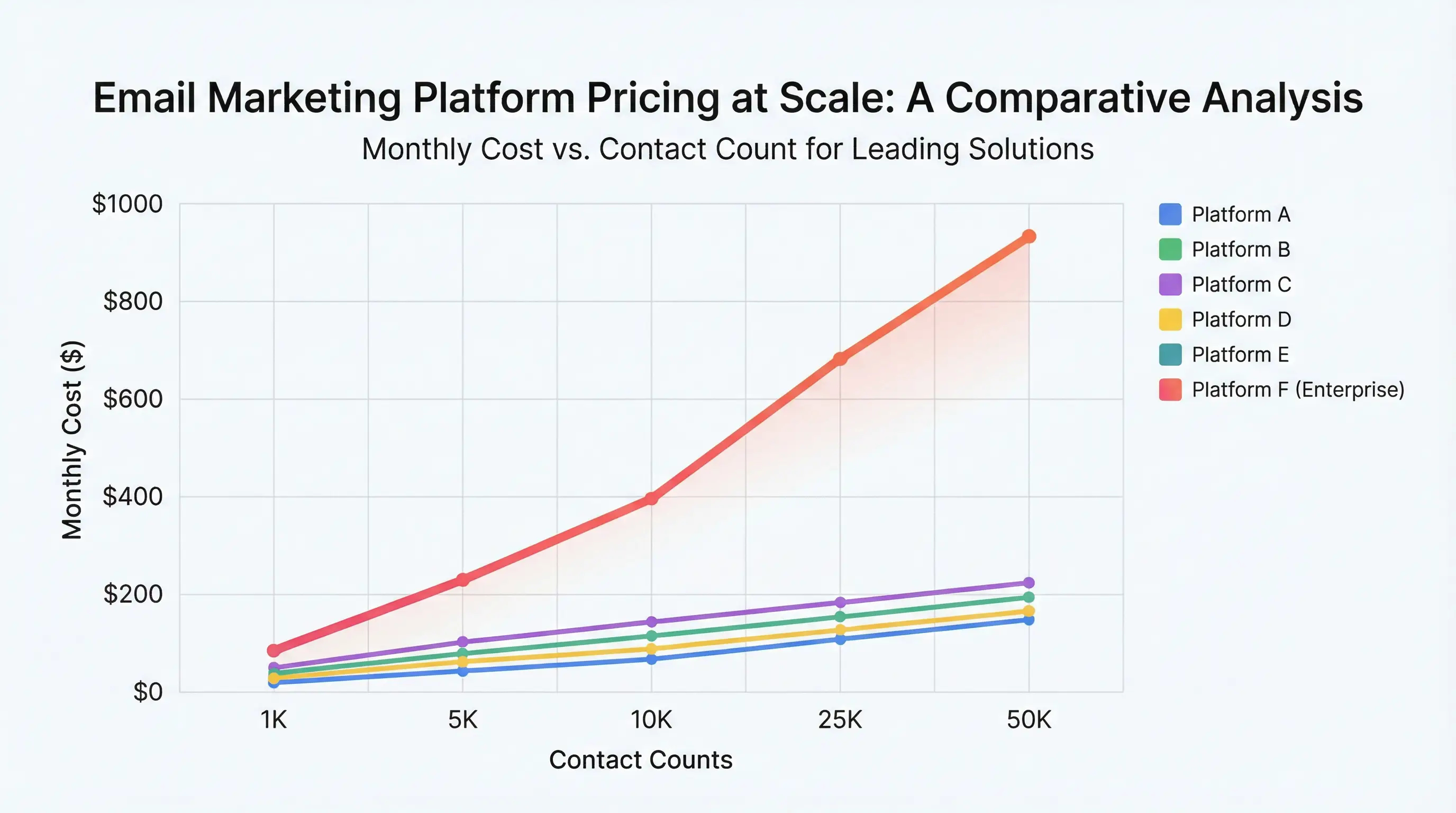
The headline number: At 25,000 contacts, MailerLite costs $139/month. Klaviyo costs $400/month. That's a $261 monthly difference, or $3,132 per year. Even Omnisend, the closest feature match, saves you $1,560 annually at this scale.
Brevo is in a category of its own because of its per-email pricing. If you have 25,000 contacts but only send 40,000 emails per month (about 1.5 campaigns/month), Brevo's Starter plan at $9-29/month makes every other option look expensive.
Contact-Based vs Email-Based Pricing: Which Saves You More?
This is the single most important pricing concept most guides skip.
Contact-based pricing (Klaviyo, Omnisend, ActiveCampaign, Mailchimp, MailerLite, Drip, Moosend, Sender): You pay based on how many contacts are on your list, regardless of how many emails you send. A store with 20,000 contacts that sends 2 emails per month pays the same as one that sends 20 emails per month.
Email-based pricing (Brevo, and some Sender plans): You pay based on how many emails you send. A store with 20,000 dormant contacts and 2,000 active buyers pays only for the emails it sends.
📊 Worked Example: The Math in Action
Store A has 20,000 contacts and sends 4 campaigns per month (80,000 emails total).
| Platform | Pricing Model | Monthly Cost |
|---|---|---|
| Klaviyo | Per contact (20K tier) | ~$350/mo |
| Omnisend | Per contact (20K tier) | ~$210/mo |
| Brevo | Per email (Business 100K plan) | ~$69/mo |
Brevo saves Store A $281/month over Klaviyo. That's $3,372/year.
But if Store A emails daily (600,000 emails/month), Brevo's cost jumps. At that volume, per-contact pricing becomes cheaper.
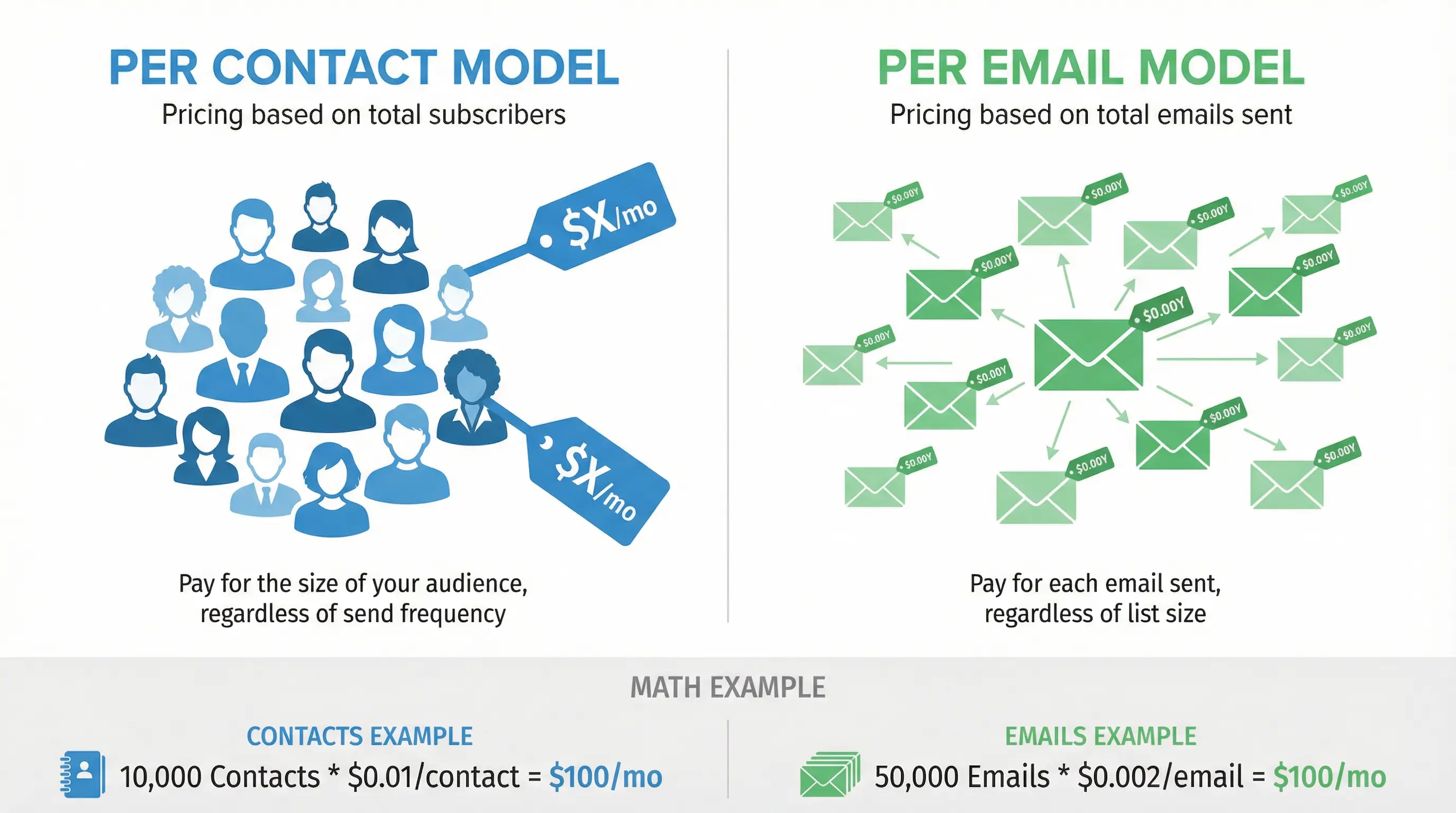
The rule of thumb: If you send fewer than 4 emails per contact per month, per-email pricing (Brevo) almost always saves you money. If you email more frequently than that, run the numbers on both models at your volume. Per-contact pricing usually wins for daily senders.
SMS Marketing: Where Alternatives Fall Short (and Where They Win)
SMS is increasingly critical for ecommerce. But if you rely on SMS, your list of viable Klaviyo alternatives gets much shorter.
| Tool | SMS Available | Countries | Cost Model | Bundled with Email? |
|---|---|---|---|---|
| Klaviyo | ✅ | ~17 countries | Per credit (~$0.01-0.015/SMS in US) | Bundled in Email + SMS plans |
| Omnisend | ✅ | US, UK, CA, AU | Credits bundled in Pro plan | Yes (Pro plan) |
| Brevo | ✅ | 200+ countries | Per SMS (separate pricing) | Separate add-on |
| Sender | ✅ | Select countries | Per SMS | Separate add-on |
| ActiveCampaign | ❌ (via integrations) | N/A | N/A | No |
| Mailchimp | ❌ (limited US SMS) | US only | Per SMS | Add-on |
| MailerLite | ❌ | N/A | N/A | No |
| Drip | ❌ | N/A | N/A | No |
| Moosend | ❌ | N/A | N/A | No |
| Constant Contact | ❌ | N/A | N/A | No |
Here's the thing: if SMS is a key part of your marketing, your realistic alternatives narrow to three. Omnisend, Brevo, and Klaviyo itself.
Omnisend bundles SMS credits into its Pro plan, which simplifies budgeting. Brevo offers SMS in 200+ countries (far more than Klaviyo's ~17), making it the strongest choice for international brands. Klaviyo's SMS is tightly integrated with its email flows, which is hard to replicate on other platforms.
If you currently run SMS flows through Klaviyo (abandoned cart texts, shipping notifications, flash sale alerts), make sure your replacement platform can handle those same triggers. Most of the tools on this list can't.
One thing to check: whether unused SMS credits roll over. Klaviyo SMS credits do not roll over month to month. If you buy credits and don't use them, they expire. Omnisend's bundled Pro plan credits also reset monthly. Brevo charges per SMS on a pay-as-you-go basis, so rollover isn't applicable. Sender's SMS credits vary by plan. Always verify rollover terms before committing to an SMS plan, especially if your sending volume fluctuates seasonally.
Worth noting: dedicated SMS platforms like Postscript and Attentive exist specifically for this. Some brands pair a cheaper email platform (Brevo, MailerLite) with a dedicated SMS tool. It works, but it adds complexity and another monthly bill.
Best Klaviyo Alternatives for Shopify Stores
"Integrates with Shopify" appears on every platform's feature page. But integration depth varies wildly. Here's what actually matters and which tools deliver.
Klaviyo's Shopify integration is the gold standard. It tracks 40+ event types, syncs your full product catalog, enables dynamic product recommendation blocks, and feeds granular behavioral data into segmentation and automation triggers. That's the benchmark.
| Tool | Product View Tracking | Cart Events | Checkout Events | Catalog Sync / Recommendations | Shopify Flow Support |
|---|---|---|---|---|---|
| Klaviyo | ✅ | ✅ | ✅ | ✅ | ✅ |
| Omnisend | ✅ | ✅ | ✅ | ✅ | 🟡 Limited |
| Drip | ✅ | ✅ | 🟡 Basic | 🟡 Partial | ❌ |
| ActiveCampaign | 🟡 Basic | 🟡 Basic | ❌ | ❌ | ❌ |
| Mailchimp | 🟡 Basic | 🟡 Basic | ❌ | ❌ | ❌ |
| Brevo | ❌ | ❌ | ❌ | ❌ | ❌ |
| MailerLite | ❌ | ❌ | ❌ | ❌ | ❌ |
| Moosend | ❌ | ❌ | ❌ | ❌ | ❌ |
| Sender | ❌ | ❌ | ❌ | ❌ | ❌ |
| Constant Contact | ❌ | ❌ | ❌ | ❌ | ❌ |
The pattern is clear. For deep Shopify integration, your real options are Omnisend and Drip. Everything else syncs customer and order data at a basic level but can't match Klaviyo's behavioral tracking.
Our top 3 Klaviyo alternatives for Shopify:
- Omnisend. The closest to Klaviyo's Shopify integration depth. Product view tracking, cart event triggers, checkout events, catalog sync for dynamic product blocks. If Shopify integration is your priority, this is it.
- Drip. Strong ecommerce focus with good behavioral tracking. Slightly less integration depth than Omnisend, but the automation builder compensates with powerful segmentation based on purchase behavior.
- Brevo. Only if budget is your top priority and you can accept shallow Shopify integration. It syncs orders and contacts. It won't track product views or cart events. Your automation triggers will be limited to purchase data and email engagement.
If Shopify integration depth is critical to your email flows, and you're not willing to compromise on behavioral triggers, your honest choice is between staying with Klaviyo and switching to Omnisend. That's the reality most guides won't tell you.
How to Actually Migrate from Klaviyo
This is the section every other "Klaviyo alternatives" guide skips. Migration is the single biggest barrier to switching. It's not painless. But it's also not as scary as most people think.
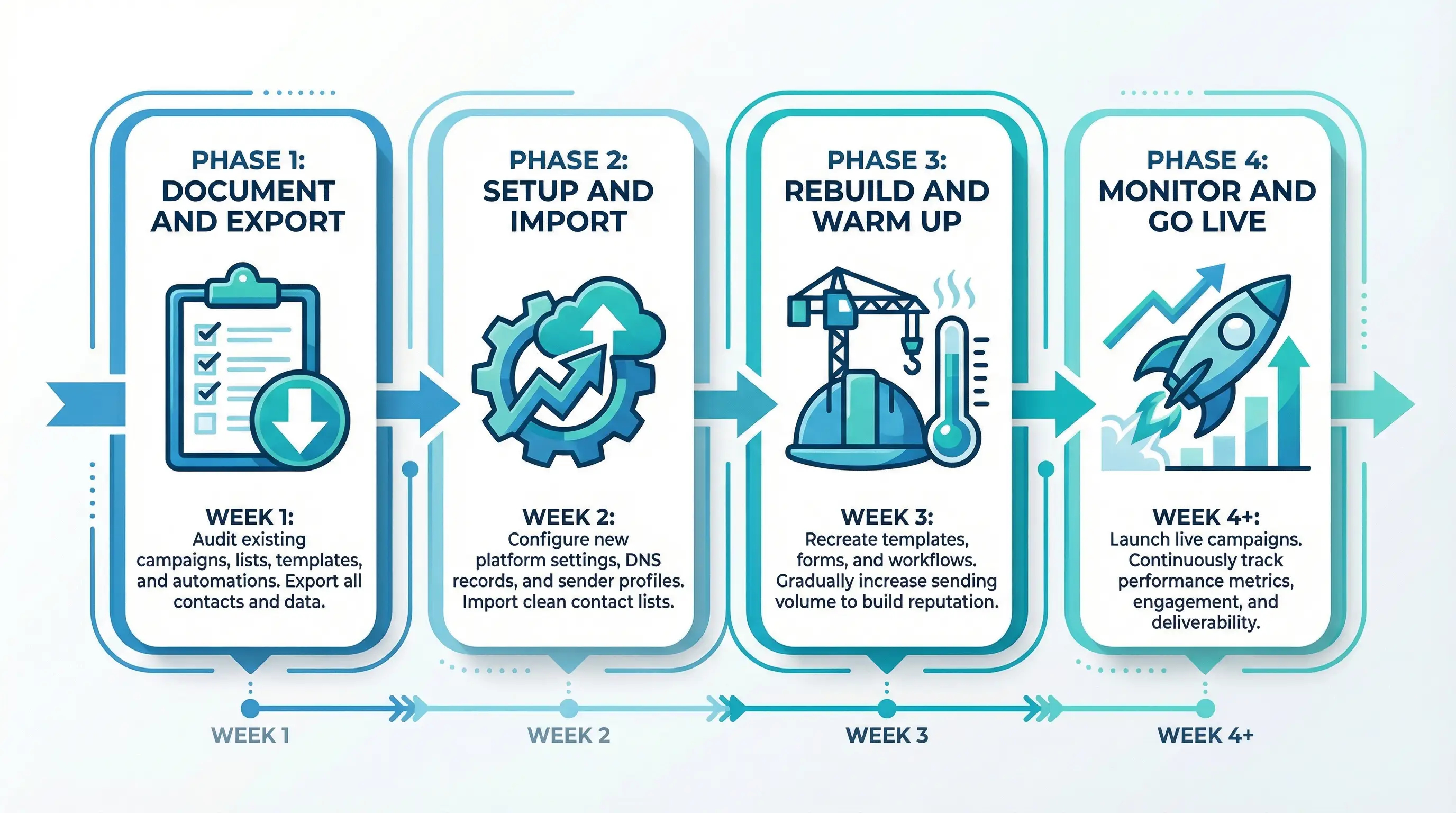
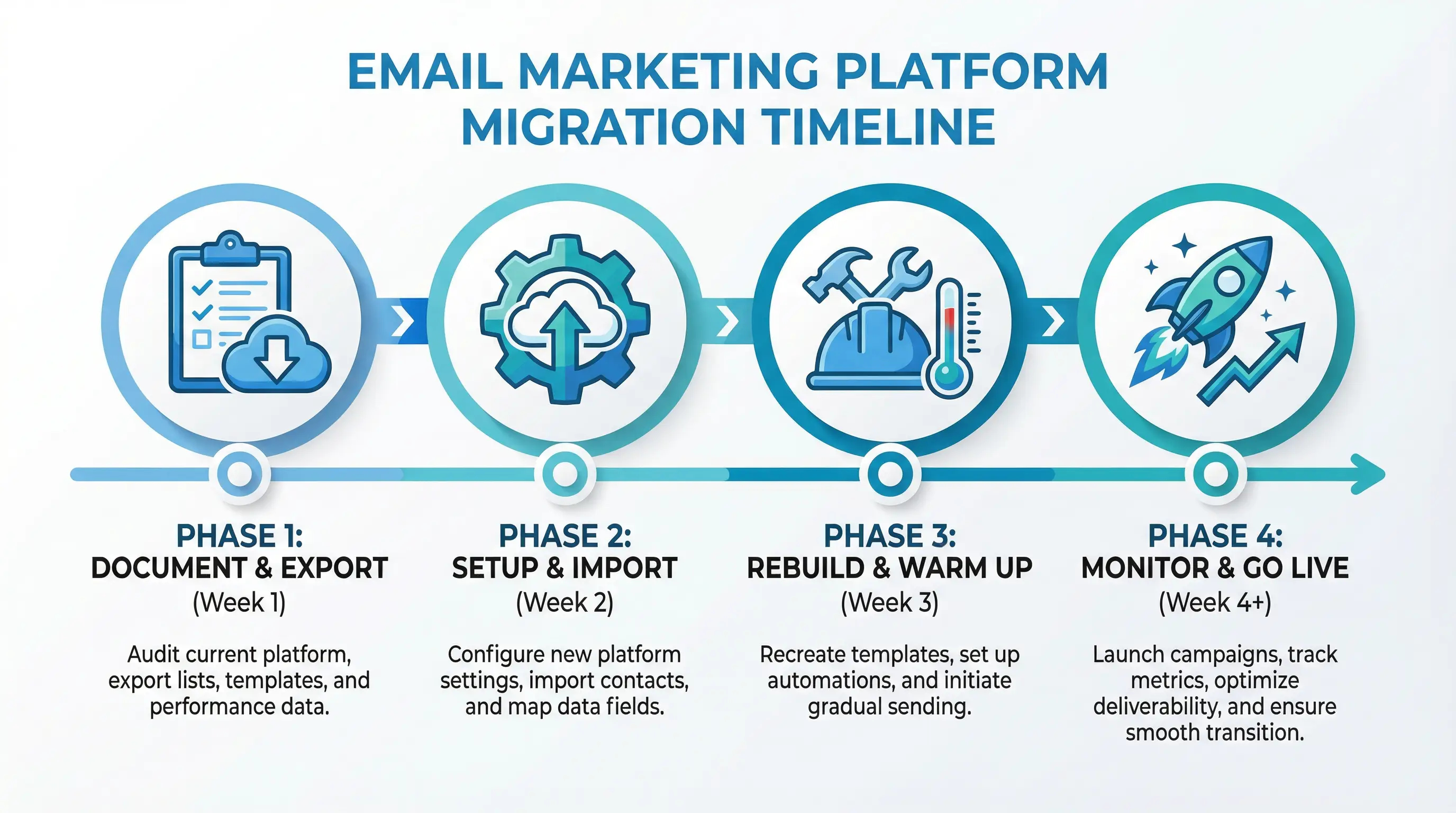
Here's the truth: budget 2-4 weeks for a standard migration. If you have 50+ active flows, budget 4-8 weeks. Do not attempt this during peak season (Black Friday, holiday, any major sale period). And if you're also considering switching your ecommerce platform, tackle that separately. Don't migrate your email and your store at the same time.
What You Can Export from Klaviyo
- Contact lists and segments. Export as CSV with all custom properties, tags, and profile data.
- Email templates. Export as HTML. Most platforms can import HTML templates, though formatting may need adjustments.
- Campaign performance data. Export historical reports as CSV for your records.
- Flow logic. You can't export automations directly. Take screenshots and document every flow: triggers, conditions, timing, email content, and branching logic.
What You'll Need to Rebuild
This is the part people underestimate.
- Automations and flows. Every single one. There is no platform on earth that imports Klaviyo flows natively. You'll rebuild each flow from scratch in your new tool.
- Segments. Segment logic must be recreated using the new platform's rules and syntax. The conditions you used in Klaviyo may not have exact equivalents.
- Dynamic product blocks. These are platform-specific. If your emails pull product recommendations from Klaviyo's engine, you'll need to rebuild those blocks using your new platform's tools (or remove them if the new tool doesn't support it).
- Signup forms and popups. Rebuild or connect a third-party tool (like Privy or Justuno).
- Integrations. Reconnect your Shopify store, review app (Yotpo, Judge.me), loyalty program (Smile.io), and any other tools that fed data into Klaviyo.
Step-by-Step Migration Checklist
- Document your existing flows. Screenshot every automation. Note triggers, conditions, delays, and branching logic. Export email content from each flow. This is your blueprint.
- Export your contact lists. Download all lists and segments as CSV files with every custom property. Include consent dates and engagement data.
- Clean your list before importing. Remove unengaged contacts (no opens in 120+ days), deduplicate, and fix obvious data quality issues. Importing a dirty list to a new platform is a missed opportunity.
- Set up your new platform and connect Shopify. Install the Shopify app, configure event tracking, and verify that data is flowing correctly.
- Rebuild your top-priority flows first. Start with the money-makers: abandoned cart, welcome series, post-purchase. Get these live before moving to secondary flows.
- Warm up your sending domain. This is critical. Start by sending to your most engaged contacts only. Gradually increase volume over 2-4 weeks. Skipping this step will tank your deliverability.
- Run both platforms in parallel for 1-2 weeks. Keep Klaviyo active for flows you haven't migrated yet. Send new campaigns from your new platform. Overlap prevents gaps in your email coverage.
- Monitor deliverability closely. Watch open rates, bounce rates, and spam complaints for the first 30 days on the new platform. If deliverability drops, slow down your volume ramp.
- Cancel Klaviyo only after everything is live. Don't rush this. Cancel when all flows are rebuilt, tested, performing, and deliverability is stable on the new platform.
Timeline and Common Mistakes
Realistic timeline: 2-4 weeks for most stores with under 50 active flows. 4-8 weeks for complex setups with 50+ flows, multiple integrations, and heavy segmentation. Build in buffer time. Rushing a migration creates more problems than it solves.
Mistake #1: Not warming up your sending domain. This is the most common and most damaging. Email providers (Gmail, Yahoo, Outlook) need to learn that your new sending address is legitimate. Send to small batches of engaged contacts first. Ramp up over 2-4 weeks.
Mistake #2: Migrating during peak season. November through January is the wrong time to switch platforms. Migration introduces risk. Peak season is when you can least afford risk.
Mistake #3: Assuming automations will transfer. They never do. Every platform stores automation logic differently. Plan to rebuild every flow from scratch. It's tedious but unavoidable.
Need help with your migration? We've guided dozens of Shopify stores through this exact process. Reach out for a free consultation.
Frequently Asked Questions
What's the cheapest Klaviyo alternative?
Sender is the cheapest paid option, starting at $7/month. Brevo starts at $9/month but charges by emails sent (not contacts), which makes it cheaper for stores with large lists. For free options, Sender offers 2,500 contacts and 15,000 emails/month at no cost, the most generous free plan available.
Is there a free alternative to Klaviyo?
Yes. Sender (2,500 contacts + 15,000 emails free), MailerLite (1,000 contacts + 12,000 emails free), Brevo (300 emails/day with unlimited contacts free), and Mailchimp (500 contacts + 1,000 sends free) all offer usable free plans. Sender's is the most generous for ecommerce stores getting started.
Which Klaviyo alternative is best for Shopify?
Omnisend. It's the closest match to Klaviyo's Shopify integration depth, with product view tracking, cart event triggers, checkout events, and catalog sync for dynamic product recommendations. See our Shopify comparison table for full details.
Is Omnisend better than Klaviyo?
For stores prioritizing cost savings at comparable functionality, yes. Omnisend delivers roughly 90% of Klaviyo's ecommerce email capabilities at 50-65% of the price. Klaviyo is better if you rely on predictive analytics (CLV scoring, churn risk) and the deepest possible Shopify event tracking. The right choice depends on which features you actually use.
How do I reduce my Klaviyo costs without switching?
Archive unengaged contacts (they count as active profiles), merge duplicate profiles, review your plan tier, use targeted segments instead of full-list sends, and negotiate directly with Klaviyo's retention team. These steps can reduce your bill by 20-40%.
Can I migrate my Klaviyo automations to another platform?
Not directly. Klaviyo automations cannot be exported and imported into any other platform. Every flow must be rebuilt manually. You can export your contact lists, email templates (as HTML), and performance data. But automation logic, segment rules, and dynamic content blocks all need to be recreated from scratch. See our full migration guide.
What's the best Klaviyo alternative for SMS marketing?
Omnisend (bundled SMS credits in the Pro plan, available in US/UK/CA/AU) or Brevo (SMS available in 200+ countries, priced separately). If you sell internationally, Brevo's country coverage is far better than Klaviyo's ~17 countries. Note that MailerLite, Drip, Moosend, and Constant Contact don't offer SMS at all.
Does email marketing still work in 2026?
Yes. Email consistently generates $36-42 for every $1 spent, according to DMA and Litmus research. Ecommerce brands routinely attribute 25-40% of total revenue to email marketing. It remains the highest-ROI marketing channel available. The question isn't whether email works. It's whether you're using the right platform for your business.
The Bottom Line
There's no single best Klaviyo alternative. The right tool depends on your contact count, your budget, how sophisticated your automation needs are, and whether SMS matters to your strategy.
Here's the quick recap:
- Best overall Klaviyo replacement for Shopify: Omnisend
- Best budget option: Brevo (per-email pricing is a game-changer for large lists)
- Best automation builder: ActiveCampaign
- Best free plan: Sender
- Best for simplicity under 10K contacts: MailerLite
- Best for DTC ecommerce automation: Drip
If you're still unsure, go back to the Quick Match section and find your scenario. Or try this: sign up for free trials of your top 2-3 picks. Rebuild your most important automation (abandoned cart is a good test). Send a test campaign. See how the interface feels. The right platform will feel right within an hour. And remember, your email platform is just one piece of the stack. Choosing the right ecommerce platform for SEO matters too.
Last updated: February 13, 2026. Pricing and features verified against official pricing pages and third-party reviews. We review and update this guide quarterly.
We love working with ambitious Shopify brands.
We can help optimize your store's conversion rate and increase sales.
We can create custom apps that integrate third-party services or add new features to your store.
We can create any theme customization you need to improve the look and feel of your brand.
Get in Touch
Written by
Alex is the founder of AESYMMETRIC, a Shopify agency specializing in conversion rate optimization, custom app development, and theme customizations. With eight years of experience in the Shopify ecosystem and e-commerce industry, he helps brands maximize sales and reduce costs through data-driven strategies and innovative technical solutions.