
Klaviyo vs Omnisend for Shopify: An Agency's Honest Comparison (2026)

Table of Contents
- The Real Question
- Quick Verdict
- Wait, Do You Even Need Either?
- Pricing: What You'll Actually Pay
- Shopify Integration: The Elephant in the Room
- Email Builder & Templates
- Automation & Flows: Where the Real Differences Live
- Segmentation & Data
- SMS & Omnichannel
- Analytics & Reporting
- Customer Support: The Underrated Factor
- Deliverability: What Nobody Talks About
- Total Cost of Ownership: Beyond the Sticker Price
- Migration Reality Check
- The Decision Framework: Which One Is Right for YOUR Store?
- 2026 Updates: What's New
- FAQ
- Final Verdict
The Real Question
Your Klaviyo bill went up again. Or maybe you're starting fresh and trying to figure out which platform deserves your money. Either way, you're staring at two names that dominate every "best email marketing for Shopify" list: Klaviyo and Omnisend.
Here's the honest answer: the right choice depends on your revenue, your team, and your ambition. Not on whoever's comparison article ranks first on Google (spoiler: most of those are written by one of the two platforms or by sites earning affiliate commissions from both).
This guide is updated for 2026, covering Klaviyo's aggressive pivot toward becoming a full B2C CRM and Omnisend's latest AI features. Let's cut through the noise.
Quick Verdict
For readers who don't have 25 minutes, here's where we land after implementing both for real Shopify stores:
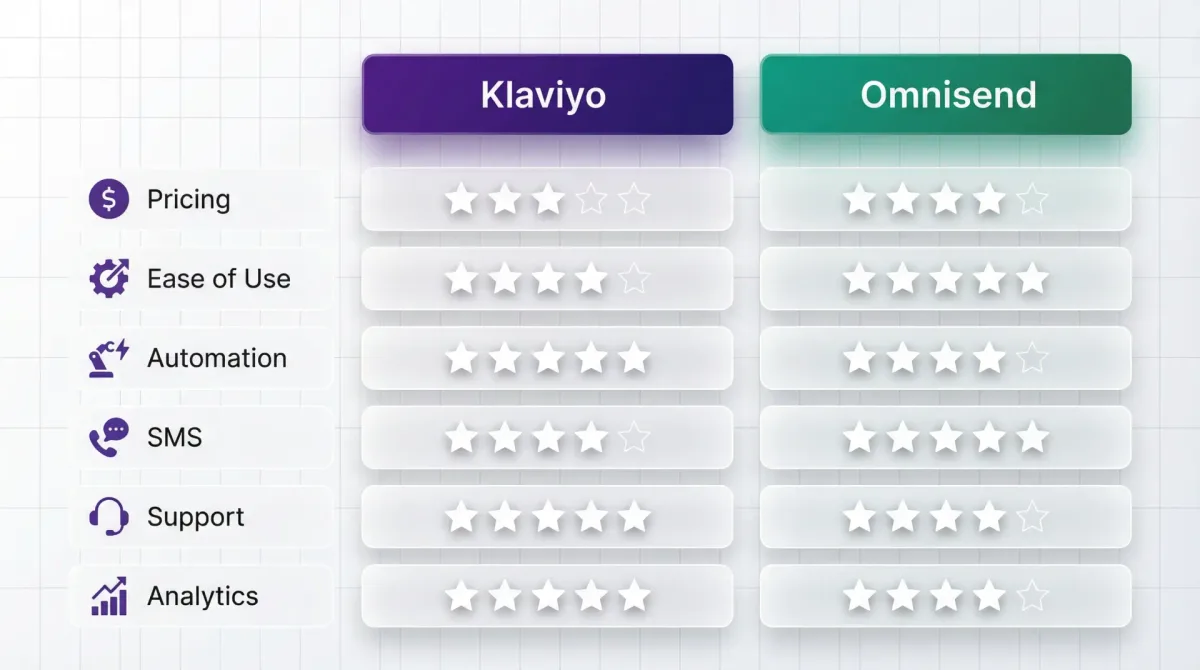
| Category | Klaviyo | Omnisend |
|---|---|---|
| Best For | Scaling stores ($100K+/mo) needing advanced data | SMBs & growing stores wanting value + simplicity |
| Pricing (10K contacts) | $150/mo (email only) | $132/mo (Standard) |
| Shopify Integration | ⭐⭐⭐⭐⭐ | ⭐⭐⭐⭐ |
| Ease of Use | ⭐⭐⭐ | ⭐⭐⭐⭐⭐ |
| Automation Power | ⭐⭐⭐⭐⭐ | ⭐⭐⭐⭐ |
| SMS | ⭐⭐⭐⭐ (native 2-way) | ⭐⭐⭐⭐ (broader global reach) |
| Customer Support | ⭐⭐⭐ (email + chat, 24/5) | ⭐⭐⭐⭐⭐ (24/7 live chat) |
| Analytics | ⭐⭐⭐⭐⭐ | ⭐⭐⭐ |
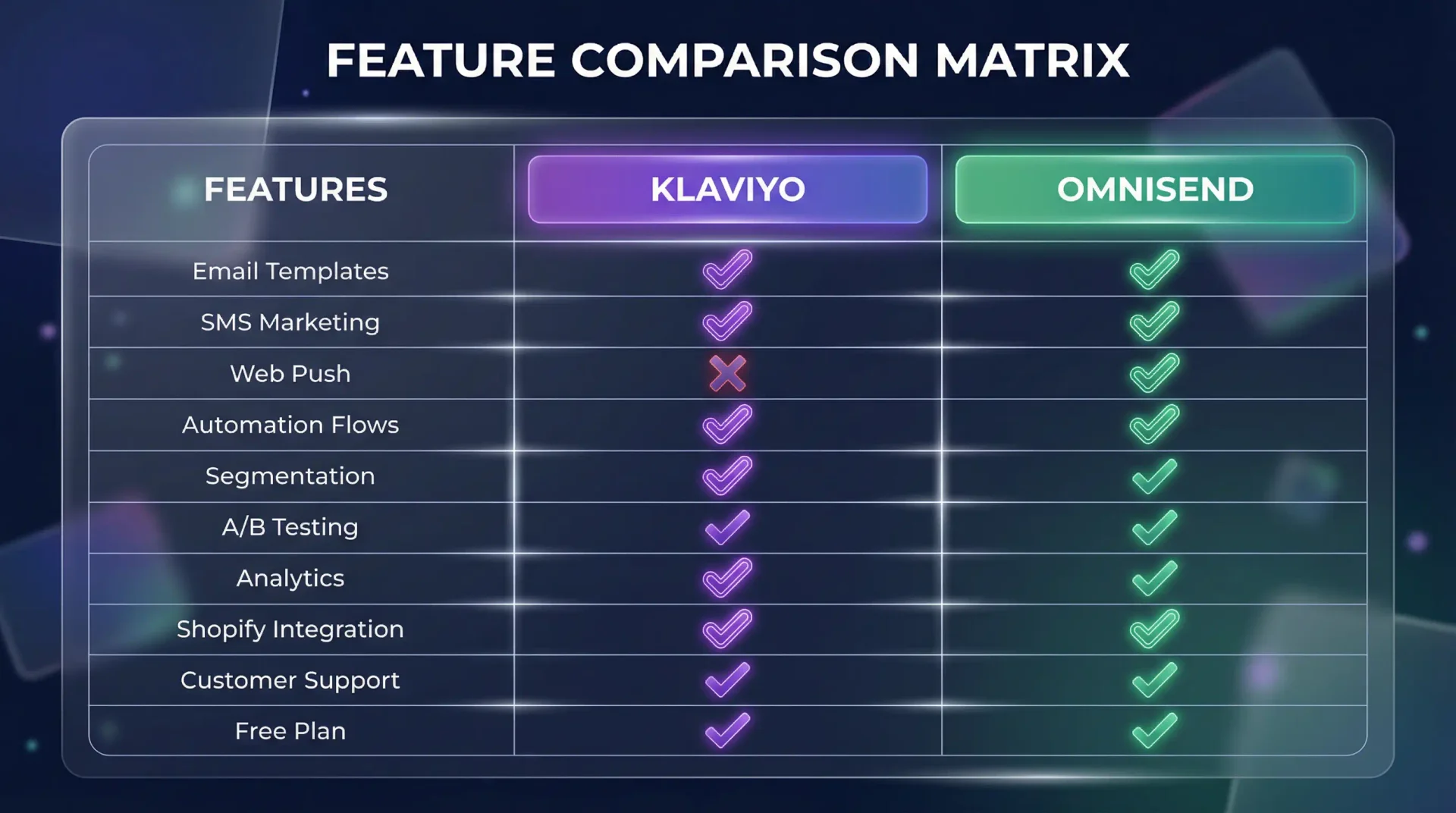
| Web Push | ❌ Not native | ✅ Built-in |
| Our Verdict | The advanced toolkit (if you'll actually use it) | The smarter pick for most Shopify stores |
Choose Klaviyo if: You're doing $100K+/month, have a dedicated email marketer (or agency), and will genuinely use predictive analytics, deep segmentation, and complex conditional flows.
Choose Omnisend if: You want 80% of Klaviyo's power at roughly 60-70% of the price, with better support, faster setup, and easier day-to-day management.
Choose Shopify Email if: You're under $30K/month, have a tiny list, and just need the basics. Seriously.
Wait, Do You Even Need Either?
This is the section no other comparison article writes. Because most of them are trying to sell you something.
Shopify Email is free for 10,000 emails per month. It's built into your Shopify admin. No extra app. No integration headaches. For a store doing under $30K/month with a list under 2,000 contacts, it handles the basics: abandoned cart recovery, order confirmations, simple campaigns, basic segmentation.
Is it limited? Absolutely. The automation builder is bare-bones. The segmentation is rudimentary. There's no SMS. The template selection won't win any design awards. But it works, and it's free.
When you've genuinely outgrown Shopify Email:
- You need multi-step automated flows (welcome series with conditional splits, post-purchase sequences based on product type)
- You want SMS alongside email in unified workflows
- Your list has grown past 5,000 contacts and you need real segmentation
- You're leaving money on the table with browse abandonment (and you know it)
- Your revenue has crossed $30K/month and email should be generating 25-40% of it
If you're reading this article, you've probably hit at least two of those triggers. But we'd be doing you a disservice not to mention Shopify Email first. We've covered the full comparison in our Shopify Email vs Klaviyo breakdown.
💡 Pro Tip: Some of our clients start on Shopify Email, graduate to Omnisend around $30-50K/month, and only consider Klaviyo if they cross $100K/month and need predictive analytics. That's a perfectly valid path, and it saves you money at every stage.
Our Take: Don't pay for a third-party email platform until you actually need one. When you do, keep reading.
Pricing: What You'll Actually Pay
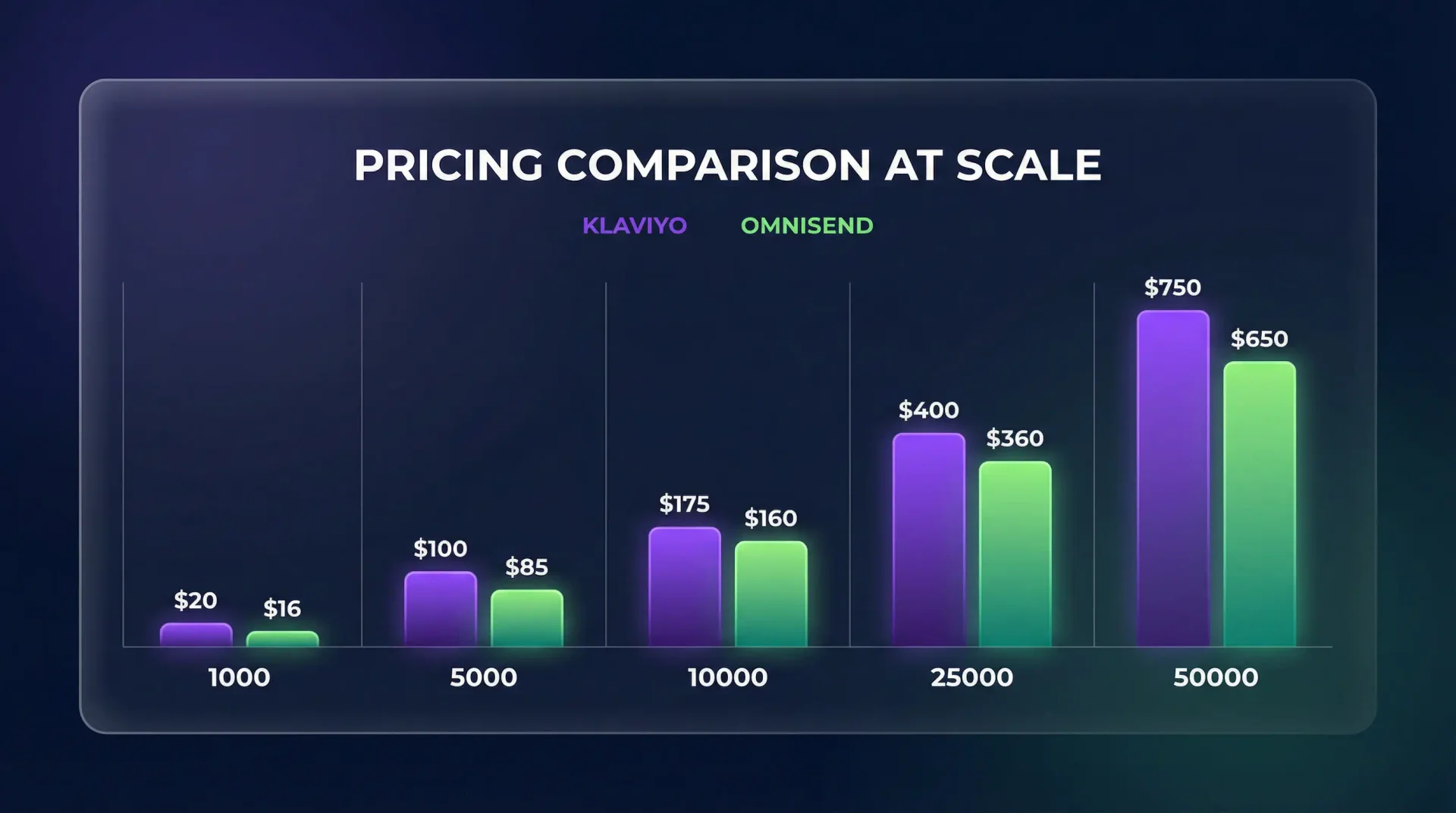
This is the section that drives the decision for most store owners. Let's use real numbers, not the starter-tier bait that most comparison articles lean on.
Side-by-Side Pricing at Scale
| Contacts | Klaviyo Email | Klaviyo Email+SMS | Omnisend Standard | Omnisend Pro | Standard Savings vs Klaviyo Email |
|---|---|---|---|---|---|
| 250 | Free | Free | Free | Free | — |
| 1,000 | $30/mo | $45/mo | $20/mo | $59/mo | 33% ($10/mo) |
| 5,000 | $100/mo | $115/mo | $81/mo | $90/mo | 19% ($19/mo) |
| 10,000 | $150/mo | $165/mo | $132/mo | $150/mo | 12% ($18/mo) |
| 25,000 | ~$400/mo | ~$475/mo | ~$270/mo | ~$390/mo | ~33% (~$130/mo) |
| 50,000 | $720/mo | $735/mo | $413/mo | $715/mo | 43% ($307/mo) |
Pricing verified February 2026 via Klaviyo and Omnisend pricing pages.
Let's make those savings tangible. At 25,000 contacts, choosing Omnisend Standard over Klaviyo Email saves you roughly $1,560 per year. At 50,000 contacts, that gap widens to $3,684 per year.
That's not pocket change. That's a freelance designer, a quarter's worth of Meta ads, or the retainer for an email marketing specialist.
Free Tier Comparison
Both platforms offer a free plan at 250 contacts and 500 emails/month. But they're not equal:
- Klaviyo Free: Email campaigns, basic automations, 150 SMS credits, email support (first 60 days only), basic reporting
- Omnisend Free: Email campaigns, automations, 500 web push notifications, $1 SMS credit, unlimited segments, 24/7 live chat support, all AI features
Omnisend's free tier is meaningfully more generous, especially the 24/7 support and unlimited segments.
SMS Credits: The Hidden Cost
This is where pricing gets tricky. Klaviyo charges separately for SMS on its Email+SMS plan. Omnisend Pro bundles SMS credits equal to your monthly plan cost. A $90/month Pro plan includes $90 in SMS credits.
⚠️ Important: Omnisend SMS credits expire after 60 days. If you're not sending enough texts to burn through them, you're effectively paying for credits you won't use. Factor this into your Pro plan math.
💰 Real-World Example: A Shopify store with 10,000 contacts sending 4 email campaigns/month plus a basic abandoned cart SMS flow might spend $150/mo on Klaviyo Email or $132/mo on Omnisend Standard. Annual difference: $216. Not life-changing at this tier, but scale to 25K contacts and the math shifts dramatically.
Our Take: Omnisend wins on pricing at every tier. The gap is modest at 10K contacts but becomes significant above 25K. That said, pricing alone shouldn't drive this decision. A platform that generates 10% more revenue per email can easily justify a 30% premium. Read on before you switch based on sticker price alone.
Shopify Integration: The Elephant in the Room
This is where our Shopify agency perspective gives us an angle nobody else has. We build and maintain Shopify stores for a living, so we see how these integrations work under the hood, not just in marketing dashboards.
Shopify Owns a Stake in Klaviyo
Shopify invested in Klaviyo before its 2023 IPO and remains a strategic partner. That matters. It means Klaviyo gets earlier access to Shopify's APIs, deeper checkout integration, and priority in Shopify's ecosystem roadmap.
In practice, Klaviyo tracks 40+ Shopify event types, including every product view, collection browse, checkout step, and order update. Omnisend tracks fewer events. For most stores, this doesn't matter. For stores running sophisticated browse abandonment flows and predictive modeling, it does.
Shopify Flow Compatibility
Both platforms integrate with Shopify Flow, but Klaviyo's integration is deeper. You can trigger Klaviyo flows from virtually any Shopify Flow connector, pass custom properties between systems, and build workflows that bridge your Shopify operations and your email marketing.
Omnisend's Shopify Flow integration works for the standard use cases (tagging customers, triggering basic flows) but it doesn't match Klaviyo's breadth.
Shopify Markets (Multi-Currency, Multi-Language)
If you sell internationally, this matters a lot. Klaviyo recently launched native Shopify Markets support, automatically pulling in localized product data, prices, and currencies so your emails display the right information for each market. Omnisend handles multi-currency but with more manual configuration.
Shopify POS and Checkout Extensibility
Klaviyo connects with Shopify POS for unified online/offline customer profiles. Both platforms work with Shopify's checkout, but Klaviyo's deeper event tracking gives it an edge for post-checkout personalization.
Headless / Hydrogen
If you're on Shopify's Hydrogen framework (headless), both platforms work via API, but neither offers a plug-and-play headless integration. You'll need developer work regardless. Klaviyo's API is more mature and better documented for headless setups.
Our Take: Klaviyo has the deeper Shopify integration. Full stop. But Omnisend covers the 90% of Shopify events that actually drive email revenue. Unless you're running a Shopify Plus store with complex international selling, custom checkout flows, or headless architecture, you won't hit Omnisend's limits. For a standard Shopify store, the integration difference is academic.
Email Builder & Templates
Both platforms give you a drag-and-drop email builder with product blocks that pull directly from your Shopify catalog. Here's where they differ.
Template Library
Klaviyo offers 100+ email templates (some sources cite up to 400 including community templates). Omnisend provides 250+ pre-designed templates. Quantity aside, both libraries cover the standard ecommerce templates you need: product launches, sales, newsletters, seasonal campaigns.
In our experience, the template quality is comparable. Neither will win a design award out of the box, and you'll still want to customize.
Builder Experience
Omnisend's builder is slightly more intuitive for non-technical users. Drag-and-drop is genuinely drag-and-drop, with fewer settings menus and less cognitive load. Klaviyo's builder is more powerful but has a steeper learning curve, with more options tucked behind menus and toggles.
Product Recommendation Blocks
Both platforms let you insert dynamic product recommendations based on browsing and purchase history. Klaviyo's recommendations are powered by its predictive engine and can factor in predicted CLV, purchase probability, and browsing patterns. Omnisend's product recommendations are solid but simpler, relying on purchase and browse history without the predictive layer.
Dynamic Content
Klaviyo supports deeper dynamic content. You can show or hide blocks based on segment membership, profile properties, or catalog data. You can create a single email that renders differently for VIP customers vs first-time buyers vs lapsed customers. Omnisend has conditional content blocks but with fewer variables to work with.
Mobile Responsiveness
Both builders produce responsive emails that render well on mobile. We've tested both across Gmail, Apple Mail, Outlook, and Yahoo on mobile and desktop with no significant rendering issues. Omnisend's templates tend to be slightly more "mobile-first" in their default layouts, while Klaviyo gives you more control to tweak the mobile rendering.
Our Take: For most stores sending weekly campaigns and standard automated emails, both builders get the job done. If you have a designer or email specialist who wants granular control, Klaviyo's builder offers more room to work. If you need to get a good-looking email out the door in 20 minutes with no design help, Omnisend is faster.
Automation & Flows: Where the Real Differences Live
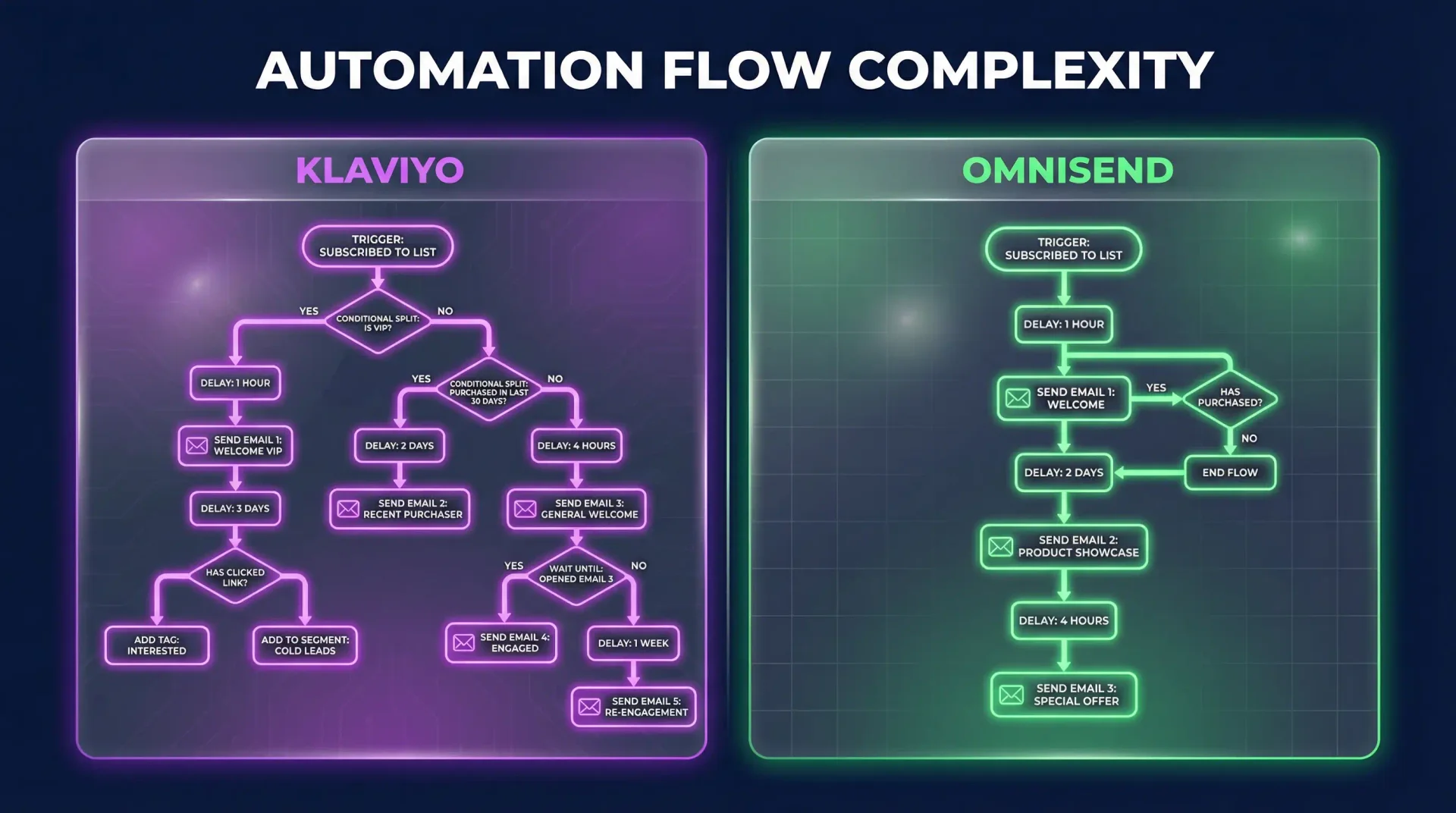
This is the most important technical section in this comparison. Automations (Klaviyo calls them "flows," Omnisend calls them "automations") are where your email marketing makes money while you sleep. The platform differences here matter more than almost anything else.
Pre-Built Automation Templates
Both platforms offer 25+ pre-built automation templates covering the ecommerce essentials: welcome series, abandoned cart, browse abandonment, post-purchase, winback, sunset, and more. You can launch a complete email program from templates in either platform.
Flow Builder Comparison
Klaviyo's flow builder is a visual canvas where you drag and connect triggers, conditions, delays, splits, and actions. It supports deep nesting. You can build a 15-step flow with multiple conditional branches, A/B tests at each stage, and time-based splits. The learning curve is real, but the ceiling is very high.
Omnisend's automation builder is cleaner and more streamlined. You get triggers, delays, conditions, and splits, but the branching depth is more limited. You can build sophisticated automations, but you'll hit the walls sooner than in Klaviyo.
Where Each Excels, Flow by Flow
| Flow Type | Klaviyo | Omnisend | Notes |
|---|---|---|---|
| Welcome Series | ✅ Excellent | ✅ Excellent | Both handle this well. Near-identical capability. |
| Abandoned Cart | ✅ More trigger options | ✅ Solid | Klaviyo tracks more checkout events; Omnisend also uses cookie-based cart tracking. |
| Browse Abandonment | ✅ Deeper tracking | ⚠️ Good, less granular | Klaviyo's 40+ event types give it an edge here. |
| Post-Purchase | ✅ Excellent | ✅ Excellent | Tie. Both can branch by product, order value, customer history. |
| Winback | ✅ Predictive churn scoring | ⚠️ Time-based only | Klaviyo's predicted churn date is a genuine differentiator. |
| Sunset / Re-engagement | ✅ Good | ✅ Good | Both handle this. Klaviyo can use engagement scoring. |
| Cross-sell / Upsell | ✅ AI-powered recommendations | ⚠️ Manual product selection | Klaviyo's product recommendations within flows are smarter. |
A/B Testing Within Flows
This is a meaningful gap. Klaviyo lets you A/B test virtually anything inside a flow: subject lines, content, send time, entire email variants, even flow paths. Omnisend's A/B testing is limited to subject lines and sender names for campaigns. You can't A/B test content or flow paths within automations.
For stores optimizing their flows to squeeze out every percentage point of conversion, this matters.
Concrete Example: Post-Purchase Flow
In Klaviyo, you might build a post-purchase flow that:
- Sends a thank-you email immediately
- Waits 3 days, then checks if the customer left a review
- If no review → send review request (A/B testing two subject lines)
- Waits 14 days, checks predicted next order date
- If approaching predicted order date → send replenishment reminder with personalized product recommendations
- If not approaching → wait, then send a cross-sell based on what similar customers bought
In Omnisend, you'd build a similar flow but without predictive timing or AI-powered product picks:
- Thank-you email immediately
- Wait 3 days → review request
- Wait 14 days → cross-sell email with manually selected products
- Wait 30 days → check purchase status, branch accordingly
Both are effective. Klaviyo's version is smarter and more personalized. Omnisend's version takes 20 minutes to set up and still drives revenue.
Our Take: Klaviyo wins for complex, data-driven flows. If you have an email specialist building and optimizing multi-branch automations with A/B tests at every stage, Klaviyo gives them room to work. If you want good-enough flows running in 20 minutes that still generate 80% of the revenue, Omnisend delivers. For most stores under $100K/month, Omnisend's automation depth is more than sufficient.
Segmentation & Data
Segmentation is where Klaviyo's premium price starts to justify itself, at least for stores sophisticated enough to use it.
Klaviyo's Segmentation
Klaviyo treats itself as a B2C CRM now, not just an email tool. Its segmentation engine includes:
- Predictive analytics: Predicted customer lifetime value (CLV), predicted next order date, churn risk score, predicted gender, predicted spending tier
- RFM analysis: Recency, frequency, monetary segmentation built in
- Custom properties: Unlimited custom fields from Shopify, quizzes, reviews, support tickets, and anything you can pass via API
- Real-time updates: Segments recalculate continuously, not on a batch schedule
- Behavioral depth: Segment by email engagement, website browsing, purchase patterns, predicted behaviors
You can build a segment like: "Customers who spent $200+ in the last 90 days, haven't purchased in 30 days, have a predicted churn risk above 50%, and browsed the new arrivals collection in the last week." That's powerful.
Omnisend's Segmentation
Omnisend offers 30+ pre-built segments (compared to Klaviyo's 7 pre-built ones) covering common ecommerce scenarios: recent buyers, at-risk customers, high spenders, inactive subscribers, and more. These pre-built segments are genuinely useful and save setup time.
Omnisend's custom segment builder handles the basics well: purchase history, email engagement, campaign activity, and contact properties. It recently added an AI segment builder that creates segments from natural language prompts.
But Omnisend doesn't have predictive CLV, churn scoring, or RFM analysis. Its segmentation ceiling is lower.
When Advanced Segmentation Actually Matters
Here's the honest truth: most Shopify stores don't need predictive CLV segmentation. If your most complex segment is "purchased in the last 30 days but hasn't purchased in the last 60 days," Omnisend handles that without breaking a sweat.
Advanced segmentation matters when:
- You have 25,000+ contacts and need to differentiate messaging at scale
- You're sending 8+ campaigns per month and need precise targeting to avoid fatigue
- You have a dedicated person analyzing data and building segments weekly
- Your product catalog is complex (many SKUs, multiple categories, varying price points)
If none of those describe you, Omnisend's segmentation is more than enough. If all of them describe you, Klaviyo's depth justifies the premium.
Our Take: If you're segmenting by more than 3-4 criteria and your strategy depends on predictive analytics, Klaviyo is the clear choice. If "purchased in last 30 days" and "email openers in last 90 days" are your most complex segments, Omnisend has you covered, and its 30+ pre-built segments will save you the setup time.
SMS & Omnichannel
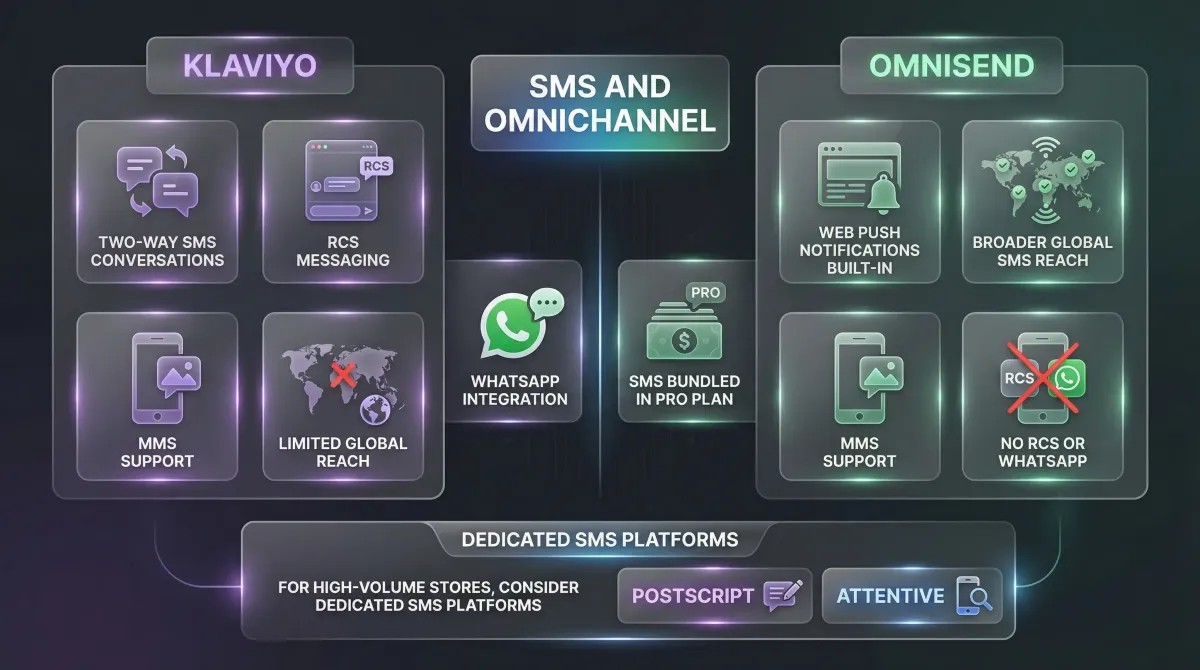
SMS is the second channel every Shopify store eventually considers. Here's how these platforms compare, and when neither is the right choice.
SMS Capabilities
| Feature | Klaviyo | Omnisend |
|---|---|---|
| Two-way SMS | ✅ Native (US, CA, UK, AUS) | ⚠️ Requires Gorgias integration |
| Global reach | ⚠️ Limited to select countries | ✅ Broader international support |
| SMS in automations | ✅ Fully integrated | ✅ Fully integrated |
| Compliance tools | ✅ Smart opt-in, quiet hours | ✅ Built-in compliance |
| RCS messaging | ✅ Rolling out | ❌ Not available |
| ✅ Available | ❌ Not available | |
| MMS | ✅ Full support | ✅ Full support |
SMS Pricing
Klaviyo charges per SMS credit on top of your email plan. Omnisend Pro bundles SMS credits equal to your plan cost, which sounds generous until you remember those credits expire after 60 days.
For stores sending moderate SMS volume (under 5,000 texts/month), Omnisend Pro's bundled credits offer better value. For high-volume SMS senders, Klaviyo's per-credit pricing may work out more predictably.
Web Push Notifications
Omnisend includes native web push notifications, a low-cost way to reach subscribers who haven't opted into email or SMS. Klaviyo doesn't offer native web push. This is a genuine differentiator for Omnisend, especially for stores looking to build an omnichannel presence without additional tools.
When to Use a Dedicated SMS Platform
Neither Klaviyo nor Omnisend is a dedicated SMS marketing platform. If SMS is a major revenue channel for your store (doing $200K+/month and sending 20,000+ texts monthly), consider a specialist like Postscript or Attentive and pair it with whichever email platform fits.
SMS is too important at scale to treat as an add-on feature inside your email tool.
Our Take: Omnisend wins for simple SMS alongside email, especially with built-in web push and broader global reach. Klaviyo wins for sophisticated SMS as a standalone channel, with native two-way conversations and upcoming RCS/WhatsApp support. Neither replaces a dedicated SMS platform for high-volume stores. For most stores under $100K/month, Omnisend's omnichannel features hit the sweet spot.
Analytics & Reporting
Dashboards
Klaviyo's dashboard is a full analytics suite. Revenue attribution, campaign performance, flow performance, deliverability metrics, cohort analysis, benchmark comparisons. It's all there, and it's detailed. You can build custom reports, track trends over time, and drill into individual campaign or flow performance.
Omnisend's dashboard covers the essentials: campaign metrics, automation performance, revenue attribution, list growth. It's clean and easy to read but less granular. You get the numbers you need for daily decision-making but not the depth for quarterly strategic reviews.
Predictive Analytics: Klaviyo's Big Differentiator
This is where Klaviyo pulls ahead decisively:
- Predicted CLV: Know which customers are likely to be high-value before they prove it
- Predicted next order date: Time your outreach to when customers are ready to buy again
- Churn risk scoring: Identify at-risk customers before they're gone
- Predicted spending tier: Segment by future potential, not just past behavior
Omnisend doesn't have predictive analytics. Period. If you're making strategic decisions based on customer lifetime value modeling and churn prevention, Klaviyo is the only option between these two.
Revenue Attribution
Both platforms attribute revenue to campaigns and flows. A word of caution: every email platform over-attributes. They all want credit for sales. Use your email platform's attribution for relative comparisons (Campaign A vs Campaign B), but rely on Google Analytics or your Shopify reports for absolute revenue numbers.
Our Take: Klaviyo is the clear winner for analytics. If you're making decisions based on predictive analytics (which customers to invest in, when to send, what to offer), there's no contest. If you just need to know which campaigns are working and which aren't, Omnisend's reporting handles it.
Customer Support: The Underrated Factor
Don't skip this section. For store owners without a dedicated email marketing specialist, support quality can be the difference between a platform that works and a platform that collects dust.
Support Comparison
| Feature | Klaviyo | Omnisend |
|---|---|---|
| Live Chat | 24/5 (weekdays only) | ✅ 24/7 (all paid plans + free) |
| Email Support | ✅ All plans (first 60 days on free) | ✅ All plans |
| Phone Support | Enterprise only | ❌ |
| Free Migration Help | ❌ | ✅ Free migration from Klaviyo |
| Onboarding | Self-service + Klaviyo Academy | Guided onboarding |
| Community | Klaviyo Community + Academy | Knowledge base |
| Shopify App Rating | 4.5 ⭐ | 4.7 ⭐ |
The numbers tell the story. Omnisend offers 24/7 live chat support on every plan, including the free tier. Klaviyo limits live chat to weekdays and restricts email support on the free plan to your first 60 days.
Why This Matters More Than You Think
If you're a solo founder or a small team managing email marketing yourself, you will get stuck. A flow won't trigger. A segment won't populate. An email will render weirdly on mobile. When that happens at 10 PM on a Saturday, Omnisend will answer. Klaviyo won't.
Omnisend also offers free migration assistance from Klaviyo. They'll help move your contacts, templates, and basic automations. It's not a full migration since your complex flows will need rebuilding, but it reduces the switching friction.
Our Take: Omnisend's support is significantly better. For stores without a dedicated email specialist, this matters more than most feature comparisons. Klaviyo Academy is excellent for learning, but when you need help right now, Omnisend delivers.
Deliverability: What Nobody Talks About
Most "Klaviyo vs Omnisend" articles either skip deliverability entirely or say "both are good" and move on. That's not good enough. Deliverability determines whether your carefully crafted emails actually reach inboxes.
Shared vs Dedicated IPs
Both platforms use shared IP pools for most customers. This means your deliverability is partially tied to the sending behavior of other users on your shared IP. At enterprise tiers, both offer dedicated IPs that give you full control but require consistent volume to maintain a good sender reputation.
Klaviyo generally has higher sending volume across its IP pools, which can be a double-edged sword. More volume means more data for IP reputation, but it also means more risk from bad actors sharing your pool.
Domain Authentication
Both platforms require SPF, DKIM, and DMARC setup for proper authentication. The process is nearly identical: add DNS records to your domain, verify in the platform. Neither makes this significantly easier or harder than the other.
One important note for Shopify stores: your transactional emails (order confirmations, shipping notifications) are sent by Shopify, not your email marketing platform. Make sure your domain authentication is set up for both your marketing platform AND Shopify to avoid conflicts.
What the Community Says
In Reddit threads and ecommerce forums, the sentiment is mixed but revealing. Several users report fewer deliverability issues and outages with Omnisend compared to Klaviyo. Others note that Klaviyo's deliverability has improved significantly since its IPO as the company invested in infrastructure.
Neither platform has a clear deliverability advantage based on available third-party testing data from EmailToolTester. Both land in the "good" tier, above Mailchimp and Brevo and on par with ActiveCampaign.
IP Warm-Up and Sending Reputation
If you're starting fresh on either platform (or migrating), you'll need to warm up your sending reputation. Both platforms handle this through their shared IP pools, but the process matters:
- Start with your most engaged segment. Send to recent openers/clickers first
- Gradually increase volume over 2-4 weeks
- Monitor bounce rates and spam complaints closely during warm-up
- Don't blast your entire list on day one. That's the fastest way to land in spam
Klaviyo provides more detailed deliverability reporting to help you manage this process. Omnisend's reporting is more basic but sufficient.
Promotional Tab Avoidance
Neither platform can guarantee inbox placement over the Gmail promotions tab. Your content, sending frequency, and recipient engagement matter more than your platform choice. The best strategies (clean lists, strong engagement, relevant content, proper authentication) work equally well on both platforms.
Our Take: Deliverability is roughly comparable between the two. Neither has a decisive advantage. Focus on list hygiene, authentication, and engagement. Those matter more than platform choice. If you're running a high-volume store (100K+ contacts), consider requesting a dedicated IP from whichever platform you choose.
Total Cost of Ownership: Beyond the Sticker Price
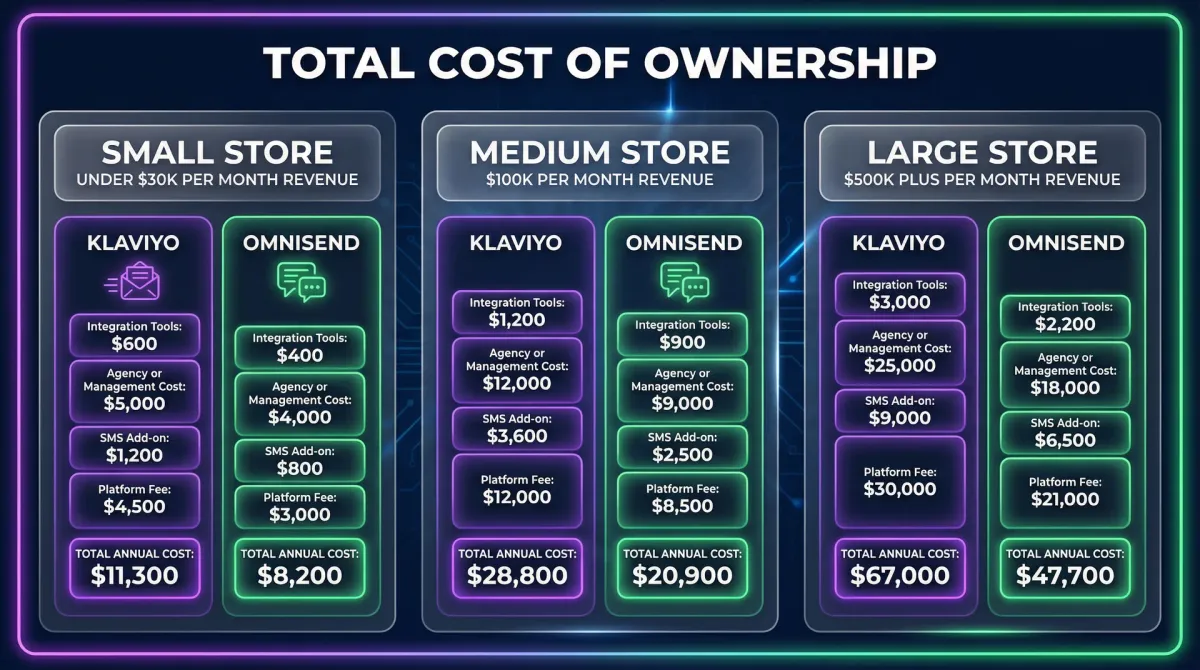
This is the section that changes minds. Sticker price is just the beginning.
TCO at Three Store Sizes
Scenario 1: Small Store ($30K/month revenue, solo founder, 5,000 contacts)
| Cost Factor | Klaviyo | Omnisend |
|---|---|---|
| Platform (email only) | $100/mo | $81/mo |
| Learning curve time | 15-20 hours | 8-10 hours |
| Additional tools needed | None | None |
| Agency needed? | Probably not | No |
| Annual platform cost | $1,200 | $972 |
At this level, the difference is $228/year. Not a significant factor. Choose based on which interface you prefer.
Scenario 2: Growing Store ($100K/month revenue, small marketing team, 15,000 contacts)
| Cost Factor | Klaviyo | Omnisend |
|---|---|---|
| Platform (email) | ~$250/mo | ~$180/mo |
| SMS add-on | ~$50/mo | Included in Pro (~$220/mo total) |
| Agency/specialist | Likely needed (~$1,500/mo) | Possibly self-managed |
| Additional tools | None | Maybe Postscript for SMS at scale |
| Annual total (platform only) | ~$3,600 | ~$2,640 |
| Annual total (with agency) | ~$21,600 | ~$2,640 - $5,000 |
Here's where it gets real. Klaviyo's advanced features often require a specialist or agency to use effectively. A $100K/month store might spend $250/mo on Klaviyo but $1,500-$3,000/mo on the agency managing it. Omnisend at $220/mo might be self-managed by your in-house marketer, no agency required.
Scenario 3: Scaling Store ($500K+/month revenue, dedicated email specialist, 50,000 contacts)
| Cost Factor | Klaviyo | Omnisend |
|---|---|---|
| Platform (email + SMS) | $735/mo | $715/mo (Pro) |
| In-house specialist | Already have one | Already have one |
| Revenue from advanced features | Predictive analytics → est. 5-10% more email revenue | N/A |
| Annual platform cost | $8,820 | $8,580 |
At this level, the platform cost difference is negligible ($240/year). But Klaviyo's predictive analytics and deeper segmentation can translate to meaningfully higher email revenue. If your email channel generates $150K/year and Klaviyo's features improve that by even 5%, that's $7,500 in additional revenue, far exceeding the price premium.
💰 Real-World Callout: The cheapest platform isn't always the cheapest solution. A $100K/month store paying $250/mo for Klaviyo plus $2,000/mo for an agency to manage it has a $27,000/year email marketing cost. That same store on Omnisend at $180/mo, self-managed, spends $2,160/year. That's a 12x difference, and it has nothing to do with the platform price.
Our Take: Factor in your team's capabilities, not just the subscription. If you can self-manage Omnisend but would need an agency for Klaviyo, the "cheaper" platform might actually be Omnisend by a wide margin. If you already have an email specialist on your team, the cost difference between platforms is minor. Choose based on features.
Migration Reality Check
Thinking about switching from one to the other? Here's what actually happens.
What Transfers
- ✅ Contact lists and profile data
- ✅ Segment definitions (basic ones)
- ✅ Historical purchase data (via Shopify sync)
- ✅ Template designs (exported/re-imported, with effort)
What Doesn't Transfer
- ❌ Automations and flows (must be rebuilt from scratch)
- ❌ Email engagement history (opens, clicks). Gone
- ❌ A/B test data and learnings. Gone
- ❌ Custom integrations (need reconfiguration)
- ❌ Sender reputation (starts fresh on new platform's IPs)
That last point matters. Your email engagement history (who opens, who clicks, who ignores) is gold for segmentation and deliverability. When you migrate, you lose that context. Your new platform doesn't know which subscribers are engaged and which are dead weight.
Timeline
Budget 4-8 weeks for a proper migration. This isn't a weekend project. You need to:
- Export contacts and data
- Set up the new platform and connect Shopify
- Configure domain authentication (SPF, DKIM, DMARC)
- Rebuild your core automations (welcome, abandoned cart, post-purchase at minimum)
- Re-create your key segments
- Warm up your new sending IP (start with small, engaged segments)
- Run both platforms in parallel for 2-4 weeks
- Cut over completely
Revenue Impact During Transition
Expect a dip. When you warm up a new sending IP and rebuild flows, your email revenue will temporarily decrease. We've seen clients lose 15-30% of their email-attributed revenue for 4-6 weeks during migration. It recovers, but budget for it.
Omnisend's Free Migration Service
Omnisend offers free migration assistance from Klaviyo. They'll import your contacts and help set up basic templates. But they won't rebuild your complex flows or custom segments. That's on you or your agency.
When Migration Is NOT Worth It
Don't switch if:
- You're planning to stay on the new platform for less than 12 months (switching cost exceeds savings)
- You rely heavily on Klaviyo's predictive analytics and nothing else fills that gap
- Your email program is generating strong ROI on the current platform and you're switching to save $50/month
- You're in a peak selling season (never migrate in Q4)
- Your team just finished setting up complex flows. Don't throw away that work for marginal savings
💡 Pro Tip: If you're on Klaviyo and considering a switch to save money, do the math first. Take your current monthly Klaviyo bill, multiply by 12. Compare that to Omnisend's annual cost at your contact tier. Then subtract the estimated migration cost (your time × your hourly rate, plus 4-6 weeks of reduced email revenue). If the net savings aren't at least $2,000-$3,000 in the first year, the juice isn't worth the squeeze.
Our Take: Migration is painful, expensive, and temporarily hurts your revenue. If you're staying less than 12 months, the switching cost probably outweighs the savings. But if the long-term fit is clearly better on the other platform, rip the bandaid off. Just plan it properly and don't do it during Black Friday.
The Decision Framework: Which One Is Right for YOUR Store?
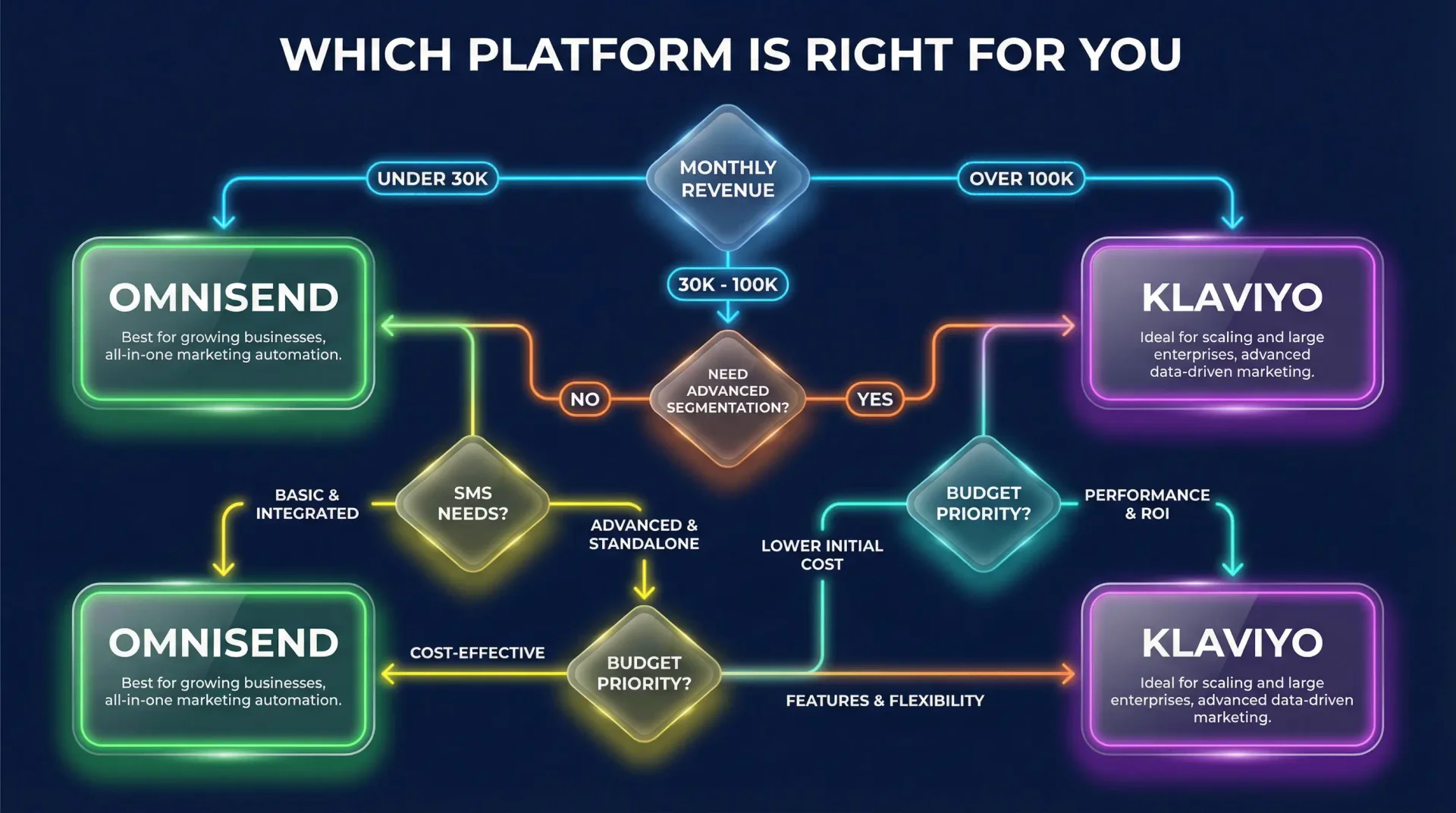
Find your situation below.
"I'm a solo founder with under 5K contacts and less than $30K/month."
→ Start with Shopify Email. It's free for 10,000 sends/month and covers the basics. When you need real automation and SMS, upgrade to Omnisend Standard. You'll save money and learn the fundamentals without getting overwhelmed by features you don't need yet.
"I'm doing $30K–$100K/month with a small team."
→ Omnisend. You get 80% of Klaviyo's power at a fraction of the cost, with better support and faster onboarding. Put the savings toward better creative, more campaigns, or your first SMS strategy. You can always move to Klaviyo later if you outgrow it.
"I'm doing $100K+/month with a marketing team or agency."
→ Klaviyo. The predictive analytics, deeper segmentation, Shopify integration depth, and flow-level A/B testing justify the premium. You have the team to use these features, so make sure they actually do.
"I'm on Klaviyo and my bill is killing me."
→ Switch to Omnisend if you're under $100K/month AND you don't heavily use predictive analytics, complex conditional flows, or deep A/B testing. Otherwise, negotiate with Klaviyo. They'd rather discount than lose you. Seriously. Call their sales team and tell them you're considering Omnisend. You'll be surprised what they'll offer.
"I'm on Omnisend and wondering if I should upgrade to Klaviyo."
→ Stay on Omnisend until you hit $100K+/month AND you find yourself limited by segmentation depth or analytics. If you're growing and profitable on Omnisend, there's no rush. The migration cost isn't worth it for marginal feature gains. Read our Klaviyo alternatives guide for more context.
"I need advanced SMS alongside email."
→ If SMS is a primary revenue driver (not just abandoned cart texts), consider a dedicated SMS platform like Postscript or Attentive and pair it with whichever email platform fits your needs. SMS is too important at scale to treat as an add-on feature.
"I run multiple Shopify stores."
→ Klaviyo handles multi-store management better. Omnisend supports multiple stores but the experience is less polished. If you're running 3+ stores, Klaviyo's centralized account management is worth the premium.
2026 Updates: What's New
Both platforms have evolved significantly. Here's what matters for your decision today.
Klaviyo's B2C CRM Pivot
Klaviyo isn't just an email platform anymore. It's positioning itself as a full B2C CRM with:
- Customer Hub: A self-service portal where your customers can manage orders, track shipments, and reorder, built right into your Shopify store
- AI Marketing Agent: AI-generated campaign concepts and content
- Helpdesk: Basic customer support ticketing integrated with your marketing data
- Reviews: Native review collection (competing with Yotpo, Judge.me)
- Social Auto-replies: Turn Instagram engagement into email/SMS subscribers
- RCS & WhatsApp messaging: Expanding beyond traditional SMS
- Personalized send time: AI-optimized delivery timing per subscriber
Is this exciting or concerning? Honestly, both. If you need a unified platform for marketing + customer data + basic support, Klaviyo is building something genuinely compelling. If you just need great email marketing, the expanding scope risks bloat and complexity.
Omnisend's Latest
Omnisend has stayed more focused, adding:
- AI segment builder: Create segments from natural language prompts
- Improved automation templates: More pre-built workflows for ecommerce scenarios
- Enhanced reporting: Better campaign and automation analytics
- Continued focus on ease of use: Maintaining the "set up in 20 minutes" promise
Omnisend's strategy is clear: stay laser-focused on ecommerce email + SMS + push, keep it easy, keep it affordable. No CRM ambitions. No helpdesk. Just marketing.
Our Take: Klaviyo is becoming a full CRM. That's exciting if you need it, expensive if you don't. Omnisend is staying focused on doing the core email/SMS job well. If you want an all-in-one platform and are willing to invest in learning it, Klaviyo's trajectory is compelling. If you want a marketing tool that does one thing excellently without scope creep, Omnisend's focus is a feature, not a limitation.
FAQ
Is Omnisend really cheaper than Klaviyo?
Yes, at every contact tier. The gap is smallest at lower tiers (around 12-19% cheaper at 5-10K contacts) and largest at scale (up to 43% cheaper at 50K contacts on the Standard plan). At 25K contacts, Omnisend Standard saves you roughly $1,560/year compared to Klaviyo Email.
Can I migrate from Klaviyo to Omnisend easily?
"Easily" is generous. Omnisend offers free migration assistance that covers contacts and basic setup. But your automations, flows, engagement history, and custom segments won't transfer. They need to be rebuilt. Budget 4-8 weeks and expect a temporary revenue dip. We cover migration in detail above.
Which has better deliverability?
Neither has a clear advantage based on third-party testing. Both use shared IP pools for standard plans and offer dedicated IPs at higher tiers. Community sentiment is split. Your deliverability depends more on your list hygiene, engagement, and authentication setup than on your platform choice.
Does Omnisend work with Shopify Plus?
Yes. Omnisend integrates with Shopify Plus and supports Script Editor compatibility, multi-currency, and the advanced features Plus offers. However, Klaviyo's integration with Shopify Plus is deeper, particularly around checkout extensibility and Shopify Flow.
Is Klaviyo worth the extra cost?
It depends on your revenue stage. Under $100K/month without a dedicated email specialist? Probably not. You'll pay more for features you can't fully leverage. Over $100K/month with a marketing team? Yes. The predictive analytics, segmentation depth, and A/B testing can generate enough incremental revenue to justify the premium several times over.
Can I use both Klaviyo and Omnisend?
Technically yes, but don't. Running two email platforms on the same Shopify store creates deliverability issues, duplicate contacts, conflicting automations, and confused reporting. Pick one.
Which is better for SMS marketing?
Klaviyo for sophisticated, two-way SMS with native conversations and expanding into RCS/WhatsApp. Omnisend for simple SMS alongside email with broader global reach. Neither replaces a dedicated SMS platform (Postscript, Attentive) for stores where SMS is a primary revenue channel. We compared both in our Omnisend vs Mailchimp guide as well.
What about Mailchimp vs Klaviyo vs Omnisend?
Mailchimp has largely fallen out of favor for serious Shopify stores. Its ecommerce features lag behind both Klaviyo and Omnisend, its pricing isn't competitive for the value delivered, and its Shopify integration was rocky for years. If you're choosing between these three for a Shopify store, it's really a two-horse race. We break this down further in our Klaviyo alternatives guide.
Final Verdict
After implementing both platforms for dozens of Shopify stores, here's the honest summary:
Klaviyo is the more powerful platform. Its predictive analytics, segmentation depth, Shopify integration, and flow-level A/B testing are genuinely best-in-class. If you have the team, the budget, and the revenue to justify it, Klaviyo will help you squeeze more revenue from your email channel than any alternative.
Omnisend is the smarter choice for most Shopify stores. It covers 80-90% of what Klaviyo does at a meaningfully lower price, with better support, faster setup, and an easier learning curve. It won't give you predictive CLV or deep conditional flow branching, but for stores under $100K/month, those features are aspirational, not operational.
The core trade-off: power vs. value. Klaviyo is a sports car. Incredible performance if you know how to drive it, expensive to maintain. Omnisend is a well-built daily driver. Reliable, efficient, and gets you where you need to go.
Our recommendations by revenue stage:
- Under $30K/month → Shopify Email, then Omnisend when you outgrow it
- $30K–$100K/month → Omnisend Standard or Pro, the sweet spot for value
- $100K+/month with a marketing team → Klaviyo. Unlock predictive analytics and advanced segmentation
- $100K+/month without an email specialist → Still Omnisend. Klaviyo's features don't help if nobody uses them
And here's the thing worth remembering: both are excellent platforms. The "wrong" choice here still puts you ahead of 90% of Shopify stores that aren't doing email marketing seriously. The best platform is the one you'll actually set up, maintain, and optimize.
Pick one. Set up your core flows. Send consistent campaigns. Optimize over time. That matters infinitely more than the platform name on the invoice.
The email marketing landscape is evolving fast. Klaviyo is building a CRM, Omnisend is sharpening its focus, and both are adding AI features monthly. Whatever you choose today, revisit your decision annually. Your store's needs at $50K/month are different from your needs at $200K/month. The best platform is the one that grows with you, or the one you're willing to outgrow and replace when the time is right.
This comparison is maintained by Aesymmetric, a Shopify agency with no affiliate relationships with Klaviyo, Omnisend, or any email platform mentioned. Last updated February 2026. Explore more: Top Klaviyo Alternatives for Shopify · Omnisend vs Mailchimp · Shopify Email vs Klaviyo
Last updated: February 14, 2026. Pricing and features verified against official pricing pages and third-party reviews. We review and update this guide quarterly.
We love working with ambitious Shopify brands.
We can help optimize your store's conversion rate and increase sales.
We can create custom apps that integrate third-party services or add new features to your store.
We can create any theme customization you need to improve the look and feel of your brand.
Get in Touch
Written by
Alex is the founder of AESYMMETRIC, a Shopify agency specializing in conversion rate optimization, custom app development, and theme customizations. With eight years of experience in the Shopify ecosystem and e-commerce industry, he helps brands maximize sales and reduce costs through data-driven strategies and innovative technical solutions.