
Klaviyo vs Mailchimp: The Complete 2026 Comparison for Ecommerce Brands
Choosing the wrong email platform is expensive. Not just in monthly fees. The real cost is migration pain, lost automations, and months of rebuilding what you already had.
We've seen Shopify brands switch platforms three times in two years because they picked based on price alone. Each migration meant lost revenue, broken flows, and weeks of work.
Here's the thing: both Klaviyo and Mailchimp are solid platforms. They're not competing for the same customer. Klaviyo was built for ecommerce. Mailchimp was built for everyone. That difference changes everything.
This guide is for ecommerce brands trying to make a smart choice. Whether you're starting fresh or considering a switch, you'll find what you need here. We'll cover pricing, features, integrations, and the stuff that actually matters for revenue.
We're a Shopify agency. We've implemented both platforms dozens of times. We'll tell you exactly which one fits your business, and when each platform is the wrong choice.
By the end, you'll know which platform to choose. No more second-guessing.
Quick Verdict: Klaviyo vs Mailchimp at a Glance
Don't have 20 minutes? Here's the short version.
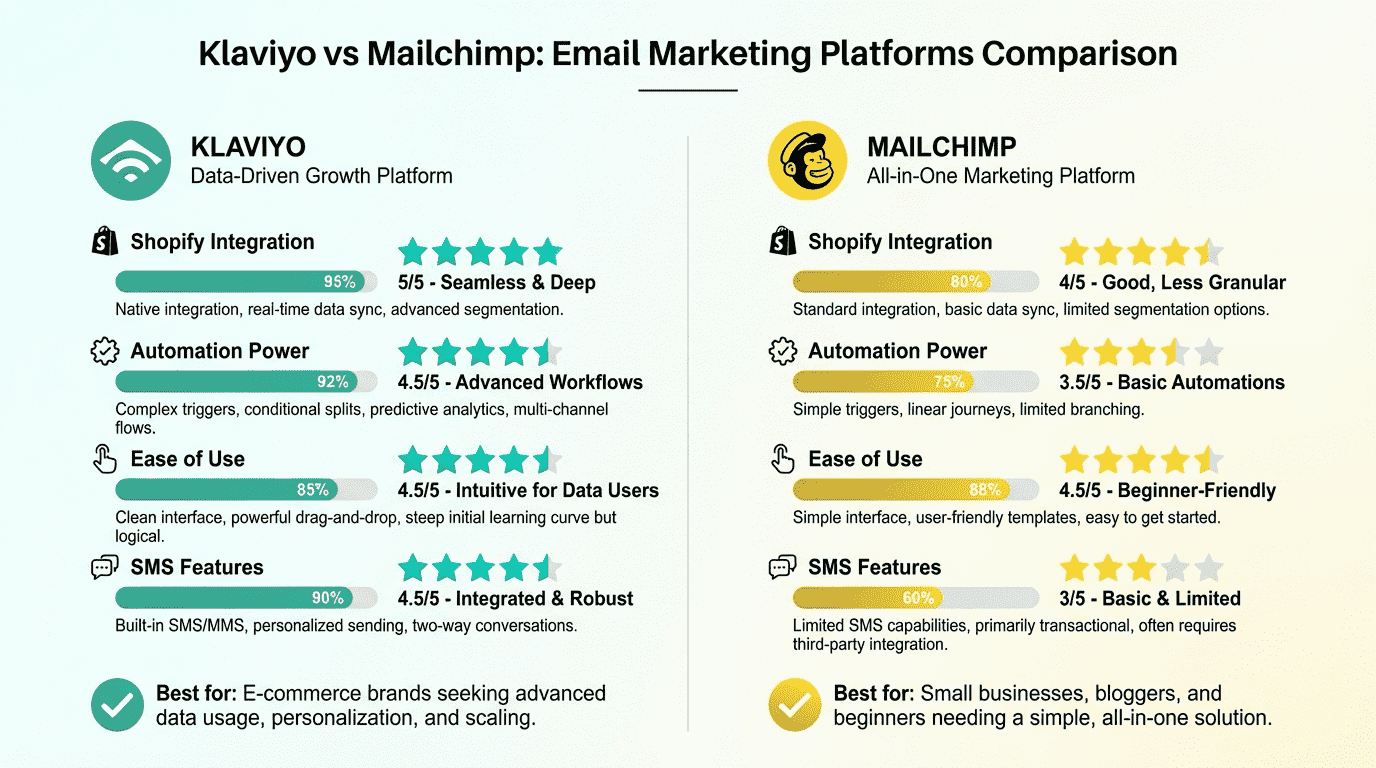
| Criteria | Klaviyo | Mailchimp |
|---|---|---|
| Best For | Ecommerce brands | General small business |
| Starting Price | $20/month (251+ contacts) | $13/month (500 contacts) |
| Shopify Integration | ⭐⭐⭐⭐⭐ Native, deep | ⭐⭐⭐ Basic sync |
| Automation Power | ⭐⭐⭐⭐⭐ Advanced | ⭐⭐⭐ Adequate |
| Ease of Use | ⭐⭐⭐ Learning curve | ⭐⭐⭐⭐⭐ Beginner-friendly |
| SMS Included | ✅ Native | ➕ Add-on ($20+) |
| Free Plan | 250 contacts | 250 contacts |
| Predictive Analytics | ✅ Built-in | ❌ Limited |
| Our Rating | 9/10 for ecommerce | 7/10 for ecommerce |
Choose Klaviyo if: You run an ecommerce store, want email to drive serious revenue, and you're willing to learn a more complex tool.
Choose Mailchimp if: You're a non-ecommerce business, just starting out, or need simple email marketing without the learning curve.
What is Klaviyo?
Klaviyo is an email and SMS marketing platform built specifically for ecommerce. Founded in 2012, it was designed from day one to help online stores turn customer data into revenue.
The platform powers over 167,000 brands as of late 2024. Those brands generated well over $50 billion in Klaviyo Attributed Value (KAV) in 2023. Big names like Glossier, Unilever, and Mattel use it.
Klaviyo's philosophy is simple: your customer data should drive your marketing. Every email, every SMS, every automation should be powered by what your customers actually do. Browse behavior. Purchase history. Predicted lifetime value. It's all there.
Who Klaviyo is Built For
- Ecommerce brands on Shopify, WooCommerce, or BigCommerce
- Stores doing $10K+ monthly revenue (or planning to)
- Teams ready to invest time learning a powerful tool
- Businesses that want email as a real revenue channel
- Brands planning to add SMS marketing
Who Klaviyo is NOT For
- Businesses sending fewer than 1,000 emails per month
- Non-ecommerce companies (consultants, bloggers, local services)
- Teams that need plug-and-play simplicity with zero learning curve
- Businesses with tiny budgets who can't justify the pricing
- Anyone who just needs basic newsletters
If you're running a serious ecommerce operation, Klaviyo was built for you. If you're not, it's probably overkill.
What is Mailchimp?
Mailchimp is the email marketing platform everyone knows. Founded in 2001, it started as a side project for a web design agency. Now it's one of the most recognized marketing tools in the world.
Over 13 million users send emails through Mailchimp. It's the default choice for small businesses because it's easy, affordable, and familiar.
In 2021, Intuit (the company behind TurboTax and QuickBooks) acquired Mailchimp for $12 billion. Since then, Mailchimp has pushed deeper into all-in-one marketing: websites, social posting, ads, and CRM features.

Who Mailchimp is Built For
- Small businesses and startups just getting started
- Content creators, bloggers, and consultants
- Teams wanting all-in-one marketing (not just email)
- Beginners who prioritize ease of use over power
- Businesses on a tight budget needing a robust free tier
Who Mailchimp is NOT For
- High-volume ecommerce stores doing $500K+ annually
- Brands needing deep Shopify data integration
- Teams who've outgrown basic segmentation
- Businesses where email drives significant revenue
- Anyone needing advanced automation flows
Mailchimp is great at being accessible. It's not great at being specialized. For ecommerce, that matters.
Pricing Comparison: The Real Costs
Pricing is where most people start. Let's break down what you'll actually pay.

Klaviyo Pricing Breakdown
Klaviyo's free tier gives you 250 contacts and 500 emails per month. That's enough to test the platform, but not much more.
Paid plans start at $20/month for 251-500 contacts. Pricing scales based on your contact list size.
| Contacts | Monthly Price |
|---|---|
| 250 | Free |
| 500 | $20 |
| 1,000 | $30 |
| 2,500 | $60 |
| 5,000 | $100 |
| 10,000 | $150 |
| 25,000 | $400 |
| 50,000 | $720 |
SMS is separate. You get 150 free SMS credits per month on paid plans. Beyond that, you pay per message: roughly $0.01-0.02 per SMS depending on volume.
Mailchimp Pricing Breakdown
Mailchimp has four tiers. The free plan gives you 250 contacts and 500 emails per month (with a daily limit of 250). Features are also heavily limited on the free tier.
| Plan | Price (500 contacts) | Key Limits |
|---|---|---|
| Free | $0 | 500 emails/month (250 daily limit), no automation |
| Essentials | $13 | 5,000 emails/month, basic automation |
| Standard | $20 | 6,000 emails/month, advanced automation |
| Premium | $350 | 150,000 emails/month, priority support |
At 10,000 contacts, Essentials jumps to $110/month. Standard hits $135/month. The pricing escalates quickly.
The Hidden Cost Trap
Here's what catches people off guard with Mailchimp:
Audience counting shenanigans. If the same contact is on three different lists, Mailchimp counts them as three contacts. Klaviyo counts unique contacts only.
Feature paywalls. Basic automation requires Essentials. Advanced automation needs Standard. Send time optimization? Premium only.
Overage charges. Go over your email limit and Mailchimp charges extra. These fees add up fast if you're running campaigns.
URL redirects. On free and low-tier plans, Mailchimp adds tracking redirects to your links. Some email providers flag these, hurting deliverability.
1-Year Total Cost Comparison
Let's look at realistic annual costs including typical usage:
| Contact Count | Klaviyo (Annual) | Mailchimp Standard (Annual) |
|---|---|---|
| 1,000 | $360 | $312 |
| 5,000 | $1,200 | $1,200 |
| 10,000 | $1,800 | $1,620 |
| 25,000 | $4,800 | $3,240 |
| 50,000 | $8,640 | $5,400 |
At lower volumes, pricing is nearly identical. At higher volumes, Mailchimp is significantly cheaper on paper. But factor in the revenue Klaviyo generates through better automation and segmentation, and the math can flip. We've seen Klaviyo pay for itself within 60 days for most ecommerce brands through improved conversion rates.
Shopify Integration: The Critical Difference
This is where Klaviyo pulls ahead. If you're on Shopify, this section alone might decide your choice.
Klaviyo + Shopify Integration
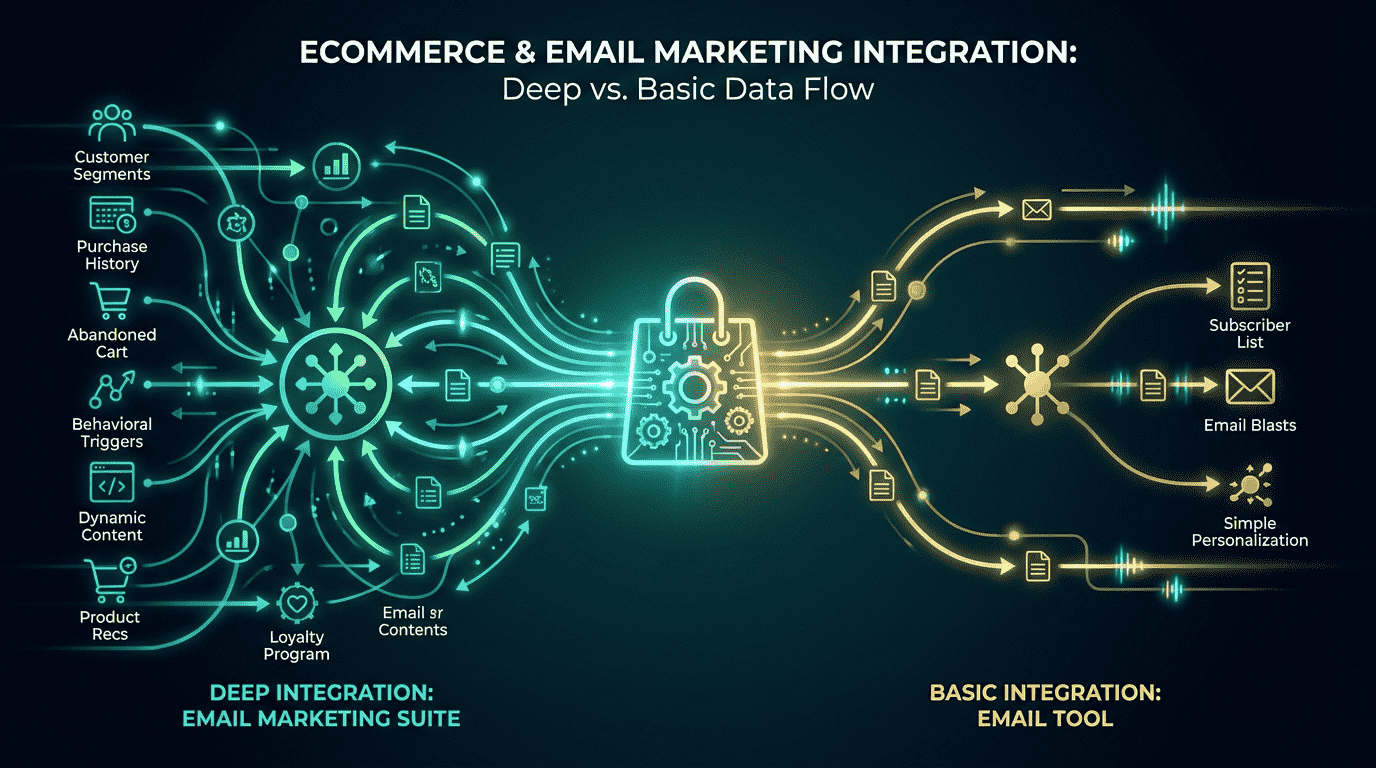
Klaviyo's Shopify integration is native and deep. One-click setup. Real-time data sync. It just works. Shopify even lists Klaviyo as a recommended email marketing app in their official guides.
What syncs automatically:
- Customer profiles with full purchase history
- Order data including products, amounts, and dates
- Real-time browsing behavior (viewed products, added to cart)
- Customer lifetime value calculations
- Product catalog with images and prices
- Discount code usage
Klaviyo also gives you pre-built flows optimized for Shopify:
- Abandoned cart (with dynamic product images)
- Browse abandonment
- Post-purchase sequences
- Winback campaigns for lapsed customers
- VIP customer flows
The platform calculates Shopify-specific metrics automatically: predicted next order date, expected lifetime value, and churn risk. This data powers smarter segmentation without any manual work.
Mailchimp + Shopify Integration
Mailchimp and Shopify have a complicated history. In 2019, they broke up publicly over data-sharing disagreements. The integration came back in 2023, but it's never fully recovered.
What syncs:
- Customer data (name, email, purchase history)
- Order information
- Product catalog
What doesn't sync well:
- Real-time browsing behavior
- Predicted analytics
- Deep behavioral data
The integration works. It's just not as deep. You'll need workarounds for advanced use cases like browse abandonment or sophisticated segmentation based on on-site behavior.
Our Take
For Shopify stores, Klaviyo wins this category decisively.
The data depth difference compounds over time. After six months on Klaviyo, you have rich behavioral profiles on every customer. After six months on Mailchimp, you have purchase history and email engagement. One of these datasets is way more valuable for personalization.
If you're on Shopify and serious about email revenue, this integration difference alone should drive your decision.
Automation and Flows: Where the Money Is Made
Automation is where email marketing actually generates revenue. Abandoned cart emails, post-purchase sequences, winback campaigns. This is the profit center.
Klaviyo Automation Capabilities
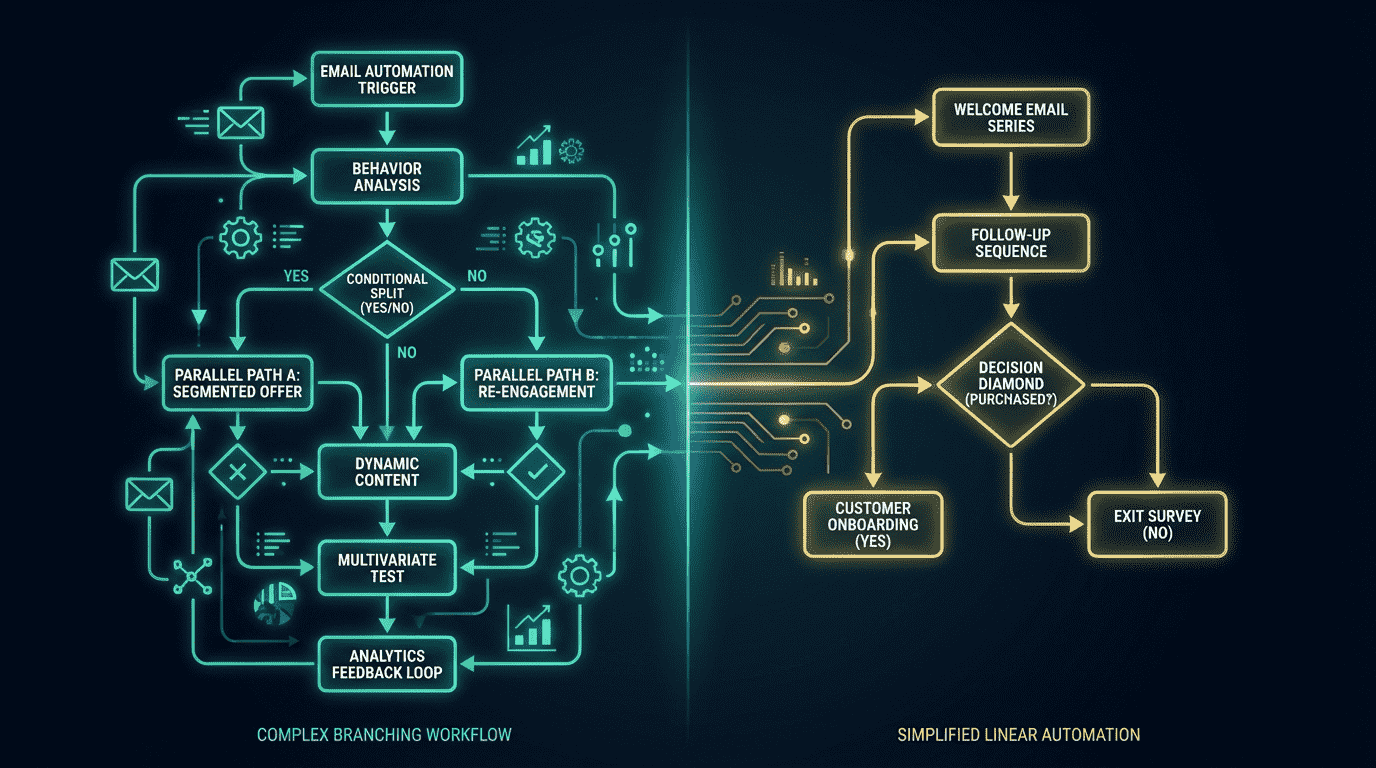
Klaviyo offers dozens of pre-built flow templates, with more appearing after you connect your ecommerce platform. But the real power is in what you can build.
Trigger types:
- Event-based (browse, add to cart, purchase, segment entry)
- Time-based (date, anniversary, predicted next order)
- Metric-based (when customer hits certain thresholds)
Flow features:
- Unlimited conditional splits
- A/B testing within flows (test subject lines, timing, content)
- Smart Send (automatically skip recently emailed contacts)
- SMS + email in the same flow
- Dynamic product blocks that pull from your store
- Webhooks for custom integrations
A typical abandoned cart flow in Klaviyo might:
- Trigger when someone adds to cart but doesn't purchase
- Wait 1 hour, send email #1
- Check if they purchased, stop if yes
- Wait 24 hours, send email #2 with different angle
- Check again, stop if purchased
- Wait 48 hours, add SMS if phone number exists
- Final email with incentive offer
You can build this in 10 minutes.
Mailchimp Automation Capabilities
Mailchimp's Customer Journey Builder has improved significantly. They offer 100+ journey templates covering common use cases.
Trigger types:
- Signup-based
- Purchase-based
- Date-based
- Tag-based
Journey features:
- Conditional logic (4 conditions on Essentials, 100 on Standard)
- Wait steps and time delays
- If/else branching
- Multi-channel (email, SMS, ads, social)
Mailchimp's automations work fine for straightforward sequences. Welcome series, purchase follow-ups, date-based campaigns. They handle the basics well.
Where Mailchimp struggles: complex conditional logic based on behavior. Building that sophisticated abandoned cart sequence requires Standard plan at minimum, and even then you're limited compared to Klaviyo.
Abandoned Cart Comparison
Let's compare the same flow on both platforms:
| Feature | Klaviyo | Mailchimp |
|---|---|---|
| Setup Time | ~10 minutes | ~20 minutes |
| Plan Required | All paid plans | Standard ($20+) |
| Dynamic Products | ✅ Automatic | ✅ Available |
| Behavior-Based Timing | ✅ Advanced | ⚠️ Basic |
| SMS in Same Flow | ✅ Yes | ❌ Separate |
| A/B Testing | ✅ Within flow | ❌ Separate test |
| Conditional Splits | Unlimited | Limited |
Which Automation Engine Wins?
For ecommerce revenue flows: Klaviyo wins clearly. The depth of behavioral triggers and sophisticated logic translate directly to more recovered carts and higher post-purchase revenue.
For simple drip campaigns: It's a tie. Both platforms handle basic sequences without issue.
For cross-channel campaigns beyond email: Mailchimp has an edge if you're using their ads management, landing pages, and social posting features. It's a broader ecosystem.
Email Design and Templates
You need to actually build these emails. Let's talk about the creative side.

Building Emails in Klaviyo
Klaviyo's drag-and-drop editor is functional but not flashy. You can build solid emails without touching code.
What's good:
- Dynamic product blocks (pull products from your store automatically)
- Personalization tags throughout (first name, last purchase, recommendations)
- Mobile preview and editing
- Saved content blocks for reuse
What's less good:
- Template library is smaller (~50 templates)
- Brand kit setup is manual
- Interface feels dense compared to Mailchimp
For ecommerce, Klaviyo's product blocks are gold. You can automatically populate "products you viewed" or "recommended for you" sections without any manual work.
Building Emails in Mailchimp
Mailchimp's editor is one of the best in the industry. It's intuitive, clean, and beginner-friendly.
What's good:
- Creative Assistant (generates brand kit from your website URL)
- Large template library (100+ templates)
- Content Studio with Canva integration
- Survey and review request blocks
- Intuitive drag-and-drop
What's less good:
- Dynamic product functionality is more limited
- Personalization options are simpler
- Ecommerce-specific blocks are basic
For non-designers, Mailchimp is easier. You'll create better-looking emails faster.
Email Design Verdict
| Need | Winner |
|---|---|
| Design ease | Mailchimp |
| Template variety | Mailchimp |
| Ecommerce product blocks | Klaviyo |
| Personalization depth | Klaviyo |
| Non-designer friendly | Mailchimp |
| Data-driven content | Klaviyo |
Bottom line: If you prioritize visual design and ease of use, Mailchimp wins. If you prioritize ecommerce functionality and personalization, Klaviyo wins.
Segmentation and Personalization
Segmentation is how you send the right message to the right person. Better segments mean higher engagement and more revenue.

Klaviyo Segmentation
Klaviyo's segmentation is where the platform really shines.
Capabilities:
- Unlimited conditions per segment
- Dynamic segments (update automatically in real-time)
- Behavioral data: browsing history, cart activity, purchase patterns
- Predictive analytics: lifetime value, churn risk, predicted next order date
- Segment AI (create segments using natural language)
You can build segments like:
- "Customers who viewed product X more than twice, haven't purchased in 60 days, and have predicted LTV over $200"
- "VIP customers (top 10% by spend) who haven't opened an email in 30 days"
- "Customers likely to churn within 90 days who have purchased 2+ times"
These segments update automatically. When someone's behavior changes, they move in or out of segments in real-time.
Mailchimp Segmentation
Mailchimp's segmentation works but has clear limits.
Capabilities:
- 5 condition limit per segment (Standard plan)
- Pre-built segments (Engaged, Lapsed, New subscribers)
- Tag-based organization
- Basic demographic and engagement data
- Limited behavioral data without add-ons
You can build basic segments:
- "Subscribers who opened last campaign and clicked"
- "Customers who purchased in the last 30 days"
- "Contacts tagged as VIP"
These are useful segments. They're just not as sophisticated.
The Segmentation Gap
Let's make this concrete.
Segment goal: Target customers who browsed a specific product, didn't purchase, have lifetime value over $200, and have purchased at least twice before.
Klaviyo: Built-in capability. Create segment in 2 minutes. Updates automatically.
Mailchimp: Would require manual tagging, third-party integrations, or it's simply impossible with native tools.
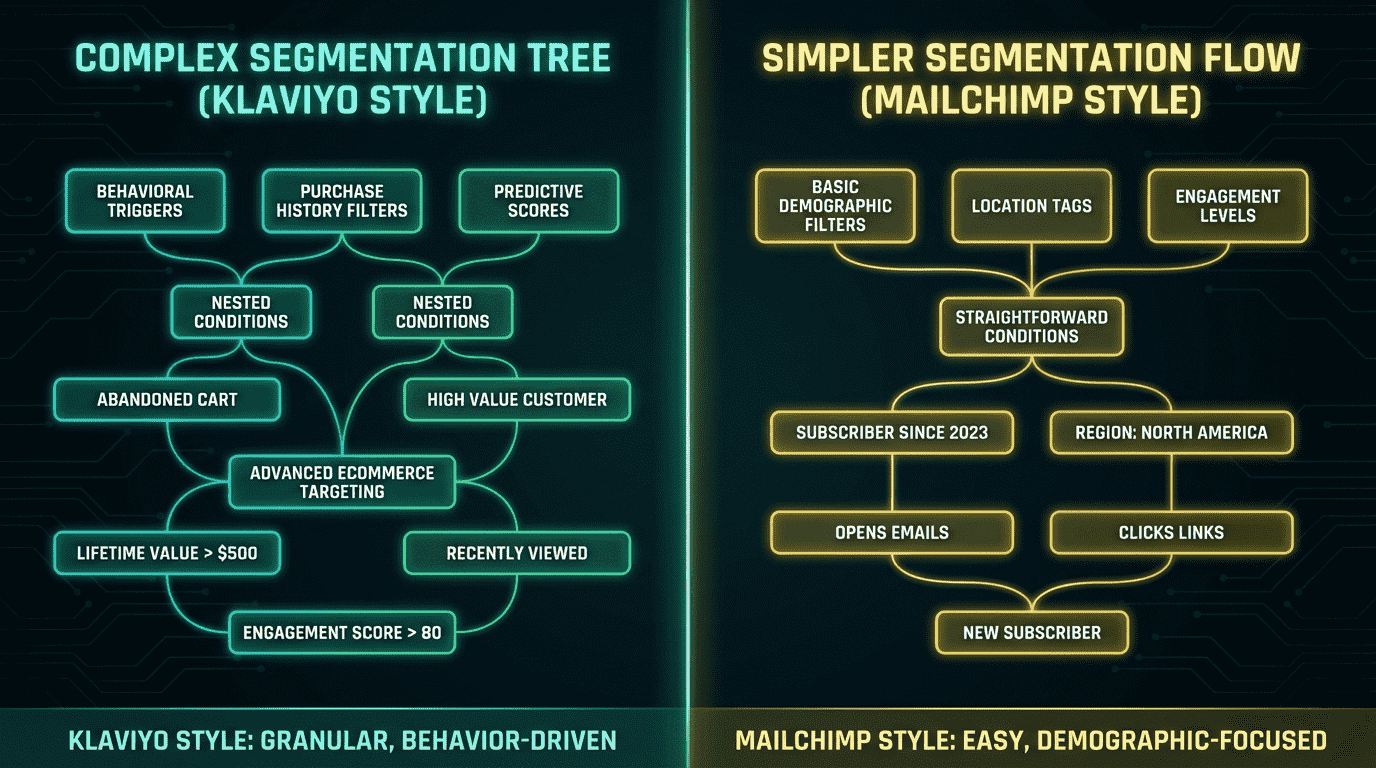
This gap matters because sophisticated segmentation drives revenue. The ability to target the right 500 customers instead of blasting your entire list changes your economics.
Analytics and Reporting
You can't improve what you can't measure. Here's how each platform helps you track performance.
Klaviyo Analytics
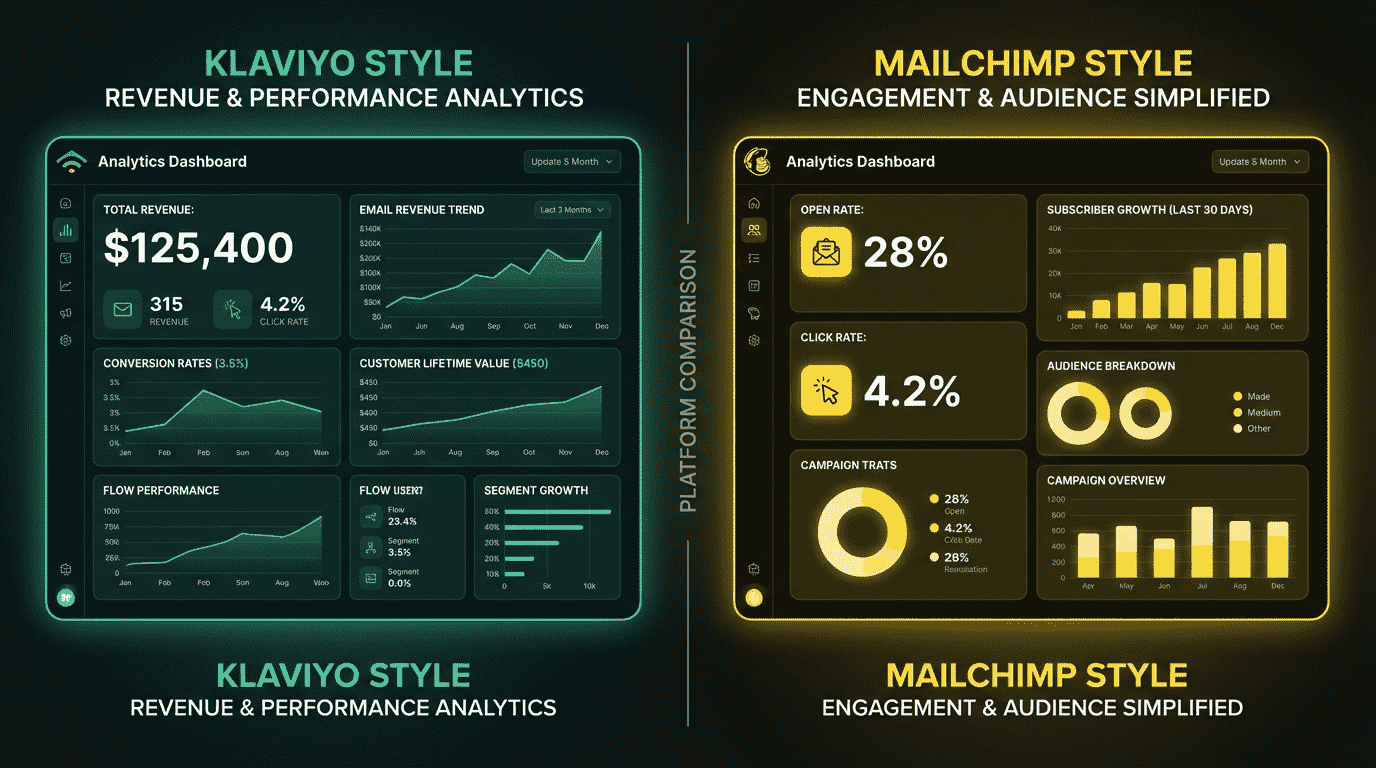
Klaviyo's analytics are built for ecommerce ROI.
Key features:
- Revenue attribution per flow and campaign
- Predictive analytics (CLV, churn probability, next order date)
- Industry benchmarks (compare your metrics to similar stores)
- Deliverability dashboard with health scores
- Custom report builder
- Cohort analysis
The revenue attribution is particularly useful. You'll see exactly how much money each email flow and campaign generates. This makes it easy to identify winners and optimize.
Mailchimp Analytics
Mailchimp provides solid campaign performance data.
Key features:
- Opens, clicks, and revenue per campaign
- Audience growth tracking
- Google Analytics integration
- Click maps (see where people click in emails)
- Comparative reports (Standard+ plan)
- Social media metrics
The analytics cover the basics well. You'll know how campaigns perform. What's missing is the deeper ecommerce insight.
What Matters for Ecommerce
When you're running an ecommerce store, these metrics matter most:
| Metric | Klaviyo | Mailchimp |
|---|---|---|
| Revenue per recipient | ✅ Built-in | ⚠️ Basic |
| Flow vs campaign revenue | ✅ Detailed | ❌ Limited |
| Customer lifetime value | ✅ Predictive | ❌ Not available |
| Deliverability monitoring | ✅ Dashboard | ❌ Basic |
| A/B test revenue tracking | ✅ Advanced | ⚠️ Basic |
Analytics Winner
Klaviyo's analytics are built for measuring ecommerce ROI. Mailchimp's are adequate for tracking engagement but lack the revenue focus.
If email is a serious revenue channel for you, Klaviyo's reporting helps you optimize for dollars, not just opens.
Deliverability: Will Your Emails Actually Arrive?
The best email in the world is worthless if it lands in spam. Deliverability is often overlooked, but it's critical.
Klaviyo Deliverability
Klaviyo offers a comprehensive deliverability toolkit that supports strong sender reputation. EmailToolTester rates their deliverability features highly.
What helps:
- Modern infrastructure built for email
- Dedicated IP available for high-volume senders
- Smart Send feature prevents over-mailing
- Deliverability dashboard with health scores
- Proactive alerts when issues arise
- Strict sender policies (keeps bad actors off the platform)
Mailchimp Deliverability
Mailchimp's deliverability covers the basics but lacks some advanced tools. In EmailToolTester's most recent bi-annual test (Jan 2024), Mailchimp achieved 89.5% average deliverability.
Concerns:
- Shared IPs by default (dedicated only on Premium at $350/month)
- Large user base includes spammers (affects shared IP reputation)
- URL redirects on lower tiers can trigger spam filters
- No deliverability dashboard
- Basic bounce handling
Why This Matters
A 1% deliverability difference doesn't sound like much. But at scale, it's real money.
10,000 emails with 95% deliverability: 9,500 delivered
10,000 emails with 98% deliverability: 9,800 delivered
That's 300 more customers seeing your message per campaign. Over a year of weekly campaigns, it adds up significantly.
Klaviyo's infrastructure advantage is real. For ecommerce brands where email drives revenue, this matters.
Customer Support Comparison
What happens when things break? Support quality varies significantly.
Klaviyo Support
Availability:
- Email and chat for all paid plans
- 60 days of support for free users
- Klaviyo Academy (free courses and certifications)
- Extensive knowledge base
Quality:
- Average response time: ~2 hours (based on testing)
- Answers are technical and detailed
- Support team understands ecommerce context
- Can help with strategy, not just troubleshooting
Mailchimp Support
Availability:
- Email only on Essentials
- Chat added on Standard
- Phone support only on Premium ($350/month)
- 30 days of support for free users
- Tutorials and knowledge base
Quality:
- Average response time: ~5 hours (based on testing)
- Responses often link to documentation
- Support is generalist, not ecommerce-focused
- Quality varies by agent
Our Experience
We've worked with both support teams multiple times.
Klaviyo's support understands ecommerce. When you ask about abandoned cart optimization or segmentation strategy, they give real answers. They know the platform deeply.
Mailchimp's support handles general questions fine. But for ecommerce-specific guidance, you're often on your own. The support feels more like FAQ navigation than strategic help.
SMS Marketing Capabilities
SMS is increasingly important for ecommerce. Here's how each platform handles it.
Klaviyo SMS
SMS is native to Klaviyo. It's included on all paid plans.
What you get:
- 150 free SMS credits per month
- Same platform as email (unified customer view)
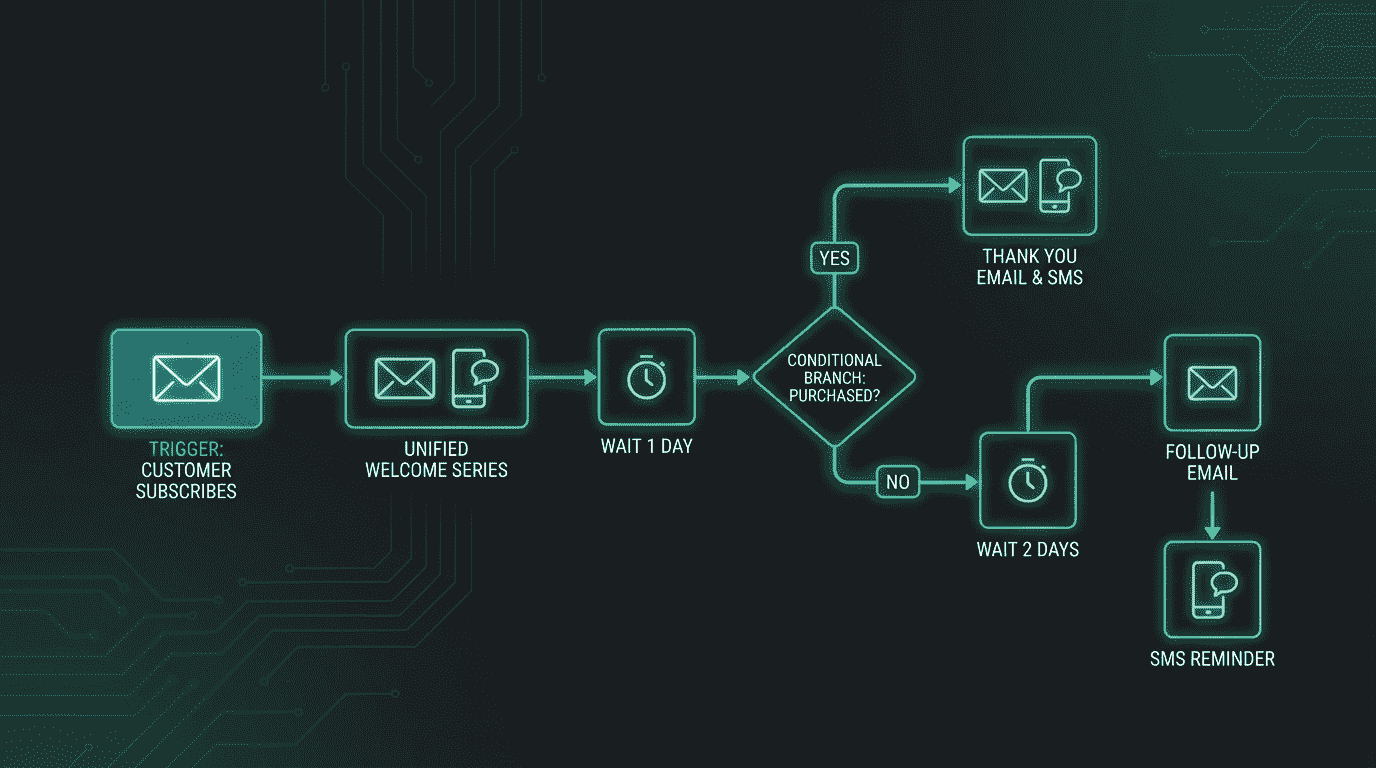
- SMS and email in the same automation flows
- MMS support (images and GIFs)
- Two-way conversations
- Pricing: ~$0.01-0.02 per SMS depending on volume
The key advantage: unified flows. You can build an abandoned cart sequence that sends email first, then SMS as a follow-up, all triggered by the same event. One customer view. One platform.
Mailchimp SMS
SMS is an add-on for Mailchimp.
What you get:
- Starts at $20 for 1,000 credits
- Separate credit system from email
- Can integrate into customer journeys
- Limited templates compared to email
- Less mature feature set
Mailchimp's SMS works. It's just not as integrated. You're managing two separate systems within one platform.
SMS Verdict
If SMS is part of your strategy, Klaviyo wins clearly. The unified platform means better customer experiences and easier campaign management.
Ease of Use and Learning Curve
Power and simplicity are usually tradeoffs. That's true here.
Getting Started with Klaviyo
Setup time: 1-3 hours (with Shopify)
Learning curve: Moderate. Plan for 2-4 weeks to feel proficient.
Interface: Functional but dense. Lots of options, lots of menus. Powerful but not pretty.
Best for: Teams willing to invest time upfront for long-term capability.
First impressions can be overwhelming. There's a lot to learn. But Klaviyo Academy offers free courses, and once you understand the logic, it becomes intuitive.
Getting Started with Mailchimp
Setup time: 30 minutes
Learning curve: Minimal. Most users feel comfortable within a week.
Interface: Clean, friendly, intuitive. Designed for beginners.
Best for: Teams that need to start sending emails today without extensive training.
Mailchimp's onboarding is excellent. You can launch your first campaign the same day you sign up.
The Trade-off
There's no free lunch here.
Mailchimp's simplicity means less power. The interface hides complexity by limiting options.
Klaviyo's complexity means more capability. The interface exposes options because they're useful.
Pick your priority. If you need quick wins with minimal investment, Mailchimp. If you're building email into a serious revenue channel, accept Klaviyo's learning curve.
Migration: Switching Between Platforms
Already on one platform and thinking about switching? Here's what to expect.

Migrating from Mailchimp to Klaviyo
This is the more common direction. Here's the process:
- Export contacts from Mailchimp (CSV format)
- Import to Klaviyo (native import tools available)
- Recreate segments (most time-consuming step)
- Rebuild automation flows (Klaviyo has import guides)
- Update signup forms on your site
- Run platforms in parallel for 2-4 weeks
- Monitor deliverability during transition
Timeline:
- Basic setup (contacts, simple flows): 1-2 weeks
- Complex setup (advanced automation, many segments): 4-8 weeks
Tips:
- Keep Mailchimp active during transition (don't go dark on subscribers)
- Prioritize revenue-generating flows first (abandoned cart, post-purchase)
- Don't migrate during a major promotion
Migrating from Klaviyo to Mailchimp
Less common, but possible. The process is similar.
Key consideration: You'll lose advanced segmentation capabilities. Any segments built on behavioral data or predictive analytics won't transfer. You're simplifying, not just moving.
Migration Costs to Consider
Beyond the technical work:
- Time investment: Your team's hours (or agency fees)
- Deliverability risk: New sending domain can temporarily hurt inbox placement
- Revenue dip: Automations don't run during rebuild
- Training: Learning a new platform takes time
Our advice: Don't switch mid-promotion or during peak season. Run platforms in parallel during transition. And make sure the switch is worth it before you start.
When to Choose Klaviyo
Choose Klaviyo if:
- You run an ecommerce store on Shopify, WooCommerce, or BigCommerce
- You're doing $10K+ monthly revenue (or aiming there soon)
- Email is or will be a significant revenue channel
- You want SMS and email on one platform
- You're willing to invest time learning a more complex tool
- You care about predictive analytics and customer lifetime value
- Data-driven personalization matters to your strategy
Klaviyo is built for ecommerce brands that take email seriously. If that's you, the platform's advantages compound over time.
When to Choose Mailchimp
Choose Mailchimp if:
- You run a non-ecommerce business (services, content, local)
- You're just starting out (under $5K/month revenue)
- You need all-in-one marketing (website, social, ads, email)
- You prioritize ease of use over power
- Budget is tight and you need a solid free tier
- Your automation needs are simple
- You're a solo operator without time to learn complex tools
Mailchimp is great at being accessible. Don't force an ecommerce-specialized tool onto a non-ecommerce business.
The Verdict: Our Recommendation
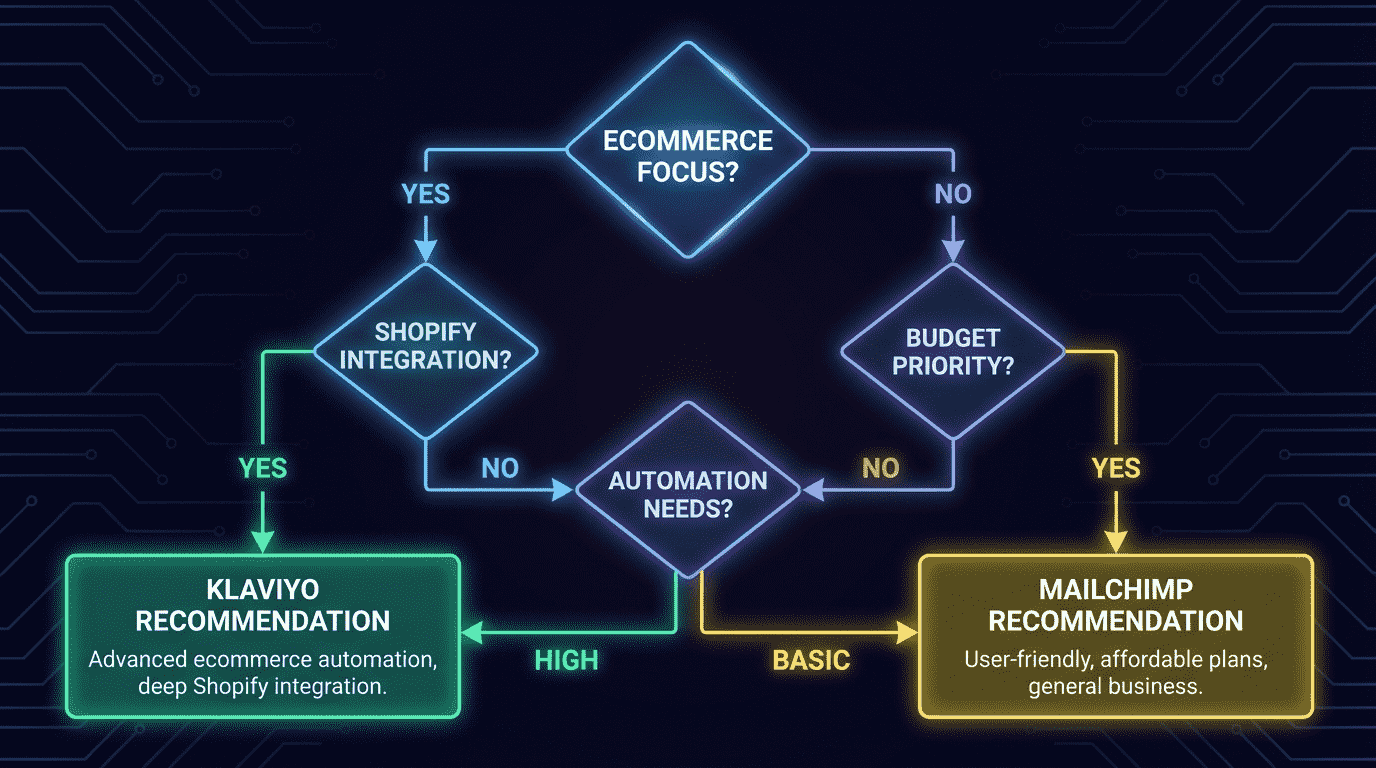
Let's be direct.
For Ecommerce Brands: Klaviyo Wins
The Shopify integration depth, automation power, and analytics are built for driving revenue. The higher learning curve pays off. The price premium is justified by results.
We've seen Shopify stores add $20-50K in annual revenue just from properly configured Klaviyo flows. The ROI is real.
Yes, it's more complex. Yes, it costs more. But for ecommerce, Klaviyo is the professional-grade tool.
For Everyone Else: Mailchimp is Excellent
If you're not running an ecommerce store, Mailchimp is a great choice. Don't force an ecommerce tool on a non-ecommerce business.
Mailchimp's breadth of features, ease of use, and accessibility make it ideal for:
- Service businesses
- Content creators
- Local businesses
- Anyone prioritizing simplicity
The Honest Truth
Both are capable platforms. The wrong choice isn't catastrophic. You can make either work.
But the right choice gives you an edge. For ecommerce, that edge is Klaviyo. For general marketing, that edge is Mailchimp.
Frequently Asked Questions
Can I use Klaviyo for free?
Yes. Klaviyo's free tier includes 250 contacts and 500 emails per month. You get full feature access, not a stripped-down version. It's enough to test the platform thoroughly before paying.
Is Mailchimp still good for ecommerce?
It's adequate for small stores. If you're doing under $10K/month in revenue and email is a minor channel, Mailchimp can work. But serious ecommerce brands will outgrow its capabilities quickly. The segmentation limits and integration depth become bottlenecks.
Which has better deliverability?
Klaviyo, based on our experience and the deliverability tools each platform offers. Klaviyo provides a deliverability dashboard, sender health metrics, and IP warmup support—features Mailchimp lacks. Klaviyo's modern infrastructure and stricter sender policies help maintain better inbox placement.
Can I use both platforms?
Technically yes. Practically, no. Running both creates data fragmentation. Your customer data lives in two places, segments don't sync, and automation becomes messy. Pick one.
How long does migration take?
For basic setups (contact import, simple flows): 1-2 weeks. For complex setups (advanced automation, many segments, custom integrations): 4-8 weeks. Plan for the longer estimate if you've built sophisticated marketing programs.
Which is better for Shopify?
Klaviyo. Definitively. The native integration is far superior. Real-time behavioral data, deep product catalog sync, and Shopify-specific metrics make Klaviyo the clear winner for Shopify stores.
What about Omnisend, Drip, or Sendlane?
These are solid alternatives worth considering. Omnisend is particularly strong for small-to-mid ecommerce brands who find Klaviyo expensive. We may cover these in future comparisons. For now, Klaviyo remains our top recommendation for serious ecommerce operations.
Is Klaviyo worth the higher price?
For ecommerce stores doing $10K+ monthly, yes. The advanced segmentation, predictive analytics, and automation capabilities drive measurable revenue. We've seen Klaviyo pay for itself within 60 days for most clients. For smaller operations or non-ecommerce businesses, the price premium isn't justified.
Final Thoughts
You've got the information you need. Now it's decision time.
If you're still unsure, start with the free tiers of both platforms. Build a simple flow. Send a few campaigns. See which interface clicks for you.
The best email platform is the one you'll actually use well. A perfectly configured Mailchimp beats a neglected Klaviyo setup every time.
That said, for Shopify stores serious about email revenue: Klaviyo is the better investment. The learning curve is worth it.
Last updated: February 2026. Pricing and features verified against official sources and third-party reviews (EmailToolTester, Zapier, official pricing pages).
Need help implementing Klaviyo for your Shopify store?
We're a Shopify-focused agency that's done this hundreds of times. From migration to flow optimization, we can help you get Klaviyo generating revenue fast.
Get in Touch
Written by
Alex is the founder of AESYMMETRIC, a Shopify agency specializing in conversion rate optimization, custom app development, and theme customizations. With eight years of experience in the Shopify ecosystem and e-commerce industry, he helps brands maximize sales and reduce costs through data-driven strategies and innovative technical solutions.