
Omnisend vs Mailchimp: Which Is Better for Shopify in 2026?
Picking the wrong email platform costs more than the monthly subscription. The real price is migration headaches, broken automations, and months of rebuilding what you already had.
We've watched Shopify brands switch platforms two or three times in a single year because they chose based on price alone. Each switch meant lost revenue, broken flows, and weeks of downtime.
If you're running a Shopify store and trying to decide between Omnisend and Mailchimp, you're comparing two very different philosophies. Omnisend was built specifically for ecommerce. Mailchimp was built for everyone.
That distinction matters more than most comparison articles will tell you.
We're a Shopify agency. We've set up both platforms for clients ranging from brand-new stores to established brands doing six figures monthly. We have opinions, and we'll share them honestly.
By the end of this guide, you'll know exactly which platform fits your store. No more second-guessing.
Quick Verdict: Omnisend vs Mailchimp at a Glance
Short on time? Here's the summary.
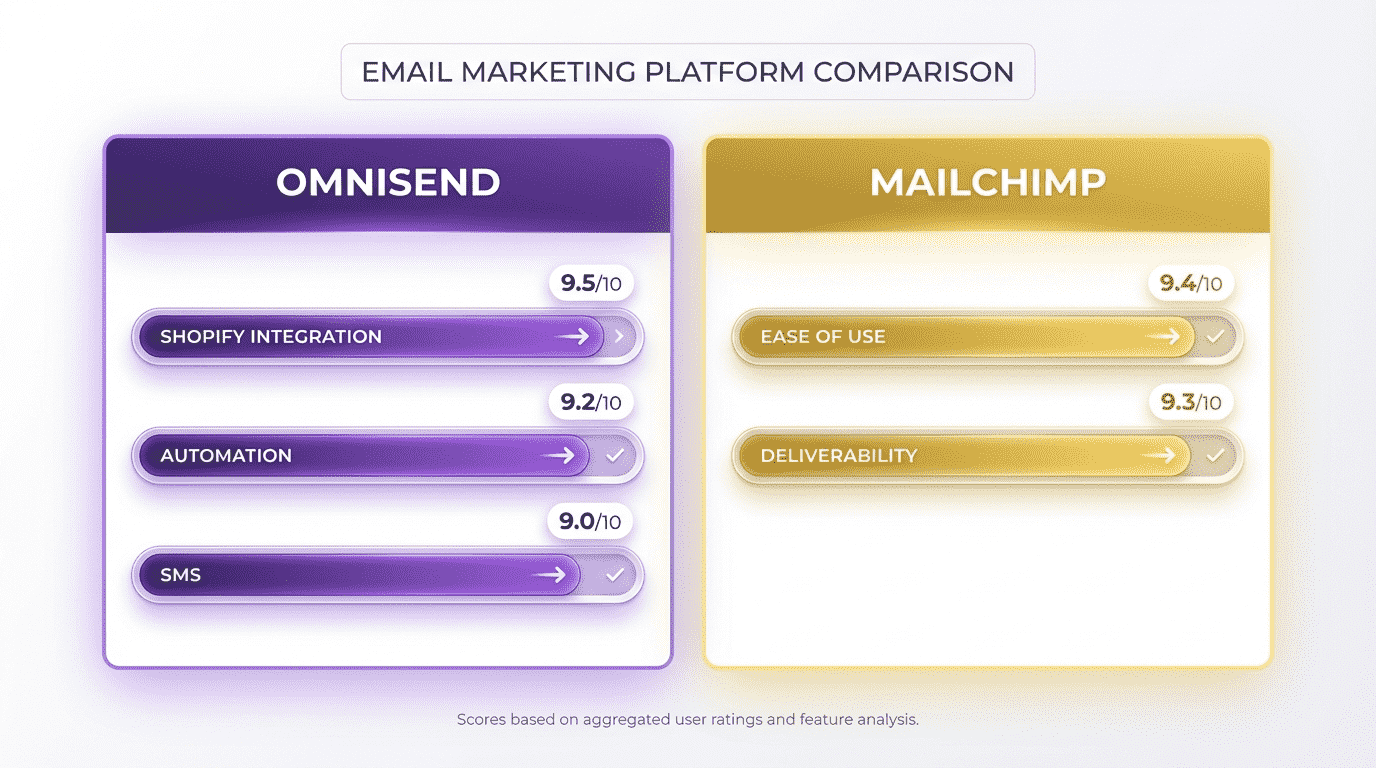
| Criteria | Omnisend | Mailchimp |
|---|---|---|
| Best For | Shopify & ecommerce stores | General small business |
| Starting Price | $16/month (500 contacts) | $13/month (500 contacts) |
| Shopify Integration | ⭐⭐⭐⭐⭐ Native, deep | ⭐⭐⭐ Basic sync |
| Automation Power | ⭐⭐⭐⭐ Ecommerce-focused | ⭐⭐⭐ Adequate |
| Ease of Use | ⭐⭐⭐⭐ Intuitive | ⭐⭐⭐⭐⭐ Beginner-friendly |
| SMS Included | ✅ All plans (even free) | ➕ Add-on ($20+) |
| Free Plan | 250 reachable contacts, 500 emails | 250 contacts, 500 emails |
| Web Push Notifications | ✅ Built-in | ❌ Not available |
| Our Rating | 9/10 for Shopify | 6/10 for Shopify |
Choose Omnisend if: You run a Shopify store and want email, SMS, and push notifications in one platform built for ecommerce.
Choose Mailchimp if: You're not primarily an ecommerce business, or you need broader marketing features like social posting, ads management, and website building.
What is Omnisend?
Omnisend is an email and SMS marketing platform built exclusively for ecommerce. Founded in 2014, it serves over 100,000 ecommerce brands worldwide. On the Shopify App Store, it consistently ranks as one of the highest-rated email marketing apps with a 4.7-star rating and over 6,000 reviews.
Omnisend's entire product strategy centers on one thing: helping online stores sell more. Every feature is designed with ecommerce conversion in mind.
What sets it apart from general-purpose tools is its multichannel approach. Email, SMS, and web push notifications all live in the same platform, sharing the same customer data and automation flows.
Who Omnisend is Built For
- Shopify, WooCommerce, and BigCommerce stores
- Ecommerce brands wanting email + SMS in one platform
- Stores that want powerful automation without Klaviyo's price tag
- Brands that value simplicity but don't want to sacrifice ecommerce features
- Merchants looking for pre-built ecommerce workflows that work out of the box
Who Omnisend is NOT For
- Non-ecommerce businesses (consultants, bloggers, agencies)
- Brands needing enterprise-level predictive analytics
- Companies that need advanced CRM functionality
- Businesses primarily focused on social media or content marketing
What is Mailchimp?
Mailchimp is the email marketing platform everyone knows. Founded in 2001, it serves over 13 million users and is one of the most recognized marketing brands in the world. Intuit acquired it for $12 billion in 2021.
Mailchimp positions itself as an all-in-one marketing platform. Beyond email, it offers website building, social media scheduling, ad management, landing pages, and CRM features. It tries to be the only marketing tool a small business needs.
That breadth is both its strength and weakness. Mailchimp does many things adequately. It does few things exceptionally when it comes to ecommerce.
Who Mailchimp is Built For
- Small businesses and startups across all industries
- Content creators and bloggers
- Teams wanting all-in-one marketing (email, social, ads, website)
- Beginners who prioritize ease of use above all
- Non-ecommerce businesses needing simple email marketing
Who Mailchimp is NOT For
- Shopify stores doing serious revenue through email
- Brands needing deep ecommerce data integration
- Teams that want SMS natively included
- Stores that need advanced automation based on shopping behavior
Pricing Comparison: The Real Costs
Pricing is where Omnisend quietly wins a lot of merchants over. Let's break down what you'll actually pay.
Omnisend Pricing Breakdown
Omnisend's pricing is refreshingly straightforward. Three plans, scaling by contact count. All features are available on all plans, including the free tier. You just get higher sending limits as you move up.
| Contacts | Free | Standard | Pro |
|---|---|---|---|
| 250 | $0 (500 emails) | — | — |
| 500 | $0 | $16 (6,000 emails) | $59 (unlimited) |
| 2,500 | $0 | $44 (30,000 emails) | $59 (unlimited) |
| 5,000 | $0 | $81 (60,000 emails) | $90 (unlimited) |
| 10,000 | $0 | $132 (120,000 emails) | $150 (unlimited) |
| 25,000 | $0 | $282 (300,000 emails) | $400 (unlimited) |
| 50,000 | $0 | $413 (600,000 emails) | $715 (unlimited) |
Key detail: Omnisend's free plan stores unlimited contacts. You can only reach 250 per month, but you're not penalized for having a large list. Every feature is available on free, including automation, segmentation, and A/B testing.
SMS credits come included on all plans. Free gets 60 international SMS credits. Standard gets 60. Pro gets 3,540. Additional credits cost about $0.015 per SMS in the US.
Mailchimp Pricing Breakdown
Mailchimp has four tiers with significant feature differences between them.
| Plan | Price (500 contacts) | Key Limits |
|---|---|---|
| Free | $0 | 500 emails/month, 250/day limit, no automation |
| Essentials | $13 | 5,000 emails/month, basic automation |
| Standard | $20 | 6,000 emails/month, advanced automation |
| Premium | $350 | 150,000 emails/month, priority support |
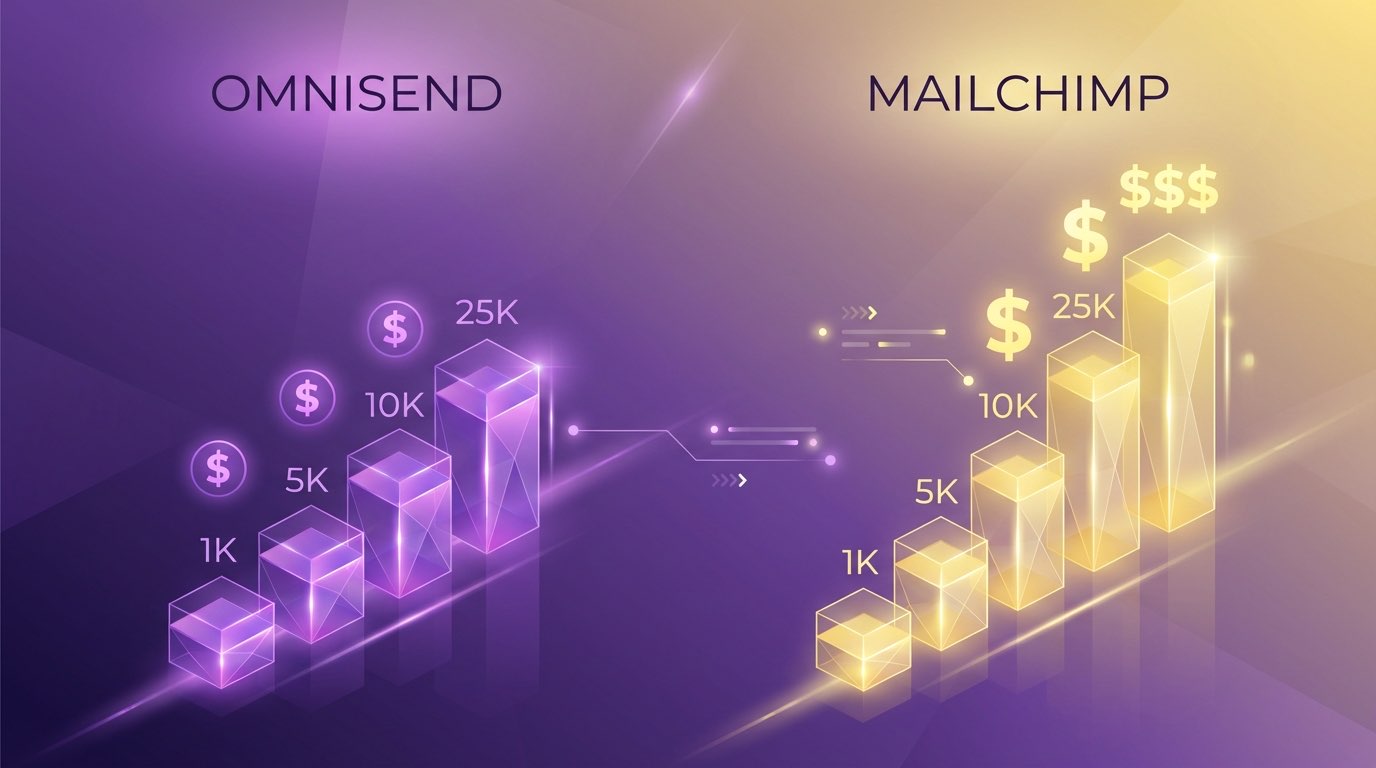
At 10,000 contacts, Essentials hits $110/month and Standard reaches $135/month. The pricing escalates quickly at higher contact counts.
The Hidden Cost Trap
Mailchimp's sticker price is misleading for ecommerce stores. Here's why:
- Feature paywalls. Automation requires Essentials ($13+). Advanced automation needs Standard ($20+). Send time optimization? Premium only ($350+). Omnisend includes all features on every plan.
- Audience counting. Mailchimp counts the same contact multiple times if they're on different lists. Omnisend counts unique contacts only.
- SMS is extra. Mailchimp charges $20+ for SMS as a separate add-on. Omnisend includes SMS credits on every plan, including free.
- Overage charges. Exceed your email limit and Mailchimp bills you extra. Omnisend's Pro plan has unlimited emails.
- Unsubscribed contacts. Mailchimp counts unsubscribed contacts toward your billable total. Omnisend only counts reachable contacts.
1-Year Total Cost Comparison (Including SMS)
Here's what you'd actually pay annually, factoring in SMS for 500 messages per month:
| Contacts | Omnisend Standard + SMS | Mailchimp Standard + SMS |
|---|---|---|
| 1,000 | ~$384/yr | ~$480/yr |
| 5,000 | ~$1,062/yr | ~$1,140/yr |
| 10,000 | ~$1,674/yr | ~$1,860/yr |
| 25,000 | ~$3,474/yr | ~$3,720/yr |
When you include SMS and compare at feature parity, Omnisend is often cheaper than Mailchimp. And that's before factoring in the revenue difference from better ecommerce automation.
Shopify Integration: Where It Actually Matters
This is the most important section if you're a Shopify merchant. Integration depth directly impacts how much revenue your email marketing generates.
Omnisend + Shopify
Omnisend was built for Shopify. The integration is native, deep, and maintained as a first-class priority. It's one of the highest-rated email apps on the Shopify App Store with a 4.7-star rating vs Mailchimp's 3.4.
What syncs automatically:
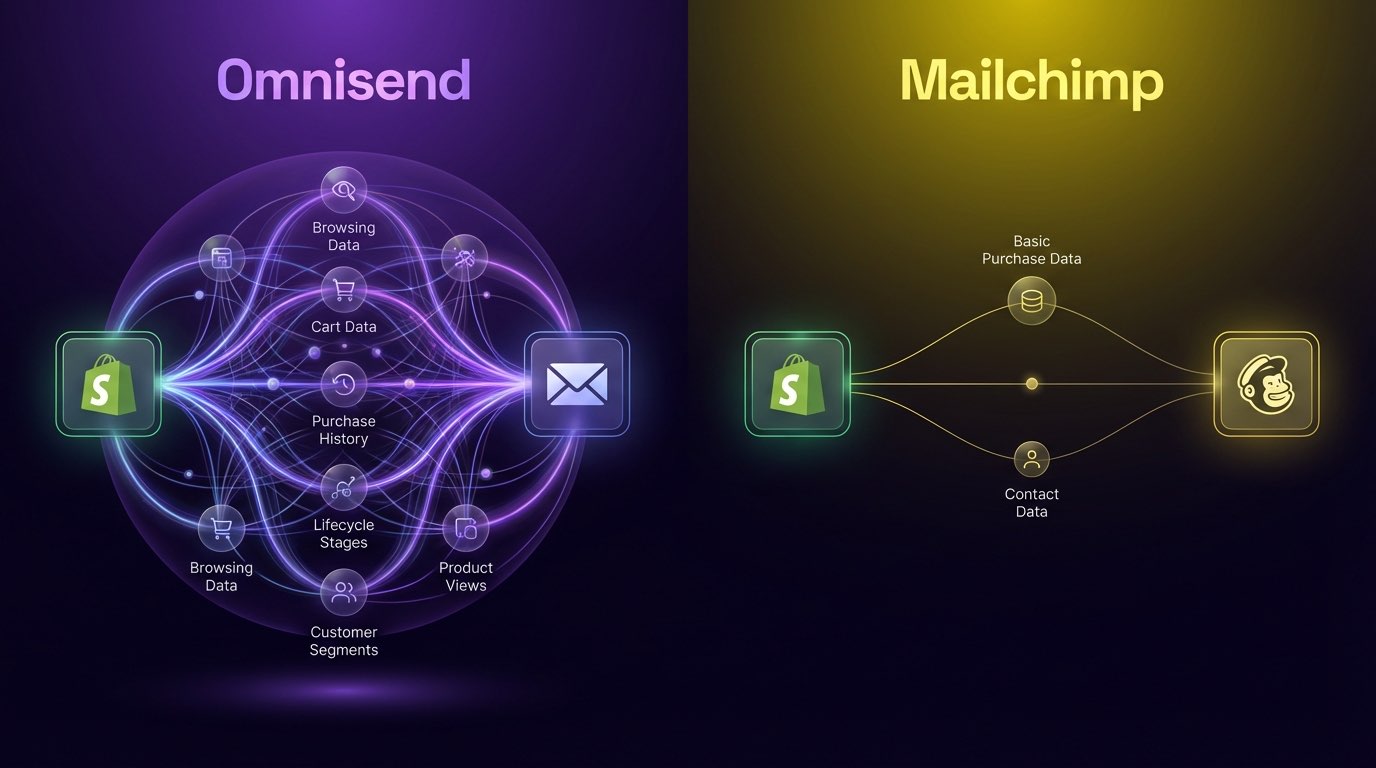
- Complete customer profiles with full purchase history
- Order data including products, amounts, dates, and fulfillment status
- Real-time browsing behavior (product views, cart activity)
- Product catalog with images, prices, and inventory
- Discount code usage and tracking
- Customer tags and segments from Shopify
Setup takes about 10 minutes. Connect Shopify, and Omnisend automatically imports your products, customers, and order history. Pre-built workflows are ready to activate with minimal customization.
Mailchimp + Shopify
Mailchimp and Shopify have a rocky history. In 2019, they had a very public breakup over data-sharing disagreements. The integration returned in 2023, but it's never fully recovered.
What syncs:
- Customer data (name, email, basic purchase history)
- Order information
- Product catalog
What doesn't sync well:
- Real-time browsing behavior
- Granular cart activity
- Deep behavioral data for segmentation
The integration works for basic use cases. But if you want to trigger automations based on what customers browse, build segments based on shopping behavior, or personalize emails with dynamic product recommendations, Mailchimp's Shopify integration falls short.
Our Take
This isn't close. If you're on Shopify, Omnisend's integration is dramatically better.
The data depth difference compounds over time. After a few months on Omnisend, you have rich behavioral profiles that power smarter automation and segmentation. On Mailchimp, you have basic purchase history and email engagement data. One dataset is far more valuable for driving revenue.
Automation and Flows: Where Revenue Gets Made
Automation is where email marketing actually makes money. Abandoned cart recovery, post-purchase sequences, winback campaigns. This is the profit center.
Omnisend Automation
Omnisend offers dozens of pre-built automation workflows specifically designed for ecommerce. The key advantage: they all work on the free plan. No feature paywalls.
Pre-built workflows include:
- Welcome series for new subscribers
- Abandoned cart recovery (email + SMS + push)
- Browse abandonment
- Post-purchase follow-up
- Product review requests
- Customer reactivation and winback
- Cross-sell based on purchase history
- Birthday and anniversary emails
- Order confirmation and shipping updates
Automation features:
- Visual drag-and-drop workflow builder
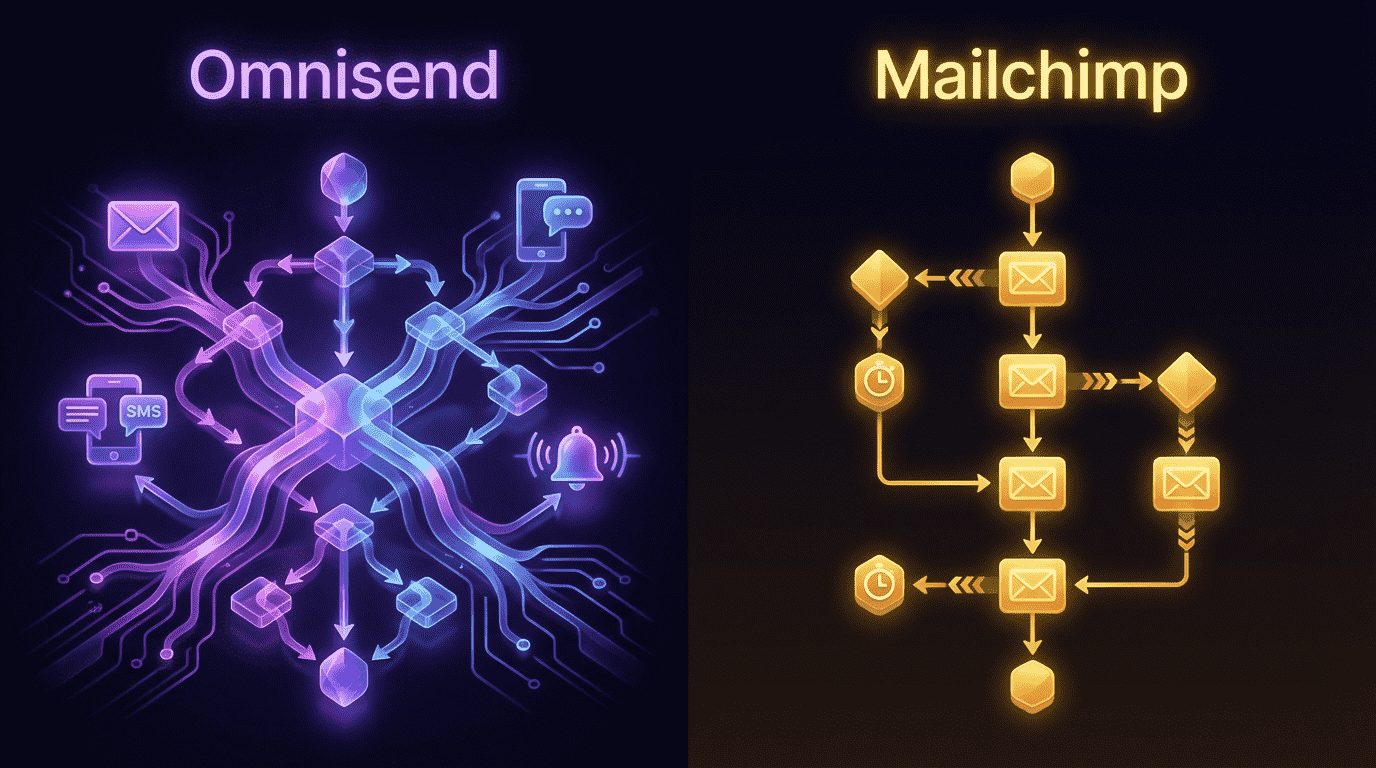
- Conditional splits based on behavior, purchase history, and segment membership
- A/B testing within workflows
- Email, SMS, and push notifications in the same flow
- Dynamic product blocks that pull from your Shopify store
- Custom event triggers via API
A typical abandoned cart flow in Omnisend: email after 1 hour, check if purchased, SMS reminder at 24 hours, final email with discount code at 48 hours. All automated, all using the customer's actual cart contents.
Mailchimp Automation
Mailchimp rebranded its Customer Journey Builder to "Marketing Automation Flows" in mid-2025. They offer 100+ journey templates.
Limitations for ecommerce:
- No automation on the free plan at all
- Basic automation on Essentials (4 conditions per journey)
- Advanced automation requires Standard ($20+)
- SMS requires a separate paid add-on
- Browse abandonment is limited without deep Shopify data
- No web push notification channel
Abandoned Cart Flow Comparison
| Feature | Omnisend | Mailchimp |
|---|---|---|
| Available on Free Plan | ✅ Yes | ❌ No |
| Plan Required | All plans | Standard ($20+) |
| Dynamic Products | ✅ Automatic | ✅ Available |
| SMS in Same Flow | ✅ Yes | ❌ Separate |
| Push Notification Follow-up | ✅ Yes | ❌ Not available |
| A/B Testing in Flow | ✅ Yes | ❌ Separate test |
| Conditional Splits | Unlimited | Limited by plan |
Bottom line: Omnisend gives you more automation power at a lower price point. Combining email, SMS, and push in a single workflow is a significant advantage for ecommerce stores trying to maximize cart recovery and repeat purchases.
SMS Marketing: The Channel That's Actually Growing
SMS is increasingly critical for ecommerce. Cart abandonment SMS has recovery rates 3-5x higher than email alone. This is where Omnisend pulls way ahead.
Omnisend SMS
SMS is native to Omnisend on every plan, including free.
- 60 free SMS credits on Free and Standard plans
- 3,540 free SMS credits on Pro
- Additional credits: ~$0.015 per SMS (US)
- MMS support (images and GIFs)
- Two-way conversations
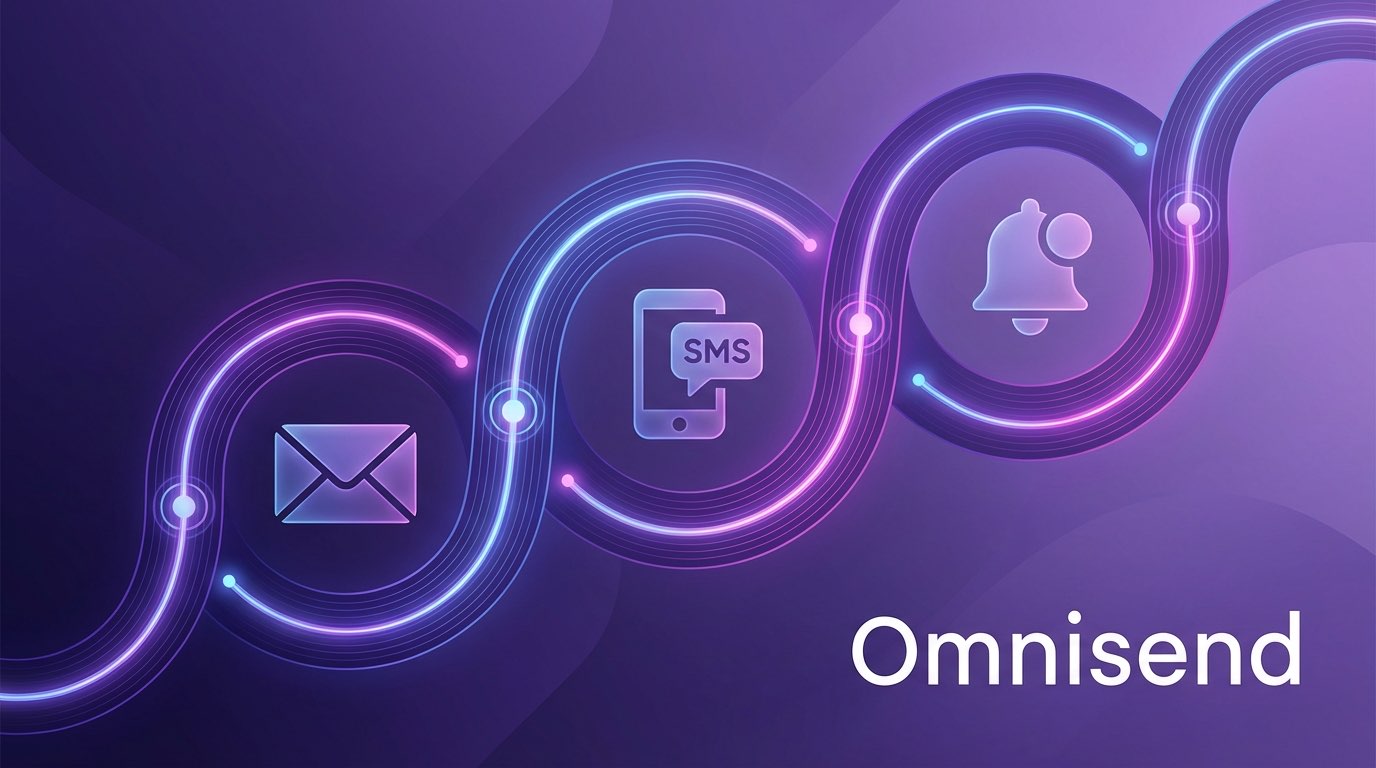
- SMS, email, and push in the same automation flow
- SMS-specific signup forms and popups
- TCPA compliance tools built in
The unified approach is the real advantage. One customer profile. One automation flow. Email first, SMS follow-up, push notification as final touchpoint. All sharing the same data.
Mailchimp SMS
SMS is a paid add-on for Mailchimp, starting at $20 for 1,000 credits.
- Separate credit system from email
- Requires Standard plan or higher for use in automation
- Limited templates compared to Omnisend
- Less integrated with email workflows
SMS Verdict
If SMS is part of your strategy (and it should be for Shopify stores), Omnisend wins clearly. The native integration, lower cost, and unified workflow builder make it the obvious choice.
Email Design and Templates
Both platforms offer drag-and-drop email builders. Here's how they compare for ecommerce.
Omnisend Templates
Omnisend's editor is clean and purpose-built for selling products.
- Product Picker: Pull products directly from your Shopify catalog. Prices, images, and descriptions auto-populate.
- Product Recommender: AI-powered block that suggests products based on customer behavior.
- Discount code blocks: Generate unique or static discount codes directly in emails.
- Wheel of Fortune: Gamified popup for email capture (unique to Omnisend).
- 250+ ecommerce-optimized email templates
- Mobile-friendly by default
- Saved content blocks for reuse across campaigns
Mailchimp Templates
Mailchimp's editor is one of the best in the industry for general use.
- Creative Assistant: Generates brand kits from your website URL automatically.
- 100+ templates across every industry
- Canva integration for in-line image editing
- Intuitive drag-and-drop interface
- Content Studio for asset management
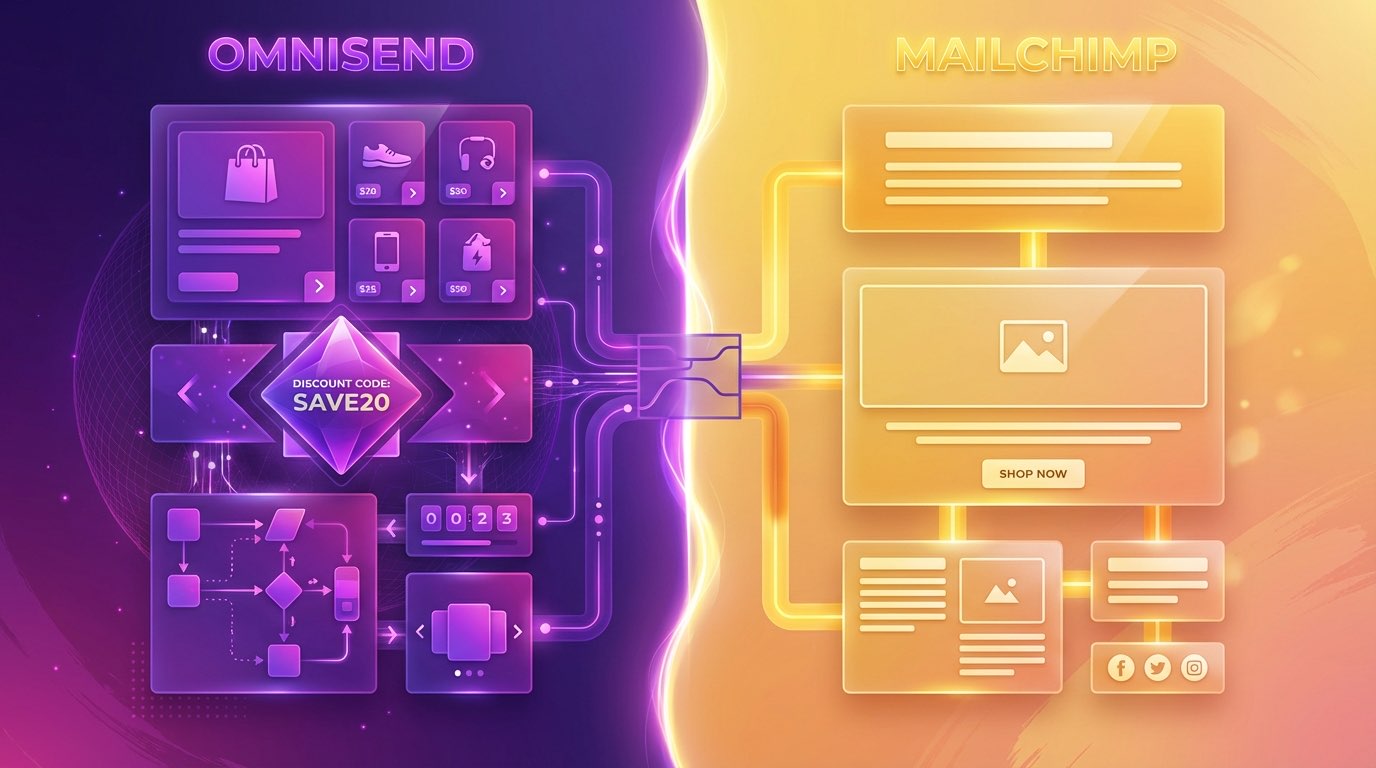
But Mailchimp's ecommerce-specific blocks are basic. Product recommendation functionality is limited compared to Omnisend's purpose-built tools.
| Need | Winner |
|---|---|
| Overall design ease | Mailchimp |
| Template variety | Mailchimp |
| Ecommerce product blocks | Omnisend |
| Dynamic product recommendations | Omnisend |
| Discount code generation | Omnisend |
| Non-designer friendly | Mailchimp |
Mailchimp has the better general email builder. Omnisend has the better ecommerce email builder. For Shopify stores, ecommerce-specific blocks matter more than template count.
Segmentation and Targeting
Better segmentation means more relevant emails. More relevant emails mean higher revenue per subscriber.
Omnisend Segmentation
Omnisend offers unlimited segmentation on all plans, including free. That's unusual and valuable.
- Unlimited segments on all plans
- Dynamic segments that update automatically in real-time
- Behavioral data: browsing history, cart activity, purchase patterns
- Shopping behavior: average order value, purchase frequency, product affinity
- Customer lifecycle stages: new, active, at-risk, lapsed
- Segment by channel preference (email vs SMS engagement)
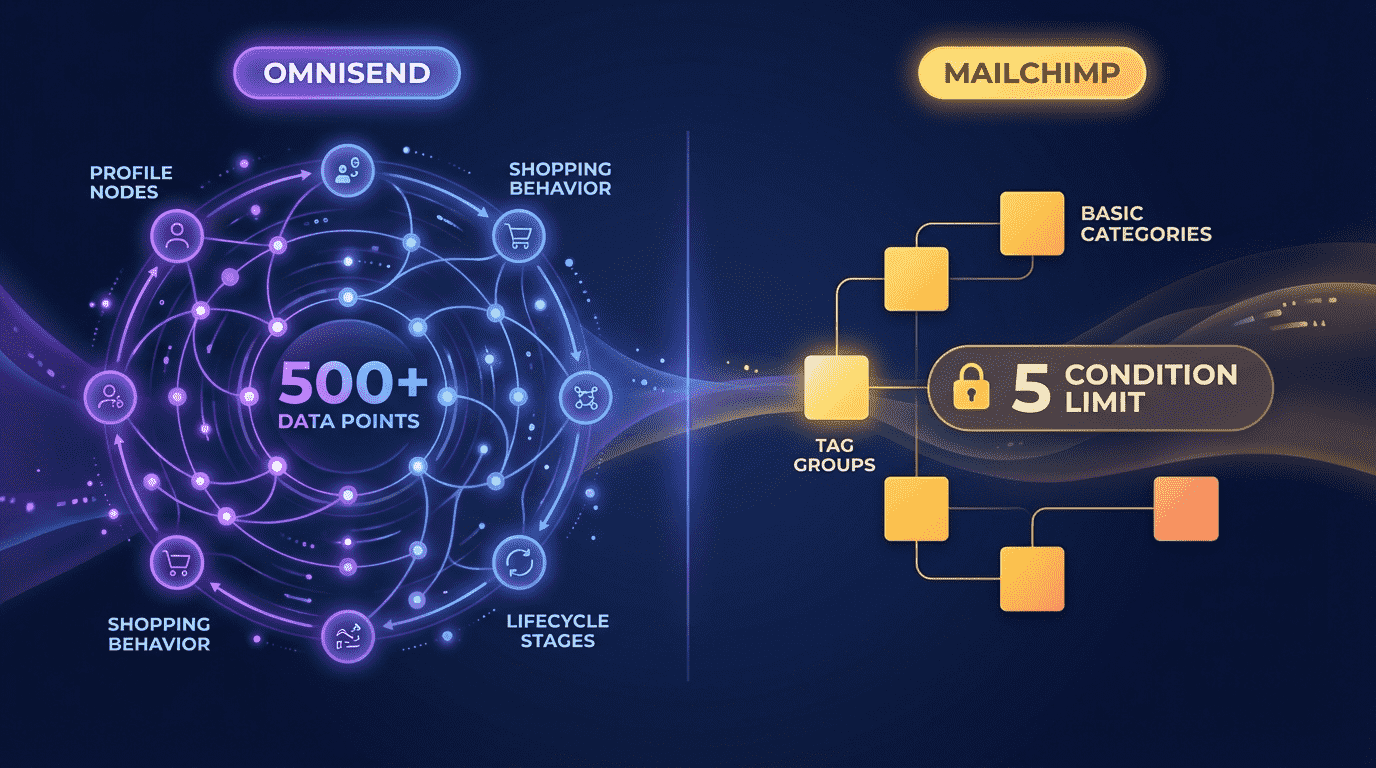
- Up to 500 data points per customer profile
You can build segments like "customers who bought product X but not product Y in the last 90 days and have opened at least 3 emails." These update in real-time as behavior changes.
Mailchimp Segmentation
- 5 conditions per segment on Standard plan
- Pre-built segments (Engaged, Lapsed, New)
- Tag-based organization
- Basic demographic and engagement data
- No lifecycle-stage segmentation built in
- Advanced segmentation requires higher-tier plans
Concrete example: You want to target customers who browsed a specific product category, didn't purchase, have spent over $200 lifetime, and purchased at least twice before.
Omnisend: Built-in capability. Create this segment in 2 minutes. Updates automatically.
Mailchimp: Would require manual tagging, workarounds, or it's simply not possible with native tools and the 5-condition limit.
For ecommerce, this gap is significant. The ability to target the right 500 customers instead of blasting your entire list changes your economics.
Deliverability: Will Your Emails Land?
The best email in the world is worthless if it lands in spam.
According to EmailToolTester's bi-annual deliverability tests, both platforms perform reasonably well. Mailchimp has historically had a slight edge here, testing at around 89-92% deliverability in recent rounds. Omnisend has tested lower in some rounds (around 78-85%), though results vary by test period.
Let's be honest: Mailchimp has a deliverability advantage due to its massive infrastructure and two decades of sender reputation building. That's worth acknowledging.
However, Omnisend offers some practical advantages:
- Dedicated IP available on Standard and Pro plans (based on volume) at no extra charge
- Smaller user base means less spam risk on shared IPs
- Ecommerce-focused senders tend to have better engagement rates
Mailchimp only offers dedicated IPs on Premium ($350/month). For growing Shopify stores, Omnisend's more accessible dedicated IP is a meaningful advantage.
Deliverability matters, but it's not the only factor. Better automation and segmentation (sending relevant emails to engaged subscribers) improves your deliverability on any platform.
The Shopify App Stack: How They Play With Others
Your email platform doesn't exist in isolation. It needs to work alongside your reviews app, loyalty program, subscription tool, and everything else in your Shopify stack. This is something no other comparison article covers.
We've installed both platforms alongside dozens of popular Shopify apps. Here's what we've found.
Omnisend Compatibility
Omnisend plays well with the most popular Shopify apps because it was built for this ecosystem.
- Reviews apps (Judge.me, Loox, Stamped): Omnisend can trigger review request flows based on order fulfillment. Data syncs cleanly.
- Loyalty programs (Smile.io, LoyaltyLion): Customer loyalty data can inform segmentation. VIP tiers feed into targeted campaigns.
- Subscription tools (Recharge, Bold): Subscription events trigger relevant automation flows. You can target subscribers differently from one-time buyers.
- Upsell/cross-sell apps: Omnisend's product recommender complements tools like ReConvert or Zipify.
The Shopify App Store ecosystem treats Omnisend as a first-class citizen. Most major apps have documented integration guides with Omnisend.
Mailchimp Compatibility
Mailchimp works with Shopify apps, but the integrations tend to be shallower.
- Reviews apps: Basic integration via Shopify data sync. Less granular trigger options.
- Loyalty programs: Requires Zapier or custom API work for meaningful data flow.
- Subscription tools: Limited native support. Most integrations need middleware.
Because Mailchimp serves all industries, its integration priorities don't always align with the Shopify ecosystem. You'll spend more time on Zapier workarounds and custom connections.
Our Experience
When we set up a Shopify store with Omnisend, the typical app stack "just works." Judge.me review requests flow through Omnisend automations. Smile.io loyalty data informs our segments. It feels like one connected system.
With Mailchimp, we often need Zapier as glue. That's an extra cost, extra complexity, and extra points of failure. For stores running 5-10 apps, this friction adds up.
Migration: Switching from Mailchimp to Omnisend
Already on Mailchimp and considering the switch? Here's what to expect from our experience doing this for clients.
Step-by-Step Process
- Export contacts from Mailchimp as CSV. Include all custom fields and tags.
- Import to Omnisend. Their built-in migration tools handle Mailchimp imports specifically.
- Recreate your segments. This is usually the most time-consuming step. Map your Mailchimp tags and segments to Omnisend's behavioral segmentation.
- Rebuild automation workflows. Start with revenue generators: abandoned cart, welcome series, post-purchase.
- Update signup forms on your Shopify store. Replace Mailchimp popups with Omnisend forms.
- Run both platforms in parallel for 2-4 weeks. Don't go dark on subscribers.
- Monitor deliverability during the transition. New sending domains need warming.
Realistic Timelines
- Simple setup (contacts, basic flows): 1-2 weeks
- Complex setup (advanced automation, many segments, custom templates): 4-6 weeks
What You'll Lose
- Historical campaign performance data stays in Mailchimp
- Any Mailchimp-specific integrations need replacement
- Audience segments built on Mailchimp tags need manual recreation
What You'll Gain
- Deeper Shopify data from day one
- SMS and push notifications included
- Better ecommerce automation without plan upgrades
- More meaningful segmentation based on shopping behavior
Tips from Our Experience
- Don't migrate during a major promotion or peak season (Black Friday, holiday)
- Prioritize revenue-generating flows first. Get abandoned cart running before anything else.
- Warm your Omnisend sending domain gradually. Start with your most engaged subscribers.
- Keep Mailchimp active until you've verified everything works on Omnisend.
When to Choose Omnisend
Choose Omnisend if:
- You run a Shopify, WooCommerce, or BigCommerce store
- You want email, SMS, and push notifications in one platform
- You need powerful automation without a massive budget
- You want ecommerce-specific features (product recommender, discount codes, cart recovery) out of the box
- You value all features on all plans with no paywalls
- You're looking for a Klaviyo alternative that's more affordable and simpler
- SMS marketing is important to your strategy
When to Choose Mailchimp
Choose Mailchimp if:
- You run a non-ecommerce business (services, content, consulting)
- You need all-in-one marketing beyond email (website, social, ads)
- You prioritize the easiest possible learning curve
- You don't need SMS or push notifications
- Your email strategy is basic newsletters and announcements
- You're a solo operator who needs plug-and-play simplicity
Mailchimp is a great product. It's just not built for what Shopify stores need most.
Our Recommendation by Store Size
Here's our direct, opinionated advice based on where your store is right now.
Just Starting Out (0-500 Contacts)
Either platform works at this stage. But Omnisend's free plan gives you a real edge: automation, segmentation, SMS credits, and push notifications. All for $0.
Mailchimp's free plan gives you no automation at all. That means no abandoned cart emails, no welcome series, no post-purchase flows. For an ecommerce store, that's a dealbreaker.
Our pick: Omnisend. Start free, set up your core flows, and grow into the platform.
Growing Store ($10K-$50K/month)
This is where the choice becomes obvious. You need automation that drives revenue. You need SMS. You need segmentation based on shopping behavior.
Omnisend Standard ($16-$132/month depending on contacts) gives you everything. Mailchimp would require Standard plan ($20-$135) plus a $20+ SMS add-on to get comparable functionality.
Our pick: Omnisend Standard. It's the sweet spot for growing Shopify stores.
Established Brand ($50K+/month)
At this level, you should evaluate whether Omnisend Pro or Klaviyo is the better fit. Klaviyo offers deeper predictive analytics, more sophisticated data modeling, and enterprise-grade features.
Omnisend Pro is excellent for brands that want powerful ecommerce automation without Klaviyo's complexity and price. See our full Klaviyo vs Omnisend comparison for a detailed breakdown. Mailchimp is genuinely not the right choice at this revenue level for ecommerce.
Our pick: Omnisend Pro or Klaviyo, depending on your analytics needs. Not Mailchimp.
For stores in the "just starting" category, also check out our comparison of Shopify Email vs Klaviyo if you're considering the built-in option.
Final Verdict
Let's be direct.
For Shopify stores at almost every level, Omnisend is the better email marketing platform. The Shopify integration is deeper. The automation is more powerful for ecommerce. SMS and push are included natively. Pricing is competitive. And the "all features on all plans" approach means you're never stuck behind a paywall.
The biggest advantage is practical: you can have abandoned cart recovery, welcome series, and post-purchase flows running within an hour of setup. With real SMS follow-ups. On the free plan.
We've seen Shopify stores add $10-30K in annual revenue just from properly configured Omnisend flows. Abandoned cart recovery alone often pays for the entire platform cost within the first month.
Mailchimp is a great product for the audience it was built for. That audience just isn't Shopify store owners.
If you want to explore how Omnisend stacks up against the premium option, read our Klaviyo vs Mailchimp comparison. Or for a head-to-head between Omnisend and Klaviyo, see our Klaviyo vs Omnisend comparison. And if you're curious about the best ecommerce platforms for SEO, that's worth considering as part of your overall marketing strategy.
Frequently Asked Questions
Is Omnisend better than Mailchimp for Shopify?
Yes. Omnisend's native Shopify integration is deeper, its automation is built for ecommerce, and it includes SMS on all plans. Mailchimp works with Shopify but wasn't designed for it.
Is Omnisend free to use?
Yes. Omnisend's free plan includes 250 reachable contacts, 500 emails per month, 60 SMS credits, and access to all features including automation, segmentation, and A/B testing. It's one of the most generous free plans in email marketing.
Is Omnisend cheaper than Mailchimp?
At lower contact counts, pricing is nearly identical. When you factor in SMS (included free on Omnisend, $20+ add-on on Mailchimp) and feature access (Omnisend includes everything on all plans, Mailchimp paywalls automation), Omnisend is often cheaper for ecommerce stores.
Can I migrate from Mailchimp to Omnisend?
Yes. Omnisend has built-in migration tools for Mailchimp imports. Export contacts as CSV, import them, rebuild your automations. Plan for 1-2 weeks for basic setups, 4-6 weeks for complex ones.
Does Omnisend have better automation than Mailchimp?
For ecommerce, yes. Omnisend includes email, SMS, and push in the same workflow on all plans. Mailchimp requires Standard ($20+) for advanced automation and charges separately for SMS.
What about Klaviyo vs Omnisend?
Klaviyo is more powerful for enterprise ecommerce with predictive analytics and deeper data modeling. Omnisend is better for small-to-mid Shopify stores wanting similar ecommerce features at a lower price. Read our Klaviyo vs Mailchimp comparison for more.
Which platform has better deliverability?
Mailchimp has a slight edge in independent deliverability tests due to its massive infrastructure. But Omnisend offers dedicated IPs at lower price points (Standard and Pro) while Mailchimp reserves them for Premium ($350/month). Good segmentation and list hygiene matter more than platform choice.
Does Omnisend include SMS?
Yes, on all plans including free. You get 60 international SMS credits on Free and Standard, 3,540 on Pro. Additional credits cost about $0.015 per SMS in the US. Mailchimp charges $20+ as a separate add-on.
Last updated: February 2026. Pricing and features verified against official Omnisend and Mailchimp pricing pages and third-party reviews (EmailToolTester).
We love working with ambitious Shopify brands.
We can help optimize your store's conversion rate and increase sales.
We can create custom apps that integrate third-party services or add new features to your store.
We can create any theme customization you need to improve the look and feel of your brand.
Get in Touch
Written by
Alex is the founder of AESYMMETRIC, a Shopify agency specializing in conversion rate optimization, custom app development, and theme customizations. With eight years of experience in the Shopify ecosystem and e-commerce industry, he helps brands maximize sales and reduce costs through data-driven strategies and innovative technical solutions.