
Shopify Email vs Klaviyo: Which One Actually Makes You More Money?
Here's a real scenario from Reddit: A store owner paying $470 per month on Klaviyo realized they could send the same 51,000 emails through Shopify Email for just $51.
That's a 10x pricing gap. It's not a typo.
"Klaviyo is charging us ~$470 for it. Shopify Email is charging us $1 per 1000 emails which is around $51. Is Klaviyo that worth it?"
This is THE question every Shopify merchant eventually asks. And the answer isn't as simple as "pick the cheaper one."
Shopify Email is built right into your store. It's free for your first 10,000 emails each month. It just works. Klaviyo is a dedicated email marketing powerhouse used by 167,000+ brands including Glossier and Unilever. It costs significantly more but promises significantly more in return.
We've helped dozens of Shopify stores navigate this exact decision. Some started with Shopify Email and graduated to Klaviyo. Others tried Klaviyo first and realized they were paying for features they never used. Both paths can be right. It depends on where you are.
In this guide, we'll break down exactly when each platform makes sense. You'll see real pricing comparisons, feature breakdowns, and a clear framework for deciding. No fluff. Just the information you need to make a smart choice.
Our verdict upfront: Start with Shopify Email if you're under $30K/month in revenue. Graduate to Klaviyo when email becomes a serious revenue driver and you're ready to invest in advanced automation. The details below will help you find your exact tipping point.
Quick Verdict: Shopify Email vs Klaviyo at a Glance
Short on time? Here's the summary in 60 seconds.
| Criteria | Shopify Email | Klaviyo |
|---|---|---|
| Best For | Beginners, small stores | Growth-stage, $50K+ revenue |
| Pricing | 10K free, then $1/1K emails | $20-720+/mo based on contacts |
| Automation | Basic (15 templates) | Advanced (60+ flows) |
| Segmentation | Pre-built presets | Unlimited conditions + AI |
| SMS Marketing | ❌ Needs separate app | ✅ Built-in |
| A/B Testing | ❌ Needs separate app | ✅ Built-in |
| CRM / Customer Profiles | ❌ None | ✅ Built-in |
| Learning Curve | 30 minutes | 2-4 weeks |
| Deliverability | Good | Excellent with tools |
Choose Shopify Email if: You're under $30K/month revenue, have simple email needs, and budget is the priority.
Choose Klaviyo if: You're over $50K/month revenue, need advanced automation, and email is a primary revenue driver.
What is Shopify Email?
Shopify Email is Shopify's native email marketing tool. It's built directly into your Shopify admin. No extra app to install. No separate login. No learning a new platform.
Every Shopify store gets 10,000 free emails per month included with their plan. That's not a trial. That's forever. For many small stores, that means email marketing costs exactly $0.
The platform automatically pulls your store's branding: logo, colors, fonts. You pick a template, customize it, and send. Most merchants can create and send their first campaign in under 30 minutes.
Shopify Email includes 71 pre-designed templates covering everything from product launches to holiday sales to abandoned cart reminders. The drag-and-drop editor is genuinely easy. No design skills required.
AI features help with the hard parts. Stuck on a subject line? The AI generates options. Need body copy? It suggests content based on your products. The AI even works in multiple languages: English, German, French, Spanish, and more.
Basic automation is available through Shopify Flow integration (a free app). You can set up welcome series, abandoned cart emails, thank you sequences, and win-back campaigns. Nothing fancy, but the essentials are covered.
The Limitations
Shopify Email is not trying to compete with dedicated email platforms on features. It's intentionally simple.
- No built-in SMS marketing
- No A/B testing without a third-party app
- Basic segmentation only
- Limited automation complexity
- No predictive analytics
- No dedicated CRM or customer profiles
Best for: Getting started without complexity or cost. If email marketing is new to you, Shopify Email removes every barrier to entry.
What is Klaviyo?
Klaviyo is a dedicated email and SMS marketing platform built specifically for ecommerce. It's not part of Shopify, but it integrates so deeply that it feels like a native extension.
Over 167,000 brands use Klaviyo. The list includes Glossier, Unilever, Mattel, and thousands of fast-growing DTC brands. The company went public in 2023 with a valuation north of $9 billion. They're serious players.
What sets Klaviyo apart is data depth. The platform doesn't just send emails. It builds complete customer profiles based on every interaction: what products they viewed, what they added to cart, what they purchased, how often they open emails, their predicted lifetime value, their churn risk.
This data powers everything. Segmentation becomes surgical. Automation becomes intelligent. You're not just sending emails. You're sending the right email to the right person at the right time.
Klaviyo offers 350+ app integrations beyond Shopify. Your review platform, your loyalty program, your subscription tool, your helpdesk. Everything connects. One unified view of each customer.
The predictive analytics are particularly powerful. Klaviyo calculates expected customer lifetime value, predicts next order dates, and identifies customers at risk of churning. You can segment on these predictions. Imagine targeting "VIP customers likely to churn in the next 90 days" with a retention campaign. That's built in.
The Trade-offs
Klaviyo's power comes with complexity and cost.
- Higher monthly fees (especially as your list grows)
- Steeper learning curve (plan for 2-4 weeks)
- More time investment to use effectively
- Can feel overwhelming for beginners
Best for: Stores treating email as a serious revenue channel. If you're ready to invest time and money into email marketing, Klaviyo rewards that investment.
Pricing: The Real Math
Let's talk money. This is where the two platforms diverge dramatically.
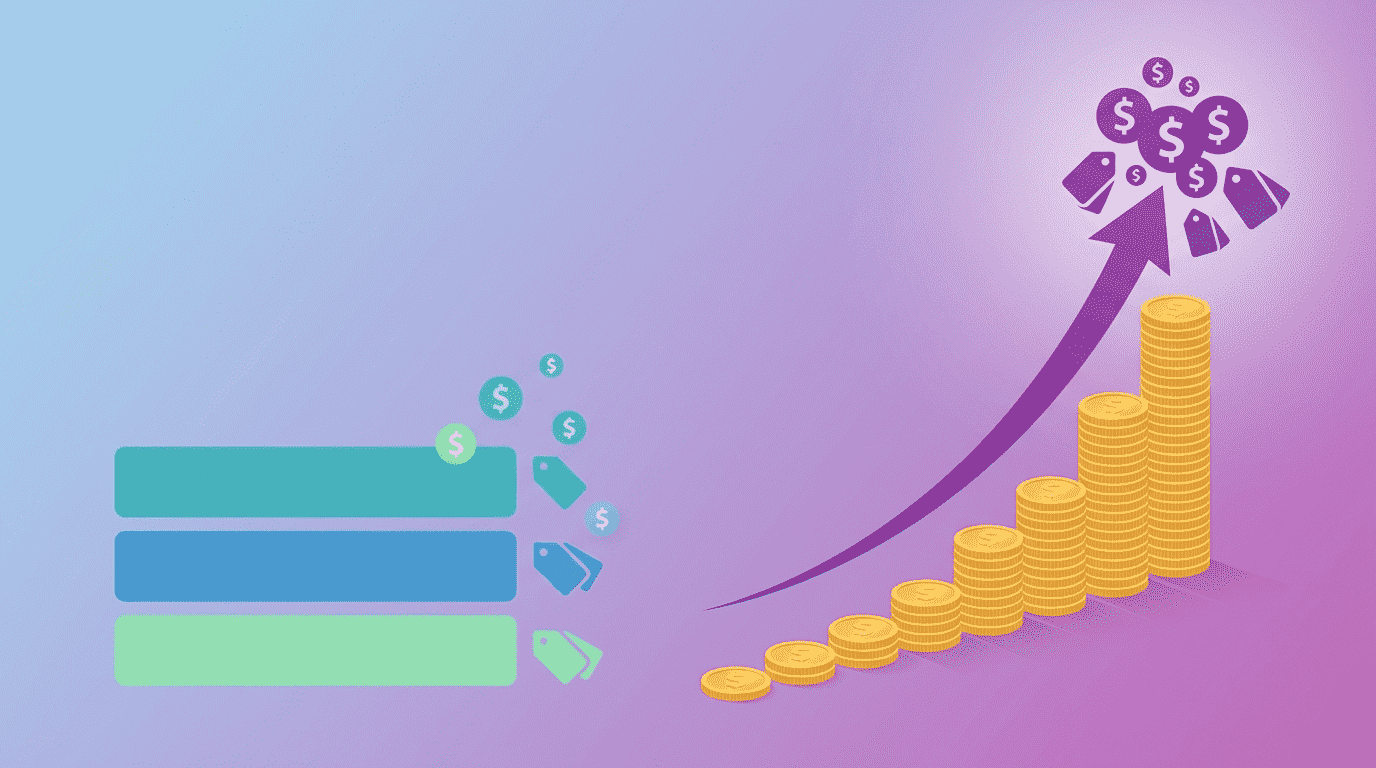
Shopify Email Pricing
Shopify Email pricing is beautifully simple.
- First 10,000 emails per month: Free (included with any Shopify plan)
- Additional emails: $1 per 1,000 emails
- Volume discount: $0.65 per 1,000 after 300,000 emails
Notice what's missing: contact-based pricing. Shopify Email doesn't care how many subscribers you have. You only pay when you actually send emails.
This creates predictable, usage-based costs:
| Monthly Emails Sent | Shopify Email Cost |
|---|---|
| 10,000 | $0 (free tier) |
| 20,000 | $10 |
| 50,000 | $40 |
| 100,000 | $90 |
| 200,000 | $190 |
Klaviyo Pricing
Klaviyo charges based on active profiles (contacts), not emails sent. This is a fundamentally different model.
The free tier gives you 250 contacts and 500 emails per month. Enough to test the platform, but not much more.
| Active Profiles (Contacts) | Monthly Price |
|---|---|
| 250 | Free (500 emails) |
| 500 | $20 |
| 2,500 | $60 |
| 10,000 | $150 |
| 25,000 | $400 |
| 50,000 | $720 |
| 100,000 | $1,380 |
Important note: Klaviyo bills on active profiles, not total subscribers. If a contact hasn't engaged in a while, they may not count toward your limit. But profiles accumulate over time, and costs can grow faster than expected.
Real-World Cost Comparison
Let's compare what you'd actually pay in common scenarios:
| Scenario | Shopify Email | Klaviyo | Difference |
|---|---|---|---|
| 5K contacts, 20K emails/mo | $10 | $100 | Klaviyo costs 10x more |
| 10K contacts, 40K emails/mo | $30 | $150 | Klaviyo costs 5x more |
| 25K contacts, 100K emails/mo | $90 | $400 | Klaviyo costs 4.4x more |
| 50K contacts, 200K emails/mo | $190 | $720 | Klaviyo costs 3.8x more |
That Reddit user wasn't exaggerating. The pricing gap is real and substantial at scale.
The ROI Question
But here's where it gets interesting. Klaviyo claims stores earn $85 for every $1 spent on the platform. Even if that number is optimistic, the question isn't "which is cheaper?" It's "which makes you more money?"
Let's run some numbers.
Industry benchmarks suggest well-optimized email programs drive 25-30% of total ecommerce revenue. For a store doing $100K/month with 25% coming from email, that's $25,000 in email-driven revenue.
Klaviyo at $150/month would be 0.6% of that email revenue. If Klaviyo's advanced automation recovers even 1% more abandoned carts or increases repeat purchase rate by a few percentage points, the platform pays for itself many times over.
Our take: The ROI equation usually favors Klaviyo once you're past $50K/month in revenue. Below that, Shopify Email's simplicity and cost savings often make more sense.
Automation and Workflows
Automation is where email marketing generates real revenue. Abandoned cart sequences, welcome flows, post-purchase series. This is the profit center. And this is where the two platforms diverge significantly.
Shopify Email Automations
Shopify Email offers 15+ pre-built automation templates. The core flows are covered:
- Welcome series
- Abandoned cart
- Thank you / post-purchase
- Win-back for lapsed customers
- Upsell and cross-sell
These automations work through Shopify Flow integration (a free app). Setup is straightforward. Pick a template, customize the content, activate.
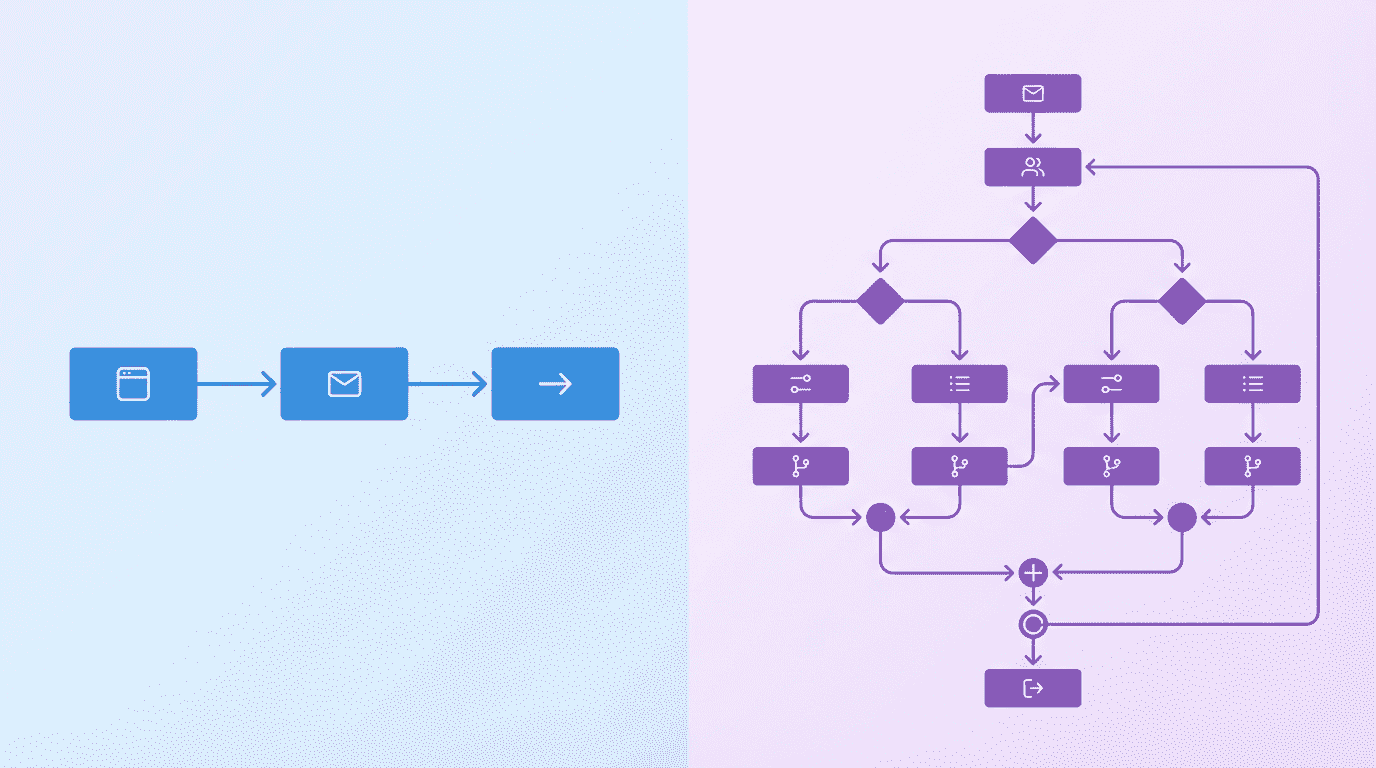
The limitation: workflows are single-step or simple linear sequences. Limited conditional logic. You can't easily build "if customer is VIP, do X; otherwise do Y" type flows.
The editor experience is also a bit clunky. You'll often get redirected between Shopify Email and Shopify Flow. It works, but it's not seamless.
Klaviyo Flows
Klaviyo takes automation to another level with 60+ pre-built flow templates and a powerful visual flow builder.
Flow capabilities:
- Multi-step workflows with unlimited branches
- Conditional splits based on behavior, properties, engagement
- Predictive AI: send at optimal time for each customer
- A/B testing within flows
- SMS and email in the same flow
- Webhooks for custom integrations
Advanced flow types you can build:
- Browse abandonment (someone viewed but didn't add to cart)
- Price drop alerts
- Replenishment reminders
- Sunset flows (re-engage or clean inactive subscribers)
- Birthday and anniversary campaigns
- VIP tier upgrades
The Automation Gap: Abandoned Cart Example
Let's compare what's possible for the same abandoned cart scenario:
| Capability | Shopify Email | Klaviyo |
|---|---|---|
| Basic abandoned cart email | ✅ | ✅ |
| Multiple emails in sequence | ⚠️ Limited | ✅ Unlimited |
| Different message for VIP customers | ❌ | ✅ |
| Wait based on predicted behavior | ❌ | ✅ |
| Add SMS if email unopened | ❌ | ✅ |
| Dynamic product recommendations | ⚠️ Basic | ✅ Advanced |
| A/B test within flow | ❌ | ✅ |
| Skip recently contacted customers | ❌ | ✅ Smart Send |
This gap compounds over time. A sophisticated abandoned cart flow can recover 5-15% of abandoned carts. The difference between a basic two-email sequence and an intelligent multi-step flow with SMS backup is real revenue.
Winner: Klaviyo, decisively. If automation is important to your strategy, this is Klaviyo's strongest advantage.
SMS Marketing
SMS has 98% open rates compared to 20-30% for email. For abandoned carts, flash sales, and time-sensitive offers, SMS converts.
Shopify Email
Shopify Email does not include SMS. To add SMS marketing, you need a third-party app. The Shopify App Store has 400+ SMS options.
This means:
- Additional monthly cost
- Separate platform to manage
- Customer data in two places
- Harder to coordinate email + SMS sequences
Klaviyo
SMS is native to Klaviyo. It's built into the same platform as email.
- 150 free SMS credits on paid plans
- Pricing: approximately $0.01-0.02 per SMS depending on volume
- MMS support (images and GIFs)
- Two-way conversations
- SMS and email in the same automation flows
- One unified customer profile
The key advantage: you can build automation flows that combine email and SMS. Send an abandoned cart email. If they don't open it within 24 hours, follow up with an SMS. All triggered automatically, all from one platform.
| SMS Feature | Shopify Email | Klaviyo |
|---|---|---|
| Native SMS | ❌ Requires app | ✅ Built-in |
| Unified customer view | ❌ | ✅ |
| SMS + email in same flow | ❌ | ✅ |
| MMS support | Varies by app | ✅ |
| Two-way conversations | Varies by app | ✅ |
Winner: Klaviyo. If SMS is part of your strategy, having it in the same platform as email is a significant advantage.
Segmentation and Targeting
Segmentation determines who gets your emails. Better segments mean higher engagement, fewer unsubscribes, and more revenue.
Shopify Email Segmentation
Shopify Email uses segments from your Shopify Customers tab. You get:
- Pre-built segments: new customers, VIPs, local shoppers, high spenders
- Custom segments with basic filters
- AI-generated segment descriptions (helpful for beginners)
The segments are functional. You can target repeat customers differently than first-time buyers. You can send local promotions to customers in specific regions. The basics work.
But the conditions are limited. You can't build complex segments combining multiple behaviors with AND/OR logic. You can't segment based on predicted lifetime value or churn risk. You can't target "customers who viewed product X but didn't purchase and have spent over $200 lifetime."
Klaviyo Segmentation
Klaviyo's segmentation engine is dramatically more powerful:
- Unlimited conditions with AND/OR logic
- Real-time dynamic segments (update automatically)
- Behavioral data: browsing history, cart activity, purchase patterns
- Predictive analytics: lifetime value, churn risk, predicted next order date
- AI segment builder (describe what you want in plain English)
Examples of segments you can build in Klaviyo:
- "Customers who viewed product X more than twice, didn't buy, and have CLV over $200"
- "VIP customers (top 10% by spend) who haven't opened an email in 30 days"
- "Customers likely to churn within 90 days who have purchased 2+ times"
- "First-time buyers who purchased from a specific collection"
These segments update automatically. When someone's behavior changes, they move in or out of segments in real time.
Winner: Klaviyo, if you need advanced targeting. For basic "VIPs vs everyone else" segmentation, Shopify Email is adequate.
A/B Testing
A/B testing lets you improve over time. Test subject lines, content, send times, and let data guide your decisions.
Shopify Email
Shopify Email has no built-in A/B testing. To run proper tests, you need to:
- Manually split your audience into random segments
- Send different versions to each segment
- Compare results yourself
- Or install a third-party app
It's possible, but clunky. Most Shopify Email users skip testing because the friction is too high.
Klaviyo
Klaviyo has robust A/B testing built in:
- Test subject lines, content, and send times
- Automatic winner selection based on your chosen metric
- A/B testing within flows (not just campaigns)
- Revenue-based optimization (not just opens or clicks)
You can set up a test in 2 minutes. Klaviyo sends version A to some recipients, version B to others, determines the winner, and automatically sends the winner to everyone else.
| A/B Testing Feature | Shopify Email | Klaviyo |
|---|---|---|
| Built-in testing | ❌ | ✅ |
| Subject line testing | ❌ | ✅ |
| Content testing | ❌ | ✅ |
| Send time testing | ❌ | ✅ |
| Automatic winner selection | ❌ | ✅ |
| Revenue-based optimization | ❌ | ✅ |
| Testing within flows | ❌ | ✅ |
For serious email marketers, A/B testing is essential. This is a clear Klaviyo advantage.
Winner: Klaviyo, no contest.
When to Use Each Platform
Let's get specific about which platform fits which situation.

Start with Shopify Email if:
- You're a new store, under 10,000 contacts
- Monthly revenue under $30K
- Simple needs: newsletters, basic abandoned cart
- Budget is the primary concern
- You're not ready to learn a new platform
- You just want to "get started" with email marketing
Shopify Email removes every barrier to entry. It's free, simple, and built in. For many stores, it's the perfect starting point.
Upgrade to Klaviyo when:
- Revenue exceeds $50K per month
- Email should drive 20-30% of your revenue
- You need multi-step abandoned cart flows
- You want SMS in the same platform
- You're ready to invest 2-4 weeks learning a new tool
- Growth is your priority over cost savings
At a certain scale, Klaviyo's advanced features generate more revenue than they cost. That's the inflection point.
The Natural Progression
Most successful stores follow this path:
| Revenue Stage | Recommendation | Reasoning |
|---|---|---|
| $0-30K/month | Shopify Email | Free, simple, covers the basics |
| $30-50K/month | Test both | Try Klaviyo's free tier, compare results |
| $50K-100K/month | Migrate to Klaviyo | Build serious automation, ROI justifies cost |
| $100K+/month | Klaviyo (table stakes) | Need the power, email is major revenue driver |
This isn't about snobbery. It's about matching your tools to your stage. Paying $720/month for Klaviyo when you're making $10K/month doesn't make sense. Using free Shopify Email when you're making $200K/month and leaving money on the table doesn't make sense either.
Migration: Shopify Email to Klaviyo
Ready to upgrade? Here's how to migrate without losing momentum.

The Process
- Install Klaviyo app (one-click Shopify integration)
- Automatic data sync begins immediately (customer data, purchase history)
- Rebuild key flows starting with abandoned cart
- Use Klaviyo's pre-built templates as starting points
- Run both platforms in parallel for 2-4 weeks
- Monitor deliverability during transition
- Cut over when confident
Timeline
- Basic setup (contacts, 2-3 flows): 1-2 weeks
- Full migration (all automations, segments): 4-6 weeks
Migration Tips
Don't migrate during peak season. Black Friday is not the time to learn a new platform. Give yourself runway.
Prioritize revenue flows first. Abandoned cart and post-purchase sequences generate the most money. Get those right before worrying about everything else.
Keep Shopify Email active until Klaviyo is stable. Run both platforms during transition. Don't go dark on your subscribers.
Watch deliverability closely the first month. A new sending platform means building sender reputation. Monitor inbox placement.
Export performance benchmarks before migration. Know your baseline metrics so you can compare performance on the new platform.
Final Verdict
Time for the bottom line.
Our Recommendation by Store Stage
| Monthly Revenue | Platform | Reasoning |
|---|---|---|
| $0-30K | Shopify Email | Free, simple, covers the basics |
| $30-50K | Test Both | Try Klaviyo free tier, compare ROI |
| $50K+ | Klaviyo | Automation ROI exceeds cost difference |
| $100K+ | Klaviyo | Non-negotiable, need the power |
The Bottom Line
The pricing gap is real. Klaviyo costs 4-10x more than Shopify Email at scale. That Reddit user paying $470 vs $51 for the same send volume wasn't wrong about the math.
But for growing ecommerce stores, that gap usually pays for itself through:
- Higher abandoned cart recovery (sophisticated multi-step flows)
- Better segmentation (right message to right customer)
- SMS integration (98% open rates on time-sensitive offers)
- Predictive analytics (proactive retention marketing)
- A/B testing (continuous improvement)
Start free with Shopify Email. Learn the basics. Build the habit of sending regular campaigns. When email becomes a serious revenue channel and you're ready to invest in growth, graduate to Klaviyo.
Both platforms are good at what they do. Shopify Email is the best free email marketing tool for Shopify stores. Klaviyo is the best advanced email marketing tool for ecommerce brands. Pick based on your stage, not someone else's opinion about which is "better." (If you're also considering Mailchimp, check out our Klaviyo vs Mailchimp comparison. Or if you want a middle-ground option, see our Omnisend vs Mailchimp comparison. And for a direct Klaviyo vs Omnisend showdown, read our Klaviyo vs Omnisend comparison.)
Frequently Asked Questions
Is Shopify Email as good as Klaviyo?
For basic email marketing, Shopify Email does the job well. It's simpler, cheaper, and built right into Shopify. However, Klaviyo is significantly more powerful for automation, segmentation, and analytics. If email is a primary revenue driver for your store, Klaviyo is worth the investment. If you're just getting started, Shopify Email is an excellent choice.
Is Shopify Email any good?
Yes. Shopify Email is great for beginners and budget-conscious merchants. You get 10,000 free emails monthly, automatic branding from your store, and basic automation through Shopify Flow. It's the easiest way to start email marketing on Shopify without spending a dollar or learning a new platform.
How much does Shopify Email cost?
Shopify Email is free for up to 10,000 emails per month (included with any Shopify plan). After that, it costs $1 per 1,000 additional emails. Volume discounts kick in at 300,000 emails ($0.65 per 1,000). There's no subscription fee or contact-based pricing.
How much does Klaviyo cost?
Klaviyo's free plan includes 250 contacts and 500 emails per month. Paid plans start at $20/month for 500 contacts. At 10,000 contacts, expect $150/month. At 50,000 contacts, $720/month. Pricing is based on active profiles, not total subscribers. SMS is priced separately at approximately $0.01-0.02 per message.
Can I use both Shopify Email and Klaviyo?
Technically yes, but it's not recommended long-term. Running both platforms can confuse customers, hurt deliverability (sending from multiple sources), and make tracking difficult. During migration, running both in parallel for 2-4 weeks is fine. But eventually, choose one platform and commit to it.
When should I switch from Shopify Email to Klaviyo?
Consider switching when: (1) Your revenue exceeds $50K per month, (2) You need advanced automation beyond basic abandoned cart, (3) You want SMS marketing integrated with email, or (4) Email should drive 20-30% of your total revenue. The $30-50K range is the ideal time to test Klaviyo's free tier and compare results.
Does Klaviyo integrate with Shopify?
Yes, deeply. Klaviyo has a one-click Shopify integration that syncs customer data, purchase history, browsing behavior, and product catalogs automatically. It's one of the best ecommerce integrations available. Historical data imports immediately, and real-time sync keeps everything updated.
Is Klaviyo worth it for small stores?
For very small stores (under $30K per month revenue), Klaviyo may be overkill. The advanced features are powerful, but if you're not using them, you're paying for nothing. Start with Shopify Email and upgrade when you've outgrown its capabilities. Many successful stores start with Shopify Email for their first 1-2 years before graduating to Klaviyo.
Last updated: February 4, 2026. Pricing and features verified against official sources and third-party reviews (EmailToolTester, Zapier, official pricing pages).
We love working with ambitious Shopify brands.
We can help optimize your store's conversion rate and increase sales.
We can create custom apps that integrate third-party services or add new features to your store.
We can create any theme customization you need to improve the look and feel of your brand.
Get in Touch
Written by
Alex is the founder of AESYMMETRIC, a Shopify agency specializing in conversion rate optimization, custom app development, and theme customizations. With eight years of experience in the Shopify ecosystem and e-commerce industry, he helps brands maximize sales and reduce costs through data-driven strategies and innovative technical solutions.